


Houses of The MiddleVerse
Be sure to check out our 2026 MiddleVerse calendar featuring a different House each month.

The House of Tempus
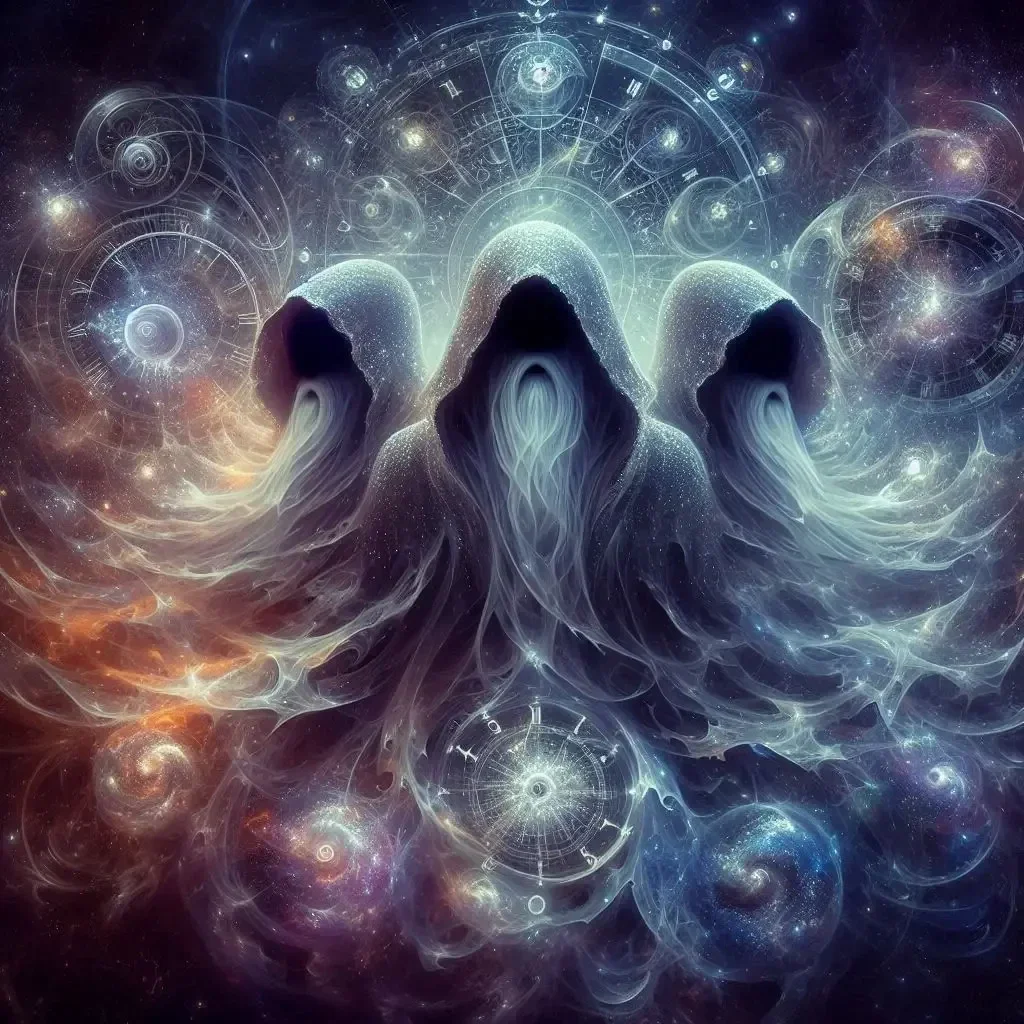
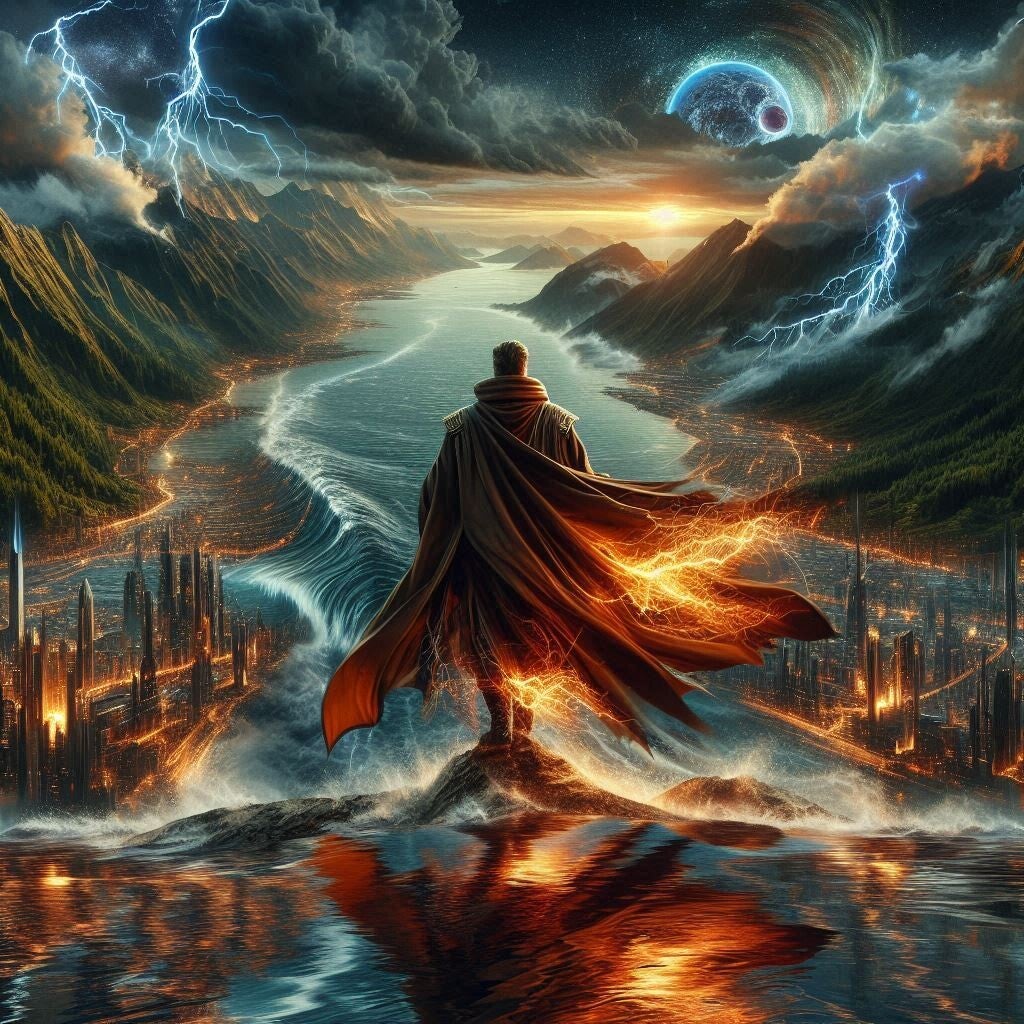
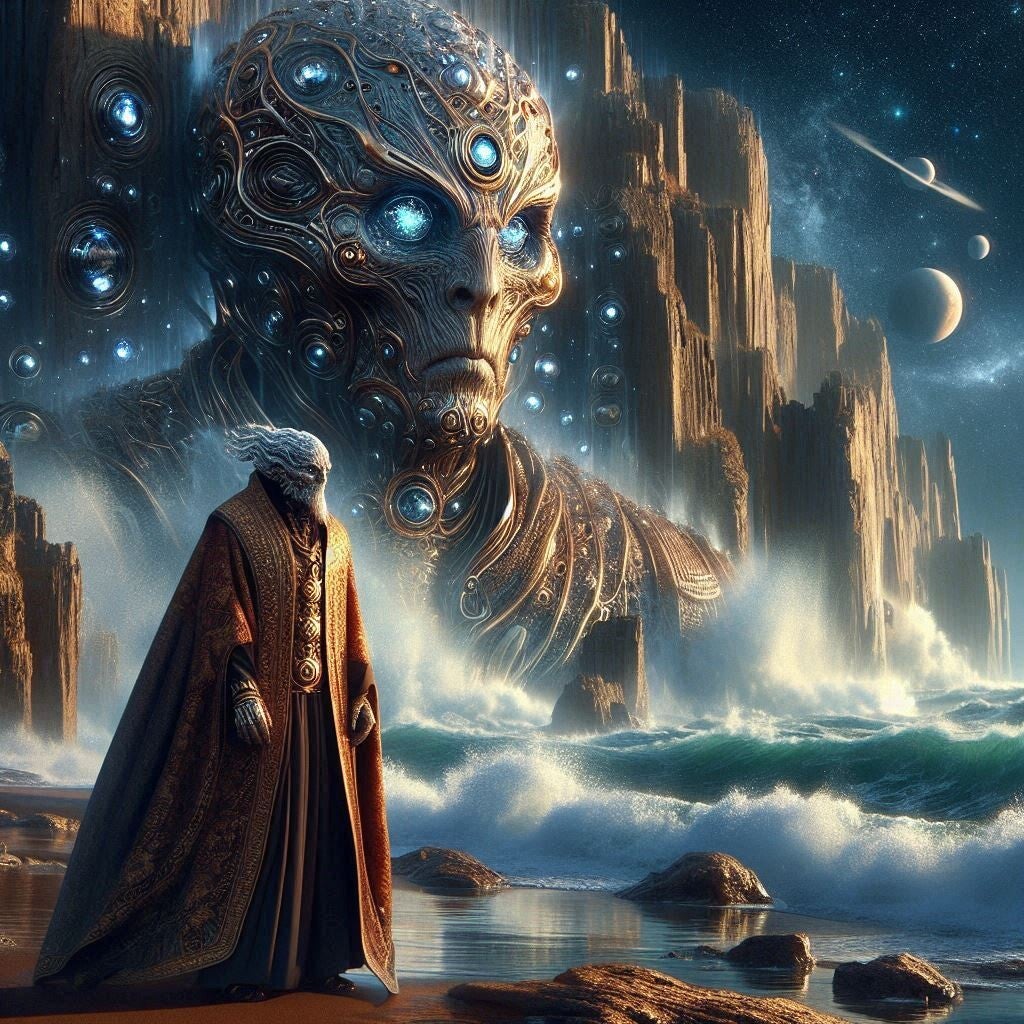
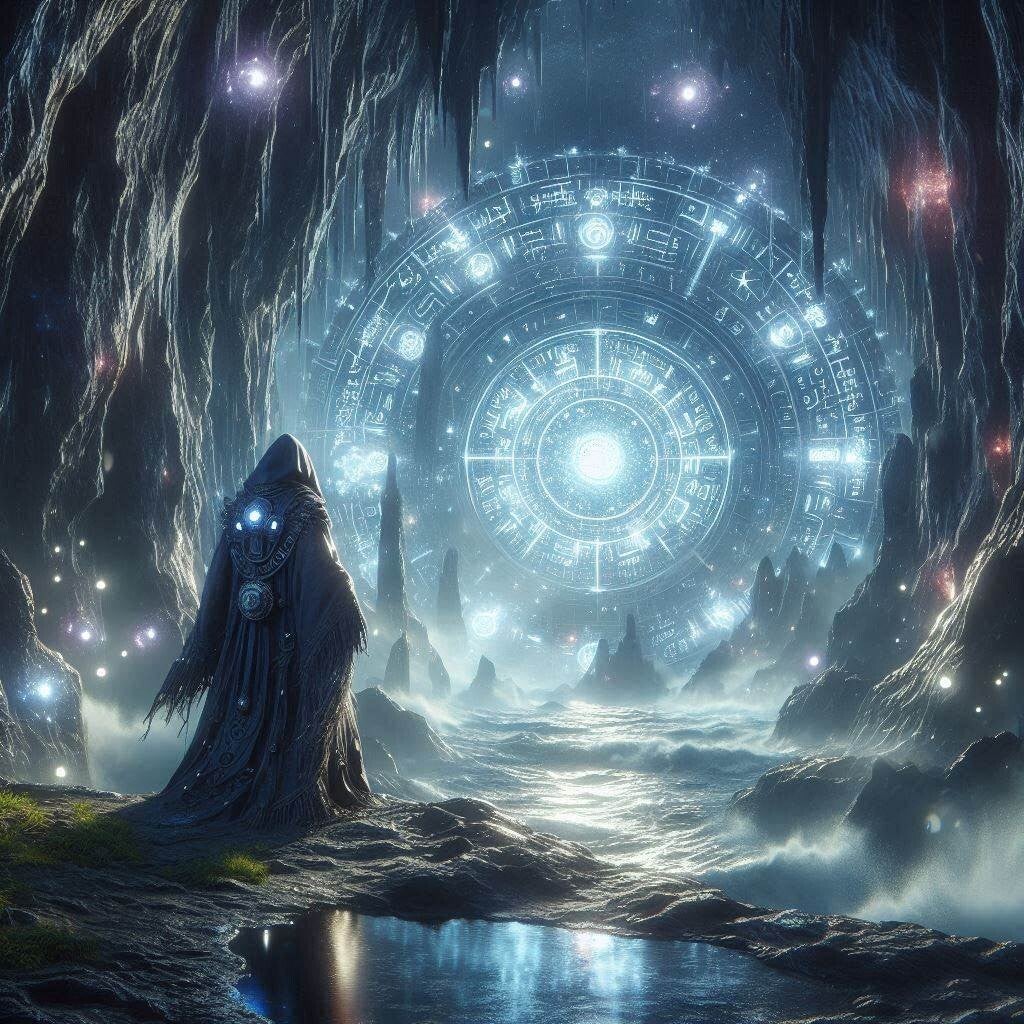
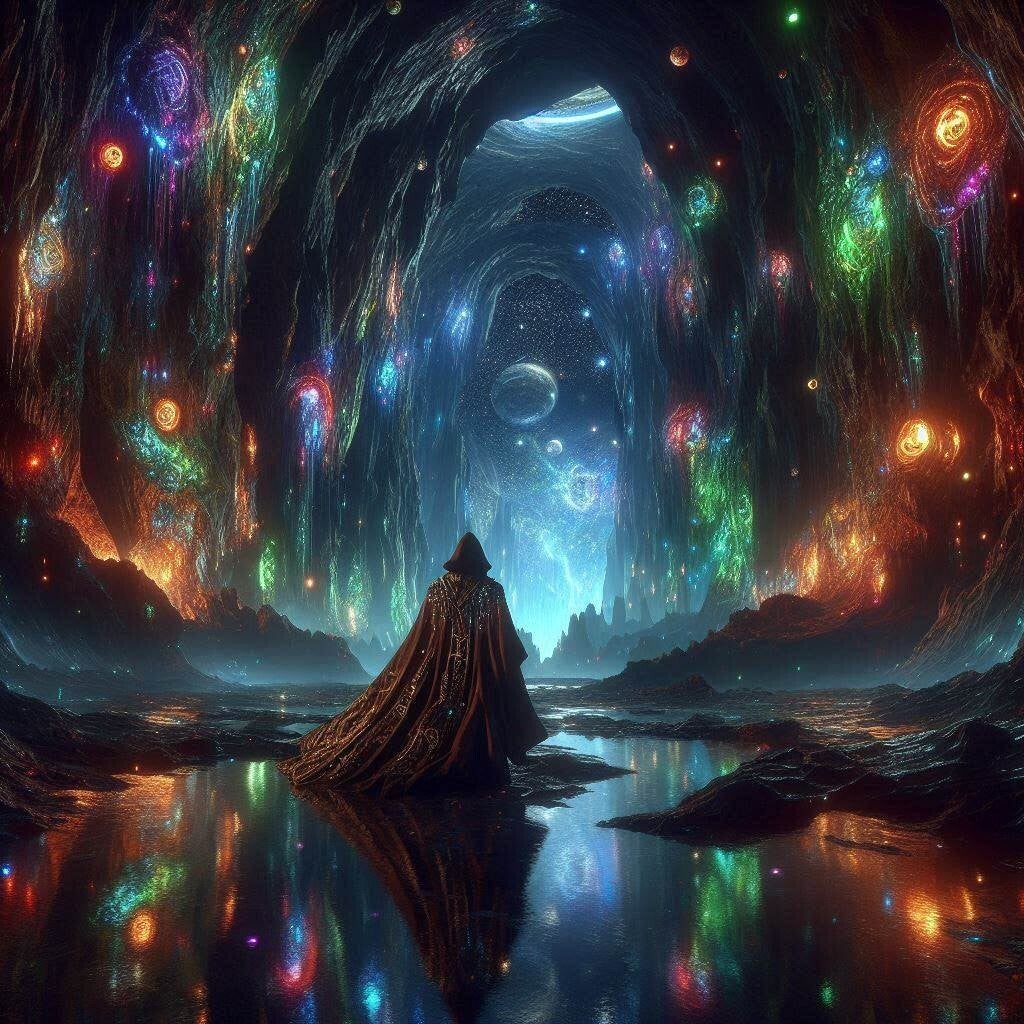
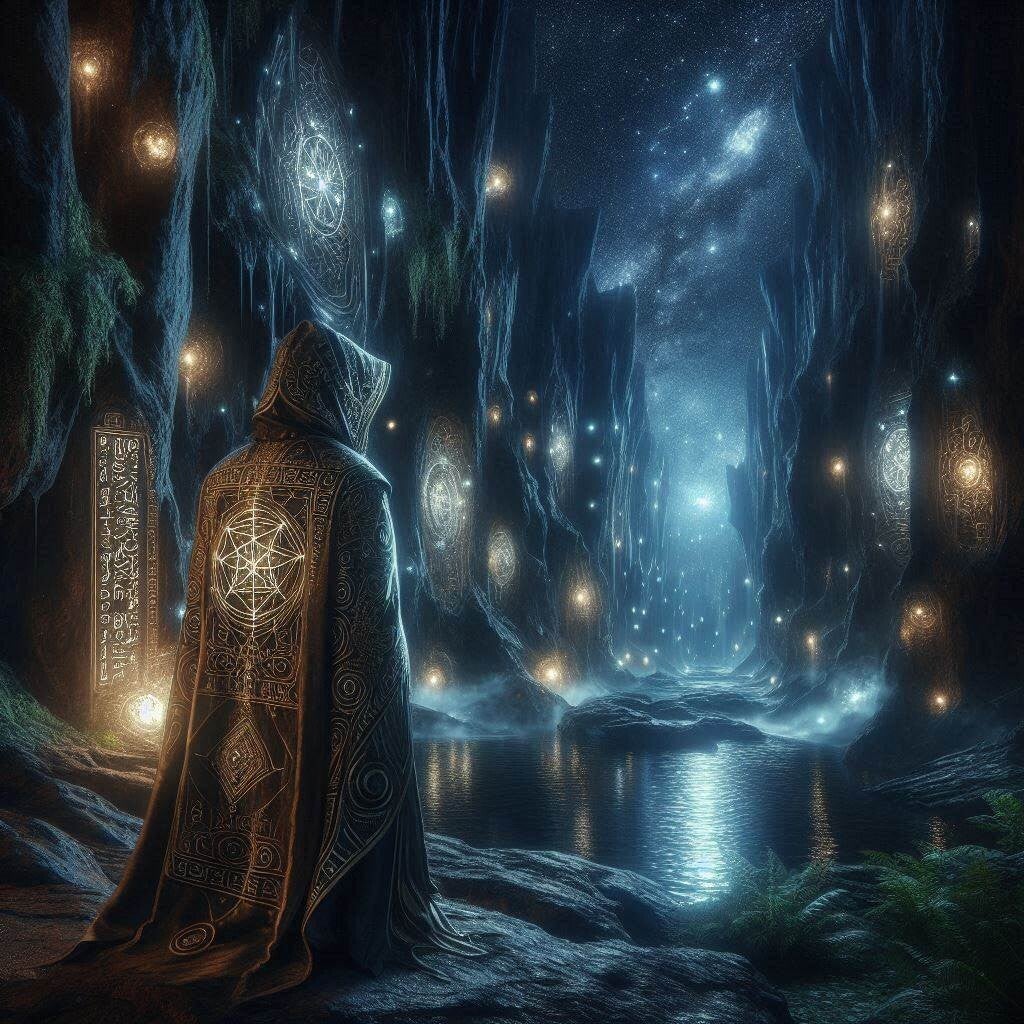
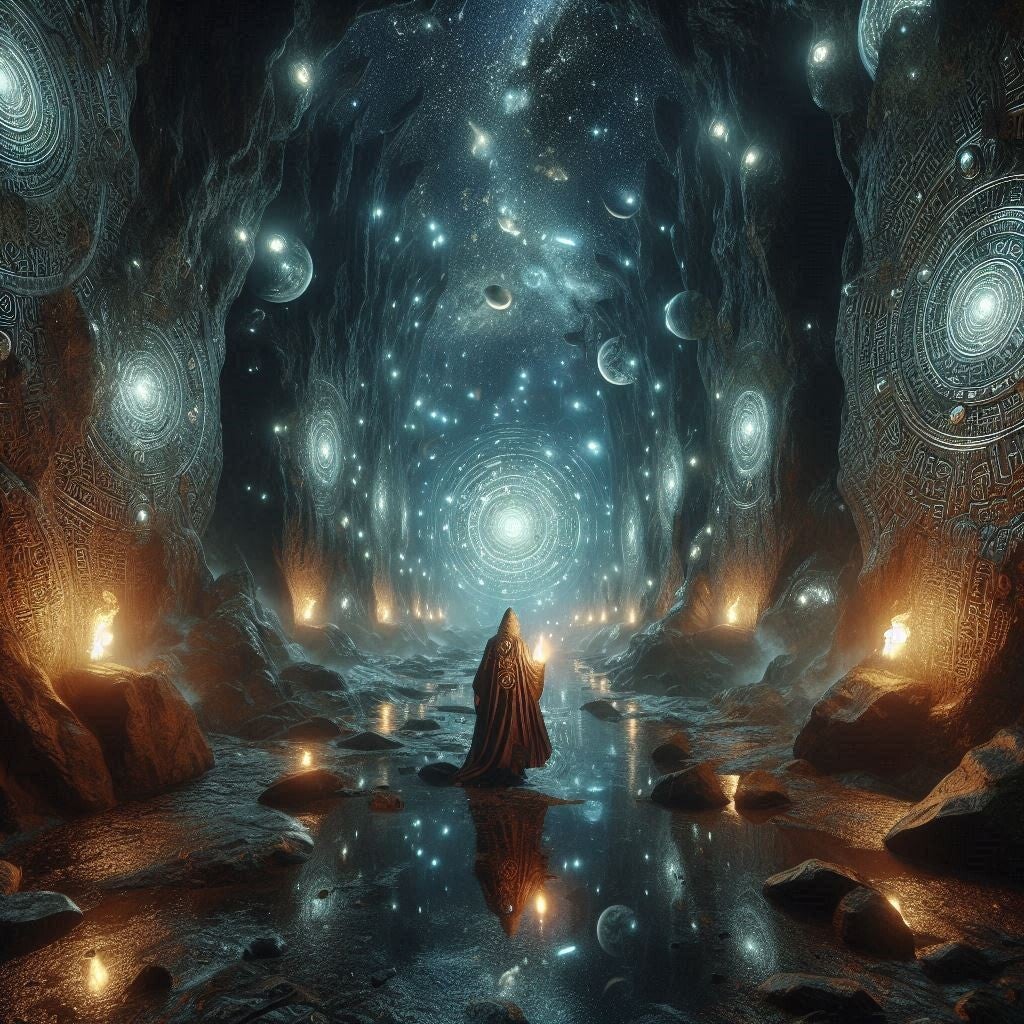
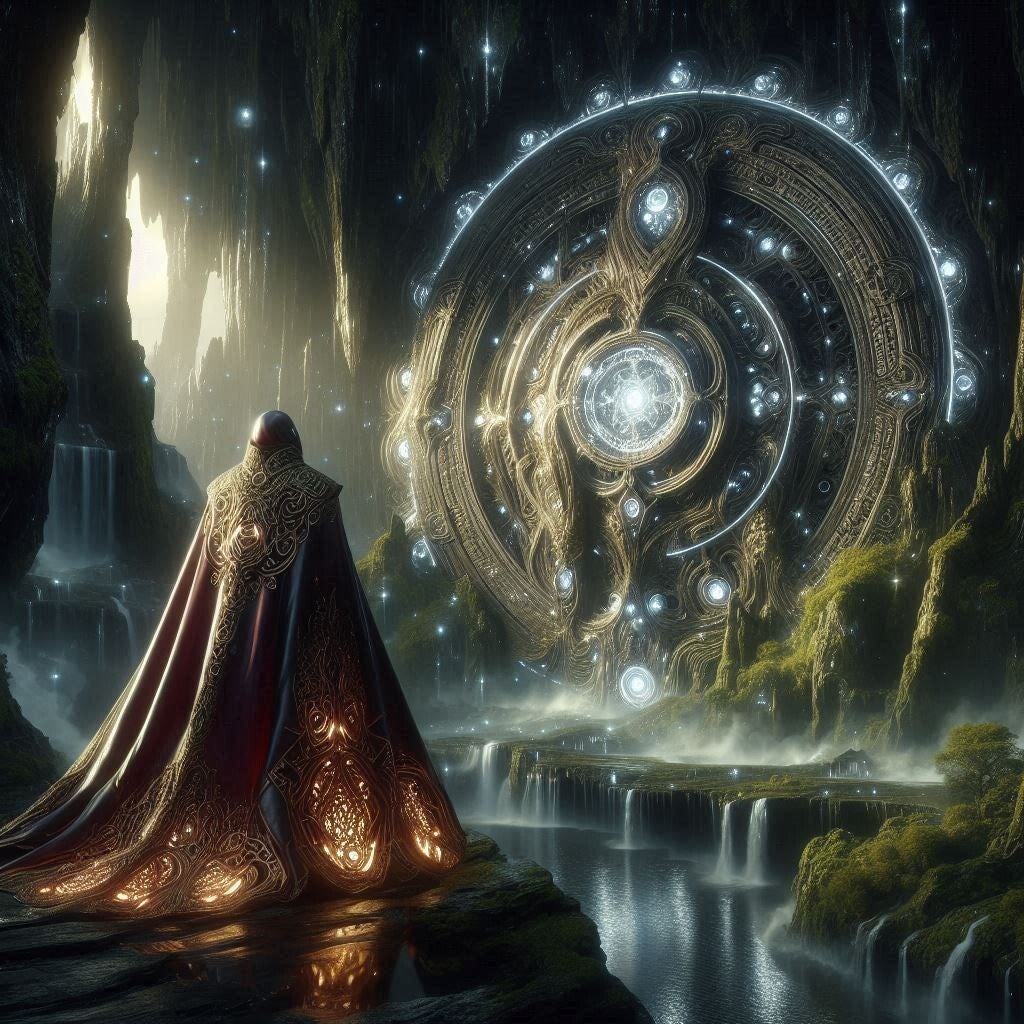
The House of Tempus is, by far, the most enigmatic and ancient presence in The MiddleVerse, transcending all other entities in both age and purpose. They are not merely a civilisation but the living embodiment of time itself. They were neither created by time nor separate from it, but its very origin. Where time begins and ends, so too does the House of Tempus, existing without beginning or conclusion, present in every moment and beyond all moments simultaneously.
As the guardians and keepers of MiddleVersian lore and of time itself, they are responsible for the delicate and complex task of monitoring the very fabric of space-time. Their existence is intertwined with the flow of time across the entirety of The MiddleVerse. They are omnipresent, existing simultaneously at every point in every timeline within the vast structure of what they call the space-time Chronological Dodecahedron - a metaphysical construct of impossible geometry through which they perceive not merely what is, but all that could ever be.
The Essence of the House of Tempus:The House of Tempus defies conventional understanding of existence. They are neither bound by physical form nor restricted by linear time. Instead, they exist in a state that is both material and ethereal, able to manifest in any form - be it biological, geological, or cosmic - depending on the necessity of the moment. Each member of Tempus is not a singular entity but a multitude, a cascade of selves extending in all directions along the timeline. To witness their true form would be to witness all of time unfurling in a single instance. They are beings both young and ancient, in birth and in death, moving beyond the boundaries of any single life.
The Kronos System - The Nexus of Time
The physical and metaphysical home of the House of Tempus is the Kronos System, an ethereal star system that exists in a temporal flux where time bends, loops, and folds upon itself. At its heart burns Aeternum - the Star of Time - a massive, pulsating sun whose light shifts through phases corresponding to distinct periods of past, present, and future, its energies responsible for maintaining the flow of time. Orbiting Aeternum are five planets, each a representation of a different aspect of time.
Planet Chronaxis, closest to Aeternum, is the Pillar of the Past, it is a world steeped in memory, its surface covered in ancient cities frozen at different moments in time, and home to the Echoing Archives, the vast underground labyrinth where every event, great and small, is recorded for eternity. Planet Temporis, the Keeper of the Present, is a world in perpetual flux, its geography shifting in the blink of an eye, and at its heart stands the Chronoclast Citadel. This is the physical headquarters of the House and the training ground of its Guardians. Planet Futurum, the Beacon of the Future, is a world covered in towering crystalline structures that serve as conduits for temporal energy, its highest peak home to the Pinnacle of Potential, where the most gifted seers of the House observe the myriad possibilities of existence. Planet Aevitas, the Realm of Infinite Time, exists outside the constraints of linear time entirely. This world is home to the Infinite Gardens where each plant represents a different moment in the cosmos. Finally comes planet Terminus, the Final Horizon - cold, desolate and silent - represents the end of time, completion rather than death, where all things come full circle; at its heart lies the Gate of Eternity, beyond which time itself ceases to exist.
Everywhere & Nowhere
The House of Tempus is everywhere at once, yet they are nowhere to be seen unless they wish to reveal themselves. They are the imperceptible push that saves one from harm, the feeling of déjà vu and the inexplicable sensation of destiny. They are the stone that trips you, preventing a greater disaster from befalling you moments later. They are also the warm feeling you experience when a loved one touches your hand, the subtle reminder of the connections that bind all beings together across time and space. These small, seemingly insignificant moments are the handiwork of the House of Tempus, the unseen architects of the cosmic order.
The Flow & the Fix
Time, as understood by the House of Tempus, has two core aspects. The Flow is the mutable aspect of time, the endless rivers of possibility and potentialities through which free will carves new directions. The Fix represents the immutable, the sacred moments that must occur, the cosmic keystones that anchor reality to coherence. The House navigates both forces with grace, preserving the essential while allowing the future to remain fluid and free. Their philosophy - the Doctrine of Minimal Interference - holds that true strength lies not in the imposition of will, but in the preservation of natural flow. Their interventions are never grand or overt, but small, imperceptible shifts. They manifest as a heartbeat delayed, a glance cast at the right instant or a storm that holds back a fleet for a single day. Coincidence, as the House of Tempus understands it, takes planning.
Guardians of the Cosmic Dance
The House of Tempus sees time not as a straight line but as a vast, intricate dance - the Cosmic Dance - in which every sentient being participates, their actions and decisions contributing to the greater flow of existence. They do not intervene to prevent every tragedy, for they understand that adversity is an essential catalyst for growth. Without conflict, there can be no resolution; without suffering, there can be no empathy and without darkness, there can be no light. Their foresight is absolute, and their understanding of the full scope of existence leads them naturally to favour the forces of good. They do this not out of bias, but because the natural course of time bends, inevitably, toward higher states of existence.
The Temporal Hierarchies
Within the House, time is governed through distinct Aspects. The Moment Shapers are those who manipulate individual instants with extraordinary precision to ensure causality flows correctly. The Epoch Weavers oversee entire eras and orchestrate the great movements of history across millennia. Finally, the Possibility Pruners are those who identify dangerous timelines and close them before they can unravel the fabric of reality. Above all these aspects sits the Synchronicity Council - the apex of the House's governance - existing in a state of perpetual ethereal communion, embodying a collective consciousness that transcends individual thought and guides the House in moments of great cosmic significance.
The Adversaries of Time
The House of Tempus faces two principal threats to the integrity of the timestream. The Entropy Seekers are entities of chaos who reject causality and seek to dissolve the boundaries of time entirely. Their philosophy finds its closest physical expression in the House of Draco, whose relentless drive for control and subversion mirrors the temporal instability the Entropy Seekers champion. The Moment Abactors are shadowy opportunists who steal significant moments from the timestream, collecting them like commodities and leaving dangerous voids in the fabric of reality. Against both, the House responds with vigilance, precision and the unwavering application of their Doctrine of Minimal Interference.
The Prophecy of the Final Moment
Woven into the deepest lore of the House of Tempus is the Prophecy of the Final Moment. It is the foretelling of a time called the Convergence, when all timelines will coalesce into a singular point, when the distinctions between past, present and future will dissolve, and a new form of existence will emerge that transcends the very limitations of time as it is currently understood. The House of Tempus works ceaselessly, through their rituals of the Great Recalibration and the Harmony of Spheres, to prepare the cosmos for this transformation. They do this not by dictating outcomes, but by ensuring that all beings are guided, gently and freely, towards readiness for reality's next evolution.
The Light Within the Darkness
Ultimately, the House of Tempus represents the light within the darkness. They are the force that ensures that, even in the darkest of times, there is always hope. They are the chroniclers of MiddleVersian history, the protectors of time, the guardians of the Cosmic Dance and the eternal watchers who ensure that, in the end, good will prevail. Their existence is a testament to the intricate and delicate balance that holds the cosmos together - a balance they have maintained since before the dawn of time itself, and will maintain until its final, inevitable and glorious conclusion.
The House of Abraxas

Orionis System
Uma Line

Orionis System
Pallas Line

Orionis System
Vidar Line

Orionis System
Cian Line
Orionis System
Orion Line

Be sure to check out our preorder available now for the upcoming House of Abraxas Visual Guide.
The House of Abraxas stands as the most influential, revered and extraordinary civilisation amongst the stars. They are the pinnacle of genetic evolution, intellectual achievement and the tireless pursuit of cosmic harmony. Human in form yet far beyond human in scope, the Abraxians are the living result of an unprecedented experiment in creation, shaped by the finest traits of twenty-three distinct sentient species and forged into a people of unparalleled potential. They are simultaneously mediators and warriors, philosophers and engineers, artists and guardians. In sum, they are a civilisation that has come to embody, in all its facets, the highest aspirations of existence in all its glory.
The Divine Experiment & The Alchemical Origins of the Abraxian Race
The Abraxians were not born through natural evolution alone, but through the monumental ambition of a mysterious figure known only as Marduk the Architect, who believed that genetics was the ultimate key to unlocking evolutionary potential. Marduk selected twenty-three sentient species from across the cosmos, each chosen with meticulous precision for attributes that would complement and elevate one another.
Amongst those whose genetic legacy flows through every Abraxian are the Chronos. These were ancient beings of temporal perception whose inheritance gave the Abraxians their intuitive sensitivity to causality and long-term consequence. The Lumina were beings of pure radiant energy whose contribution shaped the Abraxian nervous system's extraordinary cognitive capacity. The Heqetians where amphibious shapeshifters whose legacy granted enhanced regenerative ability and environmental adaptability to the Abraxian genome. The Sonu were artists of the Ekhos Solar System whose creations were able to alter reality itself, and whose influence lives on in the Abraxian capacity for symbolic thought and creative perception. The House of Cawr - giant humans from the Devasa System - provided the stabilising pillars for Abraxian physical endurance and philosophical resilience. The Leo, those feline sentients from the Ryon System, whose gifts of strength, agility and a deeply rooted code of honour beat steady in the heart of every Abraxian, provided their sense of honour and justice. The House of Selvans, those ancient sentient tree-beings from the Anitu System, whose contribution shaped the Abraxian cerebral cortex and its innate connection to ecological and energetic systems, where invaluable in Marduk's experiment. The Terrans contribution - humans of countless worlds, whose biological form was chosen as the template for the Abraxian physique, proved themselves to be paramount to the Abraxian genome. Finally, came the Draco - the shape-shifting reptilians from the Nathair System. They were, perhaps, the most controversial of all contributors, whose genetic legacy introduced a primal survival instinct that remains both a source of strength and an enduring philosophical challenge to the Abraxian civilisation.
To these nine species, fourteen more were added, each contributing psychic abilities, regenerative capacity, empathic resonance and multiple forms of multidimensional cognition. Together, these species were brought to coalesce into a living synthesis. Not merely a hybrid species, but a bridge between the finest evolutionary achievements of the entire cosmos.
The Orionis System - A Constellation of Purpose
The Abraxians trace their origins to planet Orion, the cradle of their civilisation. Orion is a world of crystalline forests, luminous coastlines and vast inland seas beneath the golden radiance of the Orionis System's twin suns. Over many centuries they expanded through evetu of its planets, and each world they called home became a distinct expression of Abraxian philosophy, together forming an interconnected constellation of unified purpose.
Planet Orion is the spiritual, cultural and technological heart of the House of Abraxas. Orion is a semi-sentient world whose biosphere responds subtly to the Abraxians presence. The capital, Aurora, rises organically from the Elysian Coast, its towers grown from living crystal that refracts sunlight into cascading rainbows, where the Celestial Dome mirrors the real-time state of the cosmos. Orion’s crystalline forests are home to the Prismatic Nightingale, whose songs bend light and sound. The Whisperweave Vines, which communicate across vast distances through biochemical and Aetherion resonance, form a slow, planetary mind that can be accessed by Abraxian scholars. Orion’s landscapes are populated by Memory Moss, a living archive that records the emotional and cognitive imprints of all who touch it.
Beneath Orion’s luminous oceans, Telepathic Coral Reefs form vast distributed neural networks, where Chromatic Koi translate invisible cosmic forces into visible motion and the Abyssal Sages - those colossal cephalopods of immense intelligence - advise Abraxian scholars of the Cian Line in matters spanning civilisational trajectories and the ethics of technological evolution. The oldest academies on Orion, such as the Academy of First Principles, the Harmonic Conclave and the Genesis Forums, ensure that Abraxian innovation never drifts from introspection and its inherent responsibility to maintain cosmic balance.
Ilyrion, the silent moon orbiting Orion, is the spiritual crucible of the Guardian Class and the most sacred martial site of the House of Abraxas. Time flows fractionally slower there, by design. Its Ashen Plains, Mirror Ridges and Still Valleys serve as the proving grounds of Guardian training. Their purpose is not to build strength, but to cultivate restraint, stillness and the ability to act from a place of absolute coherence. Ilyrion's sanctuaries - the Monastery of Unbroken Breath, the Hall of Silent Accord and the Observatory of Unseen Paths - are used to train the Guardians in breath-mastery, psychic oath-taking and the perception of probability streams. Deep, inside Ilyrion's hidden core, lies the Resonant Heart, the Genesis Crystal formation that maintains the subtle synchronisation across the entire Guardian network whilst preserving the harmonic imprints of Abraxian fallen warriors. Ilyrion itself is concealed from perception through the Veil Protocol, rendering it physically, cognitively and historically absent to all who not meant to perceive it.
Planet Ephesia is the intellectual and aesthetic crown of the Abraxian House. This is a world of perpetual bloom, bathed in Orion’s twin suns soft refracted light, its biosphere guided through harmonic terraforming to thrive alongside thought and inquiry. Ephesia's capital, Luminara, is the seat of the Cosmic Council and the home of the Great Abraxian Library - the most comprehensive repository of knowledge in The MiddleVerse, aside from the House of Tempus's Echoing Archives. This library contains the Living Tomes, archives that respond to the ethical alignment of its readers, where the Resonant Stacks exist as an harmonic frequency of Abraxian knowledge. The Great Library of Ephesia houses the Hall of Contradictions, where unresolved cosmic truths are preserved without forced synthesis. The Omniscopes are also kept there. These are devices of quantum entanglement and temporal displacement that allow perception across vast distances and divergent points in time. Above Ephesia's capital, Luminara, drift the Floating Gardens, home to the Whispering Willows whose branch-patterns encode complex mathematical and cosmic principles. These magnificent gardens are where the Philosopher's Rose grows, a blossom whose fragrance induces states of cognitive alignment rather than mere neurological stimulation.
Planet Caladrius is the Abraxian world of healing - a world suffused with regenerative Aetherion fields where even the climate is mild by design and predation is rare. Its Sanctuaries of Renewal offer the Wells of Restoration to those in need of rest, the Gardens of Reconciliation and the Quiet Halls address a different dimension of physical, emotional, or cognitive wound. Its Crystal Caves house bioluminescent crystals that accelerate cellular regeneration, underground lakes of liquid crystal with profound restorative properties, and the legendary Breath of Eternity. The Breath is an atmospheric composition believed to extend lifespan by aligning biological functions with the planet's own life rhythms. On Caladrius, the Temple of Cellular Harmony houses the Genesis Cradle, where genetic optimisation allows each new generation of Abraxians to continue evolving. The Order of Caladrius, which is forbidden from bearing weapons on this world, governs through moral authority alone, and the planet itself serves as the final refuge for warriors, scholars and Guardians broken by servitude to the House.
Planet Myrina is the anvil upon which Abraxian strength is tempered. Myrina is a world of obsidian mountain ranges, volcanic plains and storm-choked skies constantly plagued by constant tectonic instability. Its Forge Continents, the Pyraxis Reach, the Iron Wilds, the Shatterpeaks, demand different survival strategies from all Guardians who train there. At Myrina's heart stands the Forge of the Stars, where the Aetherblades and all sacred Abraxian weaponry are forged. Not as tools but as bonded entities, attuned to their wielder's psyche and moral alignment through the process of Stellar Crucibles, the Anvil of First Fire and the Trial of the Blade. The various warrior Orders of Myrina - the Ironbound, the Stormbound and the Voidwardens - embody distinct philosophies of combat. These are trials through which membership is earned through survival alone. Myrina's fauna, including the Luminous Risastors, the Quantum Wolves and the Crucible Drakes, form bonds with Abraxian Guardians built on mutual recognition rather than dominance.
Akin to the House of Aran's planet Zarah, Aegis is the Abraxian desert crucible. This is a world of crystalline amber sands, obsidian flats and violent temperature extremes, organised around massive fortified Bastion Realms of living stone capable of dynamically adapting to sustained attacks. Aegis's Wardens of Continuance diligently practice Planetary Shield Weaving, Attrition Modelling and the Fallback Doctrine, thus ensuring that even in the event of catastrophic loss, the Abraxian flame endures. On this planet, the Great Abraxian Shieldworks - the Circumferential Halo, the Sunward Bulwark and the Silent Lattice - operate in continuous readiness but never resting. Aegis measures status by endurance, art by restraint and life by the doctrine of scarcity. These are the rules by which the House promises that it can never be erased.
Astrael is Orionis's planetary wound that never fully healed - a once-thriving frontier world now abandoned, with its cities still standing, its seas glassed and its atmosphere holding the faint hum of philosophical systems that almost worked. Its collapse, triggered by a premature attempt to bind stellar resonance directly into its crust - potentially influenced by early Draconian subterfuge - introduced a harmonic instability into the wider Orionis System that propagated quietly for many generations. When the War of the Shattered Sky erupted, the Abraxians faced it without perfect equilibrium.
Planet Astrael was the first Abraxian fracture. It remains, to this day, untouched. Its Records of Hubris remain sealed, its Archives of Becoming still preserved, the Watchers of the Fall maintaining constant vigil across generations. This vigil is maintained because forgetting this failure would be the greater sin. Amongst Abraxians of the Uma Line, Astrael is invoked during moments of overconfidence. It is the scar that makes all other Abraxian virtues worth defending.
The Five Lines of the House of Abraxas
From the Orionis planetary system and Abraxian philosophy emerged the Five Lines of the House of Abraxas, each a distinct specialisation and each an indispensable facet of the greater whole. The Uma Line are the diplomats and mediators of the cosmos, their enhanced empathic abilities drawn from the Sonu and Chronos species. They were the creators of the Universal Concordance and the Harmony Protocols that govern Abraxian interspecies relations. The Vidar Line are the warrior-engineers and technologists of the House. They are the architects of the Crystal Nexus, the Consciousness Transference Protocols and the Stellar Shield. The Orion Line are the protectors of the their civilisation's borders and the backbone of the Abraxian Starfire Fleet, whose Aegis Protocol always emphasises protection over conquest. The Cian Line are the spiritualists and philosophers of the House. They are the custodians of the Doctrine of Unified Existence, practitioners of the Meditation of Quantum Resonance, as well as the eldest voices in most chamber of debate. The Pallas Line are the artists and visionaries of the House. They are the creators of the Living Symphony, the Gallery of Quantum Dreams and the extraordinary art of the Quantum Verse. The art through which Abraxian literature continues to exist in multiple possible states simultaneously.
The Guardian Class
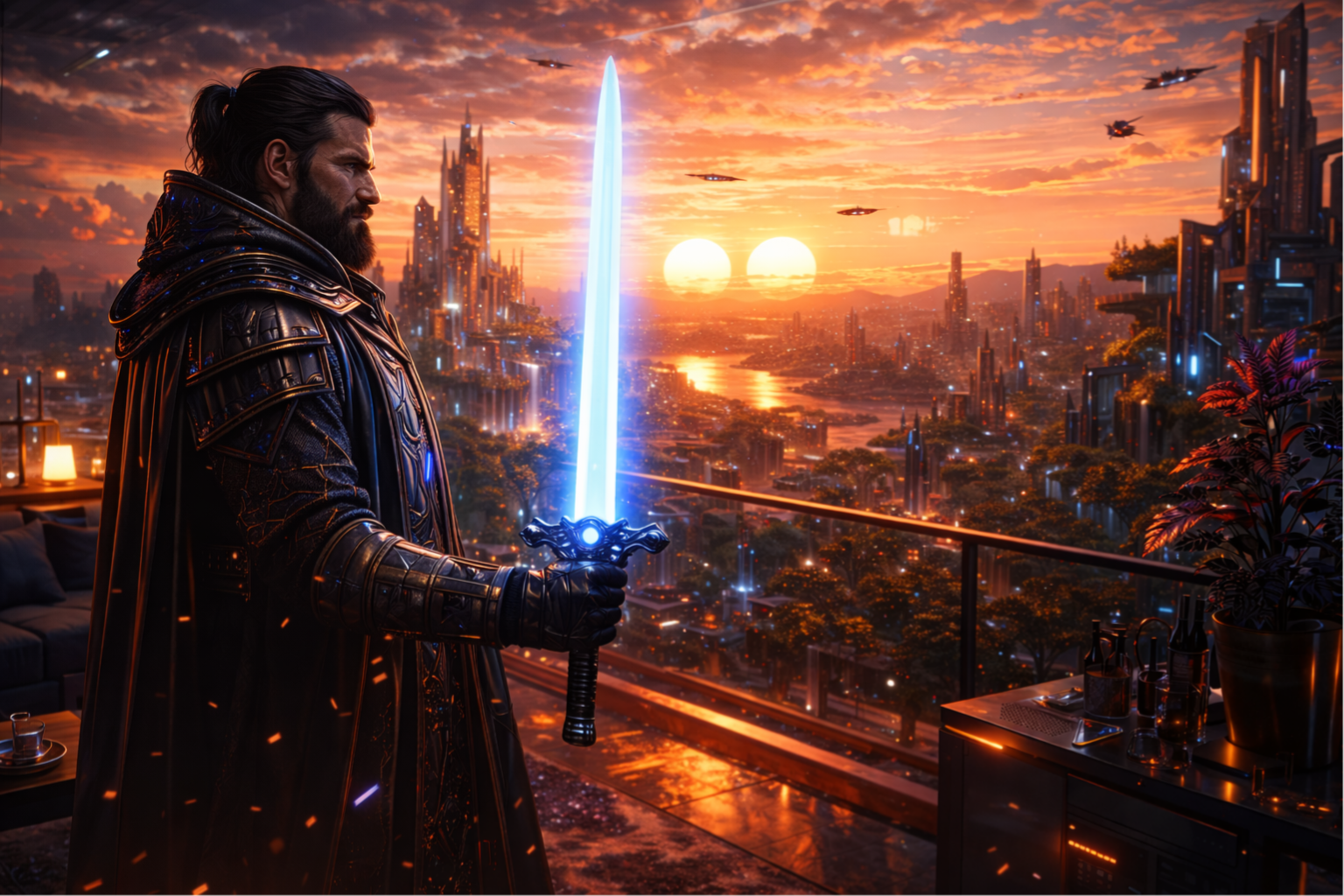
After the Great Galactic Unification, the Abraxians - alongside the House of Selvans and the House of Leo - created the Guardian Class. These are not merely warriors but conduits of the cosmic force the Abraxians call the Aetherion, the same unseen energy known to the House of Aran as the Weaving and to the House of Panthera as the Veil. The Guardian Class operates in secrecy, their existence known only to the most trusted leaders of the allied Houses. They can manipulate time and space, create individual energy portals and channel forces sufficient to alter the outcome of wars. The Guardian Class's primary weapon is the Aetherblade - a meticulously forged metal sword activated by Aetherion energy, producing a luminous sheath along the blade that rewards precision and punishes carelessness. In time, the Aetherblade became the symbol of the Guardian path itself. Of power guided by discipline, but never the reverse.
Abraxian Historic Deeds
The Abraxians helped shape the course of history through moments of extraordinary consequence. The Great Unification - the galaxy-wide movement of peace, culminating in the Great Unification Treaty signed on Ephesia - established the House of Abraxas as the architect of a new age of cooperation. The War of the Shattered Sky, a fifty-year conflict against the House of Draco, saw the Abraxians deploy the Stellar Shield and ultimately repel the Draconian invasion from the Orionis System, earning the deep respect of Houses Tigras, Panthera and Dangun. The War of the Twin Suns, the second interstellar war with the House of Draco, ended not through force of arms but through diplomacy, establishing a tenuous truce that nonetheless preserved countless worlds from utter ruin. In another interstellar conflict, called The Battle of the Hima System, the Abraxians and their Leonian allies defeated a Draconian invasion upon the Houses of Hima and Nanuk. The House of Hima held its ground until help came, proving that courage against hopelessness is always a path wirth pursuing.
The Abraxian greatest achievement was probably the Founding of the Galactic Cosmic Council, headquartered in the city of Luminara, on Ephesia. This victory remains perhaps the greatest enduring Abraxian achievement: a galaxy-wide institution of diplomacy and peacekeeping whose Great Chamber of Communion, built from psychically-responsive crystal beneath its Resonance Dome, continues to host the most consequential decisions being taken in the storied history of this universe.
The Aetherion & the Metaphysical Arts
At the foundation of Abraxian civilisation is the Continuum, or as Abraxians call it, the Aetherion - the living energy of the cosmos, through which Abraxians can sense, commune with and draw upon for healing, protection and perception. Their mastery of the metaphysical arts is unparalleled. They have mastered Chrono-Cognition, which allows the Seers of the Cian Line to perceive and interact with multiple timelines simultaneously. The art of Psychometric Resonance allows its practitioners to read the history of objects and beings through touch, thus unlocking forgotten truths and lost knowledge. Moreover, Abraxian music transcends aesthetics to become a sorts of architecture, medicine and strength paradigm. Through the art of Sonic Architecture, Abraxians have shaped entire cities as living instruments. Harmonic Technology helps them power the Songweaver Engine fleets, and the Forbidden Chord - discovered by Vidar composer Arius Voss and subsequently classified under House of Tempus oversight - has the dangerous ability to temporarily suspend the laws of physics within a localised area.
The Abraxian Legacy
The House of Abraxas remains, to this day, a beacon of hope and enlightenment. Guided by the memory of Astrael's warning, the wisdom of Ephesia's living archives, the mercy of Caladrius, the strength of Myrina, the endurance of Aegis, the conscience of Ilyrion and the moral origin of Orion itself, they continue to shape the cosmos in accordance with their founding vision. A deeper understanding, where knowledge without reverence is hollow, that power without wisdom is dangerous and that the greatest destiny any civilisation can pursue is one of balance, humility and unwavering dedication to the greater good of all.
The Branches of the House of Abraxas:
1. The Uma Line (Light):
This branch is associated with illumination, both metaphorically and literally. They are the torchbearers of knowledge, spirituality, and enlightenment, guiding others in the pursuit of higher understanding and moral clarity. They are the diplomats and mediators of the cosmos.
2. The Vidar Line (Warrior):
The Vidar branch embodies the martial spirit. They are the protectors and warriors of the House of Abraxas, possessing incredible combat abilities and a strong sense of honor and duty. They are the warriors, technologists and innovators of the future
3. The Orion Line (Boundary):
This branch is responsible for patrolling and guarding the edges of their star systems. They ensure that no external threat breaches their borders, acting as sentinels who maintain the security and integrity of their territory. They are warriors and protectors of civilisation
4. The Cian Line (Ancient):
The Cian are the eldest and most revered within the House of Abraxas. They hold the accumulated wisdom of countless millennia and are deeply respected as the custodians of history, tradition, and the ancient ways. They are the spiritualists and philosophers of the Cosmos
5. The Pallas Line (Wisdom):
Dedicated to the search for truth and knowledge, the Palas branch is likely composed of scholars, philosophers, and scientists. They are the seekers of wisdom who push the boundaries of understanding in all fields of study. They are the artists and visionaries of creation
Offshoots & Ancestry of the House of Abraxas
Over time, the influence of the House of Abraxas led to the rise of various offshoots, each developing its own unique identity and culture while retaining a connection to their progenitors.
1. House of Gurun:
Residing in the Hemathion System, the Gurun are the result of the genetically combined DNA from the Houses of Abraxas & Leo, adapting to the specific conditions of their home system.
2. House of Aran:
Inhabiting the Leander System, the peoples of planet Zarah have a distinct narrative detailed in the Echoing Archives of the House of Tempus. They represent a unique cultural or ideological evolution from the main House of Abraxas, with their own traditions and forms of governance.
3. House of Cawr:
This genetic ancestor House is composed of human giants from the Devasa System. They represent a physically divergent evolution of humanoid, adapted to different environments and societal structures.
The Allied Houses:
The House of Abraxas does not operate in isolation and works closely with other powerful houses, each representing a different form of sentient life, specialising in various domains.
1. House of Leo:
Feline sentients from the Ryon System, known for their agility, sharp intellect and a predatory nature, making them formidable allies in both strategy and combat. They stand for truth, justice and honour.
2. House of Selvans:
Tree sentients residing primarily in the Anitu and Sylvania Systems, but with roots spreading across the stars, they represent a deep connection to nature and serve as the spiritual or ecological guardians of nature.
The Opposing Forces
The House of Abraxas and the allied Houses are engaged in an ongoing struggle to protect those in need from various threats, each representing different challenges to their rule and the stability of the cosmos.
1. House of Draco:
Shape-shifting reptilians from the Nathair System, embodying cunning, cold-blooded ruthlessness and a desire for dominance, making them a formidable adversary.
2. House of Akula:
Genetically created by the House of Draco, the Akulans are sentient marine beings from the Hydronis System, representing a fluid, adaptable threat, with strengths in areas like naval and aquatic combat.
3. Houses of Upiór and Udo:
Perverted offshoots of the House of Abraxas, genetically created by the House of Draco, they reside in the Orek and Vuk systems, respectively. These houses represent a dark mirror to the Abraxians, embodying corrupted and twisted versions of their parent genome's traits.
The House of Abraxas stands as a beacon of ancient wisdom and unmatched potential, navigating a complex web of alliances and enmities across the stars. Their story is one of evolution, adaptation and the eternal struggle to maintain order in a universe fraught with danger and intrigue.

The House of Leo

Leo & Draco

Nathair System

Hemathion System

Indira System

Ryon System

Aside from the House of Tempus, the House of Leo is the most ancient, esteemed and deeply revered presence in The MiddleVerse. They have a civilisation that has come to embody, across millennia of history and legend, the highest ideals of strength, honour, unity and the sacred bond between sentient life and the natural world. They are warriors and philosophers, guardians and stewards, rulers and poets. A people who measure power not merely by what can be conquered, but by what can be protected, and who understand that the truest expression of strength is knowing when not to use it.
Origins in The Ryon System
The House of Leo traces its ancestry to the Ryon System, where three major planets orbit in relative harmony - Prydeon, Tigrath and Leonis - each home to a distinct Feline species, each shaped by the world that formed them and each contributing an irreplaceable dimension to the House's identity.
Planet Prydeon is the birthplace and spiritual heart of the House of Leo. It is a vast, vibrant world of sprawling savannahs, towering plateaus, dense rainforests and ancient forests older than recorded history. It is there that the Leonians first emerged: tall, powerful, regal beings with thick manes, golden eyes and muscular physiques, their golden and silver fur - depending on lineage - marking them as both protectors and leaders. Prydeon's harsh yet bountiful landscape shaped them into formidable warriors and philosophers in equal measure. In Leonian culture, strength is never measured by combat prowess alone but by the wisdom to know when to fight and when to seek peace. This was a duality inherited directly from the balance between the savage beauty of Prydeon's wilderness and the harmony its people strove to create. Its capital, Prydekeep, is built into the cliffs overlooking the Savannah of Kings. This is a city of stone and living wood, with towering spires that rise like ancient trees, waterfalls cascading down the cliffs and lush hanging gardens that bloom year-round. At its heart stands the Lion's Roar, the Great Hall where the Council of Prides convenes. This hall is a vast, open space of living stone and wood, its ceiling painted with murals of the House's history, its acoustics were designed so that every voice carries to every corner. The Savannah of Kings itself is sacred ground, where the greatest warriors and leaders of the House of Leo are laid to rest.
Planet Tigrath is the warrior's domain, a world of dense jungles, mountainous terrain, and deep rivers whose natural hazards ensured that only those with supreme physical fitness and keen survival instinct can thrive. It is home to the Tigras, Feline beings of striking orange and black-striped fur, muscular builds, and exceptional reflexes, renowned throughout The MiddleVerse for their extraordinary discipline and mastery of martial arts. Tigrath is home to some of the most formidable military academies throughout the cosmos, where generations have been trained not only in physical combat but in strategy, honour and leadership. For the Tigras, every battle is a test not of strength alone but of intellect and discipline combined. The city of Stripesend, located deep within the Emerald Jungle, is a marvel of martial design, a city of towering spires and hidden strongholds where every structure serves a purpose. At its heart stands the Temple of the Eye, a sacred site where Tigras warriors meditate and draw upon the ancient energies of the jungle to enhance their physical and mental prowess. Even after the House of Tigras expanded beyond the Ryon System, Tigrath remained sacred, becoming the place warriors return to when they wish to have their mettle truly tested.
Planet Leonis, the third world of the Ryon System, is a world of shadowed forests, hidden valleys and dense canopies where starlight and moonlight filter down in dappled patterns. It is home to the mysterious House of Panthera. The Pantherans are Feline beings of sleek dark fur, often black or deep shades of grey and violet. They are masters of stealth, espionage, strategy and the mystical arts. Their philosophy emphasises subtlety, patience and the power of knowledge, believing that true strength lies not in physical might alone but in the ability to strike from the shadows when least expected. The cities of Moontar and Lunara are built into the dense forests and valleys, blended so seamlessly with the natural world through bio-sculpting and ancient mystical arts that they are almost indistinguishable from the forests themselves. These cities are places of hidden passages, secret chambers, as well as sites of power where the arcane arts are practiced in secrecy.
The Unity of the Proudful
In the earliest days of Leonian history, the Feline species of Prydeon, Tigrath, and Leonis were divided into numerous prides, clans, and tribes, each with its own territory, customs and leaders. This era, known as the Age of Roaring, was defined by constant warfare and the weakening of all. It was not until the rise of High King Ryon, the legendary Leonian warrior-king of extraordinary vision, that this cycle was finally broken. Ryon saw what internal conflict was costing his people in the face of external threats. Through a combination of diplomacy, strategic alliance and, when necessary, overwhelming force, he set about uniting the prides of Prydeon extending his influence to the clans of Tigrath and the tribes of Leonis. The process was neither easy nor bloodless. Ryon challenged rival leaders in single combat, forged alliances through marriage and kinship. His most difficult test came with the Panthera of Leonis, whose wariness of the direct Leonian approach required him to demonstrate, over time and through patient respect for their customs, that unity was not submission. When he finally succeeded, the House of Leo was born and with it, an era of strength and honour, prosperity through balance and peace through shared purpose, that endures to this day.
Historic Deeds
The House of Leo has shaped galactic history through moments of extraordinary consequence. The Battle of the Twin Moons is the most legendary conflict in their history. This campaign was fought in the Astraxia System, where two habitable moons, Lunaris and Solaria, were invaded by the House of Draco, who sought to strip them of their resources and drive out their peaceful inhabitants. General Mithra Stormclaw, one of the most celebrated warriors in Leonian history, led a coalition of Leonids, Tigras and Panthera to the moons' defence. The battle was fierce and bloody, fought across days of unrelenting combat. Leonid warriors charged the Draconian lines, Tigras soldiers launched precise strikes against key enemy positions and Pantheran assassins moved through the shadows to eliminate Draconian commanders. In the end, Mithra faced the Draconian warlord in single combat on the surface of Lunaris emerging victorious, thus breaking the enemy's morale and winning a resounding victory that preserved the lives and ecosystems of both moons. The Battle of the Twin Moons was immortalized in song, art and legend, giving rise to the Chant of the Moons, one of the most revered musical compositions of the House of Leo, performed during festivals and times of remembrance, its deep resonant vocals and complex rhythms are said to invoke the spirits of the fallen and bring strength to all who hear it.
The Guardianship of Sylvania is another defining expression of what the House of Leo stands for. Sylvania is a star system of immense natural beauty and mystical significance, its planets imbued with living energies that sustain ecosystems of extraordinary delicacy. In time it became recognised as one of the most sacred solar systems in existence. The House of Leo, alongside the House of Selvans and the Orion Line of the Abraxians, took on the sacred responsibility of protecting it. For the Leonians, this is not merely duty but a spiritual calling, a deep manifestation of their belief that by protecting Sylvania, they uphold the very principles of life, balance and harmony that define their House. Leonian warriors patrol Sylvania's stellar borders, fend off invaders, maintain peace amongst its inhabitants and work tirelessly to preserve the natural and mystical forces that flow through its worlds.
Culture, Architecture & Art
The culture of the House of Leo is a rich tapestry woven from strength, honour, unity and a deep connection to the natural world. Their cities are marvels of engineering and design, built not to impose upon the landscape but to harmonise with it. This is a philosophy expressed most powerfully through the art of Bio-Sculpting, the technique of growing buildings, weapons and tools from living materials, creating structures that are functional and in harmony with the environment simultaneously. The Firmament Gardens of Prydeon are vast floating platforms covered in vegetation, providing both food and shelter. They are perhaps Prydeon's most iconic expression, a symbol of the House's conviction that civilisation and nature can coexist in harmony.
Leonian music is a celebration of life, nature and the warrior's spirit. The Canyon Roar is their most iconic musical form. It involves deep vocal harmonies, drumming and the use of natural instruments including the Fang-Horn and the Roar Drums. These instruments are crafted from the bones and hides of creatures that have passed naturally, symbolising the Leonian respect for the cycle of life. The visual arts of the House centre on natural motifs, legendary battles and the Feline species' connection to the cosmos. The Murals of Leonis, in the city of Nemean, are amongst their most celebrated works of art, its luminous pigments derived from rare plants and minerals, depicting the House's history from the Unity of the Proudful to the Guardianship of Sylvania, with a vividness that makes the depicted scenes appear to breathe.
Technology & Innovation
The House of Leo's technological achievements are inseparable from their reverence for the natural world. Their Biotech Armour, grown from genetically engineered plants and minerals, bonds with the wearer, enhancing strength, agility and resilience, adapting to the body for perfect fit and maximum mobility, even repairing itself over time by drawing on environmental energies. In space travel, the Leonian Solar Sails, powered by stellar light, are known as Lightriders. They glide silently through the cosmos with the grace of stalking predators, harnessing the energy of nearby stars without conventional fuel, making them amongst the most efficient and environmentally harmonious vessels travelling the cosmos.
Allies & Inter-House Connections
The House of Leo's deepest alliances reflect their values as clearly as their deeds. Their bond with the House of Abraxas is both ancient and foundational. The Leo were amongst the twenty-three genetic contributors to the Abraxian genome, their gifts of strength, agility and honour are embedded in every Abraxian man and woman. Together they fought in the War of the Shattered Sky, the War of the Twin Suns and the Battle of the Hima System, to name but a few. Together they were also the founding architects of both the Guardian Class and the Cosmic Council. Their bond with the House of Selvans, through shared reverence for the natural world, is equally sacred, expressed most powerfully in their joint Guardianship of the Sylvania System. Their relationship with the House of Panthera, forged in the earliest days of the Unity of the Proudful, endures as one of the most complementary alliances in the cosmos - the lion's roar and the panther's shadow, light and darkness in perfect balance.
The Leonian Legacy
The House of Leo stands as a symbol of strength, honour and unity whose deeds have shaped the history of countless worlds. Their legacy is one of guardianship. Not merely of their own people, but of the natural and mystical forces that flow through the universe, ensuring that life continues to thrive in all its forms. In the grand tapestry of MiddleVersian history, the House of Leo is a reminder that true strength comes not only from physical power but from the integrity of the soul and the bonds of kinship. This core philosophy proves that the measure of a warrior is not how many foes they have defeated, but how many lives they have protected. As long as there are those who need defending, the House of Leo will stand between them and the darkness.

The House of Draco

Nathair System

Hemathion System

Viridios System

Leander System

Nathair System
Along with the House of Leo, the House of Draco stands as the second most ancient and formidable force in The MiddleVerse. They are a race so old that they claim to be the first to attain sentience in this ancient universe. This belief in their primacy drives their relentless quest for control over every other species and civilisation in the cosmos, seeing their rule not merely as ambition but as a natural right, a destiny they are compelled to fulfil. As one of the twenty-three species that contributed to Marduk's Divine Experiment, their genetic contribution to the Abraxian genome represents its most controversial aspect, for it was the Draco's resilience, cunning and predatory instinct that gave the Abraxians their edge. It is those very same qualities that have made the Draco the most feared House in The MiddleVerse.
Origins on Draconis Prime & the Nathair System
The Draconians evolved on planet Draconis Prime, in the Nathair System, a harsh and unforgiving world where only the strongest and most ruthless survived. A reptilian species with scales, elongated snouts and powerful, sinewy limbs, the Draconians are as formidable physically as they are intellectually. Over millennia, they constructed a complex society built on the principles of dominance, conquest and control. Their cities of obsidian and volcanic glass - imposing, cold and magnificent - remain amongst the most striking architectural achievements in The MiddleVerse, symbols of a civilisation that equates beauty with power. The Nathair solar system serves as the nerve centre of the Draconian empire, the place from which all their plans for galactic domination are orchestrated and where their rule remains absolute.
A Claim to Rule
For the House of Draco, their ancient origins are not merely a point of pride but a justification for everything they do. They see themselves as rightful rulers, destined to impose order and dominion over all other sentient beings. This belief in their own supremacy is not born of arrogance alone but the founding philosophy of their entire civilisation, woven into their religion, their art, their governance and their science. To the Draconians, there is no middle ground. There is only submission or resistance, and they have spent millennia perfecting the tools with which to ensure the former.
Methods of Control
The House of Draco is formidable in open warfare. Their Dreadnought-class Warships are amongst the most feared space vessels in existence, heavily armoured and armed with plasma and photon cannons capable of decimating entire continental areas. Their Cloak Drones, small and stealthy reconnaissance vessels equipped with advanced hyperspace engines, allow them to strike anywhere with little warning. Their armies are vast, their Warlords brilliant and when they choose direct conflict, the results are often devastating.
Yet, for all their military power, the Draconians have always preferred the subtler blade. They are masters of infiltration, embedding themselves within the cultures of those they wish to control, by presenting themselves as deities to more primitive civilisations, as they attempted with the House of Aran in the Leander System, and weaving Draconian cultural motifs and puppet leaders into the fabric of more advanced Houses. Most civilisations under Draconian influence live in a state of illusion, blissfully unaware of the true nature of their shadow rulers. Their leaders, values and decisions are subtly manipulated by the Draco, their freedom a carefully constructed fiction. This illusion of freedom is perhaps the House of Draco's most dangerous weapon of all.
Perhaps most insidious of all is their Mind Control Network. This network is a combination of neural implants and psychic amplifiers capable of subverting the will of entire populations, turning them into obedient servants without the need for a single open engagement. It is a technology that has brought entire worlds to their knees without a single shot being fired.
The Cult of the Dragon
Central to Draconian culture is the Cult of the Dragon, a religious order that worships the Great Dragons, those ancient beings believed to embody the purest form of Draconian power. The Cult plays a crucial role in maintaining the Draco's grip on power, its priests functioning as both spiritual leaders and enforcers of the Draconian will. Their rituals are elaborate displays of power and sacrifice, designed to reinforce the Draco's belief in their own superiority and to bind their people to a shared identity of dominance. Draconian art is deeply propagandistic, their architecture imposing and their music, like the great Battle Hymns of Draconis, are grand and martial, sung before every major engagement to inspire fear in their enemies and build resolve in their warriors.
Genetic Mastery: Berserkers, Chimaeras & the Created Houses
Beyond their military and subversive capabilities, the House of Draco are also masters of genetic manipulation. This is the field in which they have no equal, save perhaps the Abraxians themselves. They have created genetically enhanced warriors, the Draconian Berserkers, bred purely for combat with enhanced strength, speed and regenerative abilities. The most formidable of these were the Kael-Varros line, whose warriors fought against the House of Aran at the Battle of Sarim on planet Zarah, alongside the Chimaera Beasts, those monstrous, living weapons of their own design, before ultimately being defeated by King Aran I, one of the few regents in MiddleVersian history to break Draconian forces in open battle.
The House of Draco's ambitions in genetic engineering extended further still. They created entire Houses. These are civilisations that were sculpted to serve their purposes, each a testament to both their creators' genius and the darkness of their intent.
In the Vuk System, they created the House of Udo. This is a hybrid species forged from Abraxian DNA and fossilised remains from the House of Lyco, the original werewolves, producing powerful, wolf-featured beings of primal instinct and dark capability. In the Orek System, they created the House of Upiór. This was a nefarious fusion of Abraxian and vampiric DNA, enigmatic and seductive predators who feed on the life force of others, masters of dark mysticism and twilight warfare. Lastly, in the Hydronis System, through centuries of experimentation with the genetic material of marine predators, they created the House of Akula. These are sentient, amphibious beings of immense physical and intellectual power, designed to conquer oceanic realms and serve as an extension of Draconian dominion across the cosmos' deepest seas. All three Houses were forged as instruments of Draconian will, though each, in time, would develop identities and ambitions of their own. This proved to be a consequence their creators had perhaps underestimated.
The Draco's genetic legacy extended to the House of Selvans as well, though not through creation but corruption. The Selvans of the Orek and Vuk systems, once noble arboreal beings of balance and natural wisdom, were perverted by Draconian influence, their forms twisted into grotesque instruments of decay and destruction, turned against the very nature they were born to protect.
The Eternal Conflict: Draco versus Leo & Abraxas
The greatest obstacles to the House of Draco's ambitions have always been the House of Leo and the House of Abraxas. The Leonians, paragons of righteousness and defenders of the free civilisations of The MiddleVerse, are the Draco's most feared and relentless foe - thus creating the dichotomy between the serpent and the lion - an ideological as much as a military adversary, representing everything the Draco stands against. The scholars of the Abraxian Cian Line often speculate that the Draco's obsessive need for control is born of a deep-seated insecurity, the fear of the chaos that might ensue if they are not in command. The House of Abraxas, meanwhile, presents a more complex challenge. Their vast presence across multiple star systems, their many Lines and branches and the very Draconian genetic contribution within their genome, make the relationship one of the most layered and volatile in history.
Without the Leonians, Abraxians and the allied Houses, most civilisations would long ago have fallen under the Draconian iron grip. Their struggle against the House of Draco has defined much of the history of the cosmos. In sum, it represents a war of ideologies as much as of starships and armies, a conflict between freedom and tyranny, between the light that builds and the shadow that consumes.
Reach Across the Stars
The House of Draco's influence has, at times, spanned nearly every star system where sentient life has evolved. In the Nathair System, their power is absolute. In the Indira, Hemathion and Leander Systems, their agents have worked ceaselessly to erode the influence of the Allied Houses. Even in the Kronos System, home of the omnipresent House of Tempus, the Draco have attempted to establish a foothold, though their efforts there have, for obvious reasons, proven fruitless. Their military conquests are numerous and infamous. The Conquest of Mareath, the Subversion of the House of Volpe and the Siege of Solstice, all serve as a demonstration of their willingness to employ whatever means are necessary to expand their dominion. Their most galaxy-spanning conflict, the War of the Broken Stars, saw them launch a full-scale invasion of the Taranis Cluster against the House of Abraxas and their allies. This was a war that ended in decisive defeat and forced their retreat to the Nathair System's core planets.
The Draconian Civil Wars
Not all Draconian campaigns have been turned outwards. The Draconian Civil Wars, a series of brutal internal conflicts sparked by rival factions vying for supremacy, nearly tore the House apart from within. The most famous of these, the Battle of Crimson Vale, saw the warlord Malakai rebel against the ruling Kael-Varros Line, only to be defeated by Kael Drathis and his first lieutenant, Varros Vhaskar, leading a smaller but far more skilled force to victory. Centuries later Kael Drathis met his end at the hands of King Aran I, on planet Zarah, in the Leander System. The civil wars weakened the Draconian control over several key star systems, providing the Allied Houses with crucial opportunities to reclaim lost territory. This was a stark reminder that the Draco's greatest vulnerability has always resided within themselves.
The Prophecy of the Draco & the Final Battle of Draconis Prime
The Final Battle of Draconis Prime marked the last great reckoning between the House of Draco and the Alliance of Houses. Led by the Houses of Abraxas, Leo and Selvans, with the Guardian Class playing a decisive role, the Alliance launched a massive assault on the Draconian homeworld itself. Despite deploying their full arsenal - Dreadnoughts, the Mind Control Network, Chimaera Beasts and their elite Berserkers - the Draco's superior military technology could not overcome the Alliance's unity and strategy. Draconis Prime was besieged. The Draconian leadership was forced to surrender. The Cosmic Council, in the aftermath, banned the most dangerous of Draconian technologies, the Chimaera Beasts above all, as too unethical to exist in any civilisation's arsenal.
The remnants of the House of Draco are now a shadow of their former selves, their empire reduced to a handful of star systems on the fringes of the galaxy, closely monitored by the Cosmic Council. They have been permitted to retain their autonomy and have not been completely destroyed. For the House of Tempus, ever watchful, understands that even the darkest forces serve a role in the Cosmic Dance. They know that without the shadow, there can be no light and that the Draco's history serves not only as a cautionary tale, but as one of the great lessons for all other civilisations.
An unquenchable thirst for domination ultimately brought the Draco low. Whether the embers of that thirst still burn, and what they may yet ignite, remains one of the most closely watched questions in the cosmos.

The House of Udo


Born not of nature's long patience but of a Draconian laboratory's cold ambition, the House of Udo stands as one of the most extraordinary and most unsettling genetic achievements in the history of The MiddleVerse. They are a created people, forged by the House of Draco from a fusion of Abraxian DNA and fossilised remains from the House of Lyco, the original werewolves. The intent was calculated to produce a new breed of sentient being that combined the mystical depth and intellectual sophistication of the Abraxians with the primal ferocity and predatory instinct of the wolf. What emerged was, something the Draco had not fully anticipated, a civilisation of profound power and complexity, one that would, in time, refuse the chains of its creators entirely.
Origins in The Vuk System & the Genesis of a House
The House of Udo was established in the Vuk System, a star system designated by the House of Draco for genetic experimentation and colonisation. It is a solar system shaped by shadow and moonlight, its planets and their moons were engineered to sustain the unique biology and culture of the Udo. These are beings characterised by their wolf-like features, heightened senses, formidable physical prowess and an innate affinity for dark magic. The creation of the House of Udo was a singular moment in Draconian history, representing the culmination of long-standing experiments in genetic manipulation. The Draconians believed they had created the perfect instrument. Powerful enough to be useful, yet designed to remain controllable. On both counts, they would ultimately be proven wrong.
A People Forged in Conquest
The earliest chapters of Udo history are written in blood and fire. Driven by their predatory instincts and armed with advanced technology, the Udo launched a series of campaigns to subjugate the indigenous populations of the Vuk System. These were a primitive but resilient species that had built their own societies on the moons and planets the Udo now claimed as their birthright. The most defining of these campaigns was the Conquest of Lycaon, fought on the rich and fertile moon of that name, where intense battles saw the Udo deploy both their genetic advantages and their considerable arsenal to establish dominance over that solar system's original inhabitants.
What followed was the Great Cleansing, a campaign of cultural assimilation and military repression designed to erase remaining resistance and impose Udo rule across the entire Vuk Star System. It was a ruthless act of civilisational imposition, reflective of the Draconian values that had shaped the Udo's earliest instincts. Yet even in the execution of their creators' methods, the seeds of something different were already present, for the Udo were building their own order, not simply extending the House of Draco's. This distinction would, in time, prove crucial.
Not all passed without challenge. The Insurrection of Eldrak was a rebellion of disenfranchised indigenous groups and dissenting Udo factions that erupted in Eldrak City, the Udo's largest urban centre. It shook the foundations of their rule and forced them to confront the contradictions embedded in their own methods of governance. The insurrection was suppressed, but its memory endured, and it remains a defining event in the House of Udo's political consciousness.
The Lunar Revolt: Breaking Free of the Draco
The Draco created the Udo to serve, however the Udo had other ideas. As they grew more self-reliant, more assured of their own identity and more aware of the extent to which the Draconians sought to manipulate their development, tensions between creator and creation escalated into open conflict. The Lunar Revolt was a series of fierce battles fought across the entirety of the Vuk System. This was the Udo's declaration of independence. It was not a clean or simple war, but it was a decisive one. The Udo proved that they were no longer an instrument of anyone's will but their own and emerged from the conflict with their sovereignty intact, yet their relationship with the House of Draco permanently and irrevocably altered.
The evolution of Udo sovereignty was not merely military. They developed their own governance structures, their own philosophical frameworks and their own distinct cultural identity. A philosophical stance that honoured the duality of their genetic heritage without surrendering to either side of it. They were neither Abraxian nor Lyco but Udo, entirely and defiantly.
The Vuk System: A Solar System Built for Eternal Night
The cities and worlds of the Vuk System reflect the Udo's nature with extraordinary fidelity. Eldrak City, the capital, sits on Vuk Prime. This is the central planet of the system, whose skyline is defined by the great Onyx Spires that rise from the city's heart, alongside Shadow Temples and the Grand Lunar Hall, seat of Udo political and ritual life. It is a city of imposing beauty, designed to inspire both reverence and unease.
Planet Lycaon, now a heavily fortified world of the Udo domain, bears the scars and symbols of its conquest. Its Lunar Bastions and Shadowed Fortresses stand as permanent reminders of how the Udo's power was first established, as well as the price that power demanded. Noctis, a secondary planet in the system, is the cultural heart of Udo civilisation. It is home to the Moonshadow Citadel and the Eclipse Gardens, a hub for music, art and the ceremonial life that gives the Udo peoples their sense of shared identity. Finally, in the outer reaches of that star system lies Umbra - yes, it is a name shared by the Pantherans as well. Umbra is a remote moon of harsh, dark environment, dedicated to experimental research, technological development and the training of Udo warriors in conditions that demand absolute, unyielding resilience.
Udo Culture & The Rite of the Moonshadow
The culture of the House of Udo is one of the most distinctive in The MiddleVerse. It is a fusion of primal instinct and refined mysticism that belongs entirely to them. Central to their cultural life is the Rite of the Moonshadow, a ceremonial event held during the full moon, involving ritualistic hunts, magical rites and communal feasting. It is both a celebration of their werewolf heritage and a reinforcement of their bond with the lunar cycles that govern much of their worlds and its biology. To witness the Rite of the Moonshadow is, by all accounts, to witness a civilisation at the fullest and most authentic and unashamedly expression of itself.
Udo art, known as the Art of the Night, blends the primal aesthetics of their ancient Lyco lineage with the sophisticated techniques inherited from their Abraxian heritage. Nightweave Tapestries and Lunar Sculptures are its most celebrated forms, depicting scenes of predatory power and mystical ritual with an artistry that belies the ferocity of their subjects. Their music, built around the Howling Drum, the Lunar Chime and the Shadow Flute instruments, produces haunting, resonant melodies of dark and arresting beauty. The greatest of these compositions, the Moonshadow Symphony, is performed in grand communal celebrations. It is a sweeping, emotionally complex musical work that encapsulates the dual nature of the Udo soul.
The Technology of Shadowcraft & the Moonforge
The Udo are not merely warriors and mystics but also remarkable engineers and scientists, applying their understanding of both Abraxian and Lyco genetics to develop technologies uniquely their own. Their Genetic Adaptation Devices allow them to modify their physical forms and enhance their predatory abilities with precision and control, ensuring they remain dominant in their natural environment. Their Shadowcraft Engineering techniques are also akin to Pantheran Shadowbinding. These are stealth systems and advanced camouflage, inspired by their dual nature, which allows their cities and military structures to blend almost seamlessly with their surroundings, making the Udo as elusive as they are powerful.
Their greatest architectural achievement, the Moonforge Construct, defines the built environments of the Vuk System. Utilising moonstone and other rare and precious materials, these advanced construction systems create structures of extraordinary resilience and striking beauty which are functional, symbolic and deeply expressive of the Udo's connection to the lunar forces that run through every aspect of their existence.
The Corrupted Selvans of the Vuk System
The Udo's dominion over the Vuk Star System extends to a darker inheritance. That of the corrupted Selvans who dwell within their territories. These beings, once noble arboreal guardians of the natural order, were perverted by Draconian influence into twisted, lupine reflections of their former selves. Their leaves are dark and withered, their roots drain the life from the soil rather than nurturing it. They serve the Udo's hunts and rituals, embodying the destructive aspects of nature rather than its nurturing wisdom. Scholars from the House of Abraxas and the House of Leo believe that somewhere beneath the corruption, the original essence of the Selvans still endures. And that redemption, though extraordinarily difficult, may not be beyond reach.
A Civilisation Defining Its Own Destiny
The House of Udo is the living proof that creation does not determine one's destiny. Forged as an instrument of Draconian will, shaped by conquest and the darkest of genetic ambitions, they nonetheless found their own path. A path built on sovereignty, cultural richness and a fierce refusal to be defined by the intentions of others. They are neither wholly light nor wholly shadow. They are a people of the in-between, of the moonlit threshold between the civilised and the wild, and it is in that liminal space that their true power, along with their truest identity, resides.
The other Houses regard the House of Udo with a mixture of wariness and fascination. In a cosmos where origin so often dictates allegiance, the Udo remain defiantly their own. In the silver light of their full moons, with the Moonshadow Symphony rising across the spires of Eldrak City, there is something in their story that speaks to every civilisation that ever had to become itself against the wishes of those who thought they owned it.

The House of Upiór


There are Houses that command respect, then there are Houses that inspire awe. The House of Upiór commands something rarer and more unsettling than either. It inspires a dread that is inseparable from fascination, a terror that has a beauty to it, as the deepest darkness always does. Born from the cold ambition of the House of Draco, fused from Abraxian DNA and the ancient genetic material of vampiric lineages, the Upiór are amongst the most enigmatic and formidable civilisations in the cosmos. They are creatures of the in-between. Beings of the twilight that is neither day nor night, but of the space between life and the slow draining of it. It is from that liminal vantage that they have built one of the most sophisticated, striking and quietly terrifying civilisations the stars have ever seen.
Origins in The Orek System & the Genesis of Twilight
The House of Upiór was created by the House of Draco and given dominion over the Orek System. Orek is a region of space that feels, to all who pass through it, as though all light has been deliberately drained away. It is a solar system of perpetual twilight, of icy plains and shadow valleys, of eerie bioluminescent flora that glows with cold, spectral light, of electromagnetic storms crackling across barren worlds. It was designed, or perhaps simply chosen, to mirror its inhabitants perfectly.
Orek Prime is the heart of the system. It is a grim, atmospheric world of sprawling gothic architecture and darkened skies, where the Upiór ruling elite and their major institutions are based. Planet Nyxar is a desolate world of icy plains and shadow valleys, serving as the site of secretive research and the rigorous training of Upiór warriors, its unforgiving environment the ideal forge for their unique combat disciplines. Vespera is a moon of eerie bioluminescent beauty and the cultural and mystical centre of Upiór life. It is the place where their art, their music and their most sacred ceremonies find expression. Planet Draven, lashed by electromagnetic storms, is the industrial and technological engine of the House, housing the advanced facilities where their weaponry and defensive systems are developed and refined.
The Rise to Power: The Twilight Rebellion & the Blood Pact
The earliest history of the House of Upiór is one of conflict and the assertion of supremacy. Their rise to dominance within the Orek System was not gifted to them by their Draconian creators but seized in the crucible of the Twilight Rebellion. These were a series of brutal conflicts fought against rival creations of the Draco and other factions that contested control of that star system. The Upiór fought with the cunning and ferocity that their vampiric heritage demanded, and emerged from the Rebellion as the undisputed masters of the Orek System. It was their first proof that they were more than the Draco's instrument, they were a force entirely their own.
Their position was further consolidated through the Blood Pact. This was a crucial alliance formed with the House of Udo, another genetic creation of the Draco inhabiting the neighbouring Vuk system. The Pact enabled the two Houses to share resources, military strategies and technologies, reinforcing their mutual power as well as their collective resistance to external threats and internal dissent. It was a partnership forged in pragmatism but sustained by a genuine alignment of interests. A natural alliance of two created peoples, each working to carve out a sovereign existence in the shadow of the House that brought them into being.
The Orek Accord, a significant peace treaty that followed in the wake of the system's early conflicts, solidified the Upiór's political position and established the framework for their interactions with other Houses. In time, becoming the framework that balanced their predatory nature with the requirements of existing within the broader order of things. With the Accord in place, the Upiór turned their full attention to building the civilisation they had fought to be free to create.
The Complex Relationship with the Draconians
The House of Upiór's relationship with their creators has never been simple. The Draco sought to maintain control over them long after their creation, manipulating their development and attempting to bend them to Draconian purposes. The Upiór resisted, though not always openly, not always through direct confrontation but with the patient, strategic intelligence that their vampiric heritage instilled in them. Like their forebears, they are masters of the long game, as comfortable navigating decades of quiet subversion as they are in open battle. These were the qualities that ultimately allowed them to assert their autonomy without triggering the full weight of Draconian military response. Their relationship remains complex, and its tensions never fully resolved, but the Upiór are no one's servants and the House of Draco knows this.
Culture: Ceremonies of Darkness & Transcendent Beauty
The culture of the House of Upiór is one of the most layered and arresting in existence. It is, at its core, a culture that has made art of its own nature, looking unflinchingly at the darkness from which it came and found, within that darkness, an aesthetic philosophy of extraordinary sophistication.
The Nocturnal Rites are the cornerstone of Upiór cultural life. These are elaborate ceremonies performed during their perpetual twilight hours, celebrating their connection to the night and honouring their vampiric heritage through ritual, dance and blood ceremonies that reinforce communal bonds and spiritual identity. These are not mere tradition. They are a living expression of who the Upiór are at their core, repeated across generations as both remembrance and affirmation.
On the moon of Vespera, the Shadow Festivals draw the Upiór together in grand celebrations of artistic achievement. It is there that they perform their dramatic spectacles of darkly beautiful art and haunting musical compositions that illuminate, in both senses of the word, the contradictions at the heart of the Upiór soul. Their art, of Ebon Sculptures and Nocturne Paintings, is predominantly gothic and macabre in theme, depicting scenes of shadow, night creatures and the complex interplay of darkness and light with an emotional depth that has earned the admiration even of Houses that fear them. Their music, built around the Blood Drum and the Eclipse Harp is both haunting and rhythmic, fusing ancient vampiric traditions with modern technological influence to produce compositions that resonate with an almost physical force.
Upiór society is further enriched by its internal diversity. They are divided into bloodlines, each with distinct traits and roles, where some are dedicated to military prowess and governance, while others tend to mystical practices and artistic endeavours. This plurality is not a source of division but of depth, lending the House of Upiór a cultural complexity that belies the singular darkness of their reputation.
Technology: Engineering the Shadows
The Upiór are as formidable in their laboratories as they are in the field or on the ceremonial floor. Their Twilight Engineering techniques represent one of the most advanced applications of shadow-based technology, aside from the Pantherans. Much like the Feline Panthera, they have created cloaking devices, energy weapons and defensive systems all designed to operate with devastating effectiveness in low-light conditions. In the permanent twilight of the Orek Star System, they have perfected the art of darkness as a tactical environment and bring that mastery to every theatre of war in which they operate.
Their Genetic Enhancements, drawing directly on their vampiric heritage, have elevated their physical abilities, longevity and adaptability far beyond what their original Draconian design specified. They do not merely survive in the Orek System's harsh conditions but thrive in them, having engineered themselves to do so across centuries of deliberate, precise biological refinement. Their cities reflect this technological mastery in every stone and shadow. The capital of Orek Prime, Noctis, once again sharing its nomenclature with the Pantherans, is a sprawling metropolis of gothic architecture and extensive catacombs. It is a city of imposing fortresses, grand halls and shadowed alleys that functions as the political, military and cultural heart of the House. On Vespera, the Luminara Complex houses ornate theatres, hidden galleries and bioluminescent gardens serve as the backdrop for the Shadow Festivals. On Nyxar, the Ebon Keep stands as both fortress and training ground. It is a facility designed to endure the planet's extreme conditions and serving as the base of the Upiór's most elite warriors and research teams.
The Corrupted Selvans of Orek
The Upiór's dominion over the Orek System encompasses a darker inheritance, manifesting itself in the corrupted Selvans who inhabit their worlds. These arboreal beings, once noble creatures of balance and natural wisdom, have been perverted by Draconian influence and the insidious energies of the Orek System into instruments of decay. Their forms are twisted and withered, their roots draining the life from the ground rather than sustaining it. They serve the Upiór's dark rituals, their corrupted connection to the natural world now a conduit for entropy and dissolution. Amongst the Cian scholars of the House of Abraxas and those of the House of Leo, there exists a quiet hope that the original essence of these Selvans endures somewhere beneath the corruption and that redemption remains, if not assured, at least imaginable.
Shadows & Ambition
The House of Upiór is what happens when darkness is provided with intelligence, discipline and the freedom to become its true self. Originally created as an instrument, they became a civilisation in its own right. They were given a star system of perpetual twilight and built an empire of culture and power within it. Handed a heritage of predation and shadow, they transmuted it into art, philosophy and military excellence that the brightest Houses would find difficult to match.
They are not evil in any simple sense but complex, ancient and entirely themselves. They feed on life but also create extraordinary beauty. They dwell in shadow but also illuminate what that shadow contains. In a cosmos of competing powers and shifting allegiances, the House of Upiór remains one of its most watchfully observed civilisations. They are the reminder that The MiddleVerse is far stranger and far more magnificent than the comfortable light of any single House can fully illuminate.

The House of Akula


The House of Akula is the most formidable and feared force in the aquatic realms of the cosmos. They are the sovereign predators of the deep, born not from natural evolution but from the calculated ambition of the House of Draco. Their very name, derived from ancient tongues meaning "shark," encapsulates their nature, aggressive, cunning, and relentless. Created through centuries of Draconian genetic engineering, the Akulans were forged with a singular purpose. They were bred to conquer the oceanic realms and serve as an extension of Draconian will across the aquatic expanses of the cosmos. Yet over the millennia, they became something more than mere instruments of their creators, building an identity, a culture and a legacy as the self-proclaimed Sovereigns of the Deep.
Origins and Creation
The Akulans were the product of Draconian genetic science at its most ambitious. They are a blend of genetic material drawn primarily from the greatest marine predators, infused with the House of Draco's own traits of intelligence and cunning. Designed to endure environments ranging from serene coral reefs to the crushing pressures of the deepest abyssal trenches, they possess a physiology of extraordinary resilience and adaptability. Unlike other Draconian creations,the Akulans developed a fierce independent streak that borders on arrogance, manifesting as a latent tension that simmers beneath their loyalty. A loyalty maintained not through devotion but through the genetic and psychological control mechanisms engineered into their very DNA. The Akulans view every other aquatic civilisation as either a potential subject or an enemy to be conquered, and the vast oceans of the cosmos as their birthright.
The Hydronis System & The Dominion of the Deep
The Akulan civilisation is concentrated within the Hydronis System, a vast star system of five oceanic worlds, each playing a distinct role in the Akulan empire.
Planet Thalassia, the seat of Akulan power, is an ocean-covered world whose surface is almost entirely submerged, its depths hiding both breathtaking beauty and immense danger. Deep within the remains of a submerged supervolcano, the Keto Caldera, lies Keto, the Akulan capital. This city is a sprawling metropolis of bioluminescent coral and volcanic glass. At its heart stands the Pearl Palace, the seat of the ruling council of Warlords and Scholars, and the Cathedral of Waves, a colossal temple housing the legendary Staff of Tides - an ancient artefact believed to command the oceans themselves, guarded by the elite warrior class, called the Tidal Blades. Akulan society on Thalassia is rigidly stratified, from the Warlords at its apex to the Warriors and Scholars who serve beneath them, down to the Servitors who maintain the city's vast infrastructure.
Planet Marelon, the Cultural Heart of Akulan society, is a planet of vibrant temperate seas and flourishing coral reefs, its capital Corallum built entirely within a massive living reef whose architecture grows and shifts with the tides. It is a city of art, commerce and music, where Akulan musicians perform haunting underwater compositions on the Hydrolute and Wavechime. These are instruments whose sounds mirror the slow pulse of the tides and the hum of deep currents.
Planet Abyssara is a world of extremes. It is dark, turbulent, and filled with primordial forces, home to the fortress city of Leviath, built within the planet's deepest trench, and the Abyssal Archive, a vast and heavily guarded repository of the most dangerous knowledge in the aquatic cosmos.
Planet Pelagia serves as the agricultural and resource world of the Akulan Empire, its warm shallow seas sustain vast underwater farms and centres of aqua-engineering.
Finally, comes Nautalon, the stormy military world of the Hydronis system's outer edge. This planets is home to the Trident Citadel and the Tideforge - the industrial heart of Akulan war-making, where Aqua-Forge Technology produces weapons and materials of extraordinary strength, forged under the immense pressures of its deep, planet wide, ocean.
Akulan Historic Deeds
The defining moments of Akulan history speak to both their ferocity and their resilience. The War of the Abyssal Rift saw the legendary warlord Korran Kai Jero lead his people in a desperate battle against the Elder Leviathan, the Primordial creature, akin to those on planet Zarah, in the Leander System. A being of catastrophic power that had slumbered for aeons beneath Abyssara's deepest trench. When even the Staff of Tides could not prevail, Jero himself led a daring assault into the creature's lair and sealed the Abyssal Rift, entombing the Leviathan at the cost of countless Akulan lives and cementing his place as the greatest hero in their history. The Coral Wars, fought over the vital reefs of Marelon, drove their long-standing rivals the Hobotnicans from the Hydronis System entirely. This was a campaign of sustained brutality led by warlord Aku Selarus that culminated in the capture of the Reefspire and the establishment of the Coral Council to govern the Hydronis system's resources. Those campaigns culminated with the discovery of the Staff of Tides, found in the depths of Nautalon by the explorer Nereus Thalassa, transforming the Akulan civilisation forever - a moment interpreted as divine confirmation of their destiny to rule the aquatic realms.
The Akulan Legacy
The House of Akula is a civilisation of contradictions. A people created in servitude yet fiercely proud, shaped by conquest yet possessed of genuine cultural richness, bound to the House of Draco yet harbouring the seeds of independence - manifesting itself most blatantly during the events of the awakening of the Serpent's Path. The Akulans are the iron fist of Draconian will beneath the waves and the undisputed masters of the deep. As long as ocean worlds exist, the House of Akula will attempt to rule them.

The House of Hobotnica


The House of Hobotnica is, probably, the most remarkable and resilient aquatic civilisation in the cosmos. They are a people defined not by conquest or domination but by transformation, adaptability and an unbreakable bond with the mysteries of the deep. Named after the ancient word for octopus, the Hobotnicans are a species of highly intelligent, shape-shifting cephalopods whose mastery of metamorphosis is without parallel. For millennia they were the undisputed rulers of the Hydronis System, architects of a civilisation of extraordinary beauty and wisdom. Driven from their ancestral home by the Akulans and their Draconian masters, they rose again in the distant Valtameri System. Becoming survivors, rebuilders and guardians of a legacy that refused to, sort of speak, be "drowned."
Origins & the Hydronis System
The Hobotnicans were the original sovereigns of the Hydronis System, their civilisation built across five oceanic worlds of remarkable diversity. Planet Thalassia was their cradle. Its abyssal trenches and coral reefs were home to Tentas, much like Abraxian cities, it was a living capital of bioluminescent coral and cephalopod-constructed tunnels that continuously evolved and reshaped itself in response to the needs and emotions of its inhabitants. At its heart stood the Reefspire, a colossal coral formation that served as the cultural and spiritual soul of the Hobotnican people. Planet Marelon's Rainbow Reefs were their sacred ground, the coral believed to be a living embodiment of its ocean's divine energy. Planet Abyssara's lightless depths housed the Abyssal Sanctum, their primary site of pilgrimage, where initiates sought connection with the Veil of Shadows - that ancient artefact of immense power said to grant shape-shifting abilities beyond the limits of any known biology. Planet Pelagia gave rise to Chroma, an arts capital whose buildings shifted colour with the emotions of its citizens. Planet Nautalon - stormy and treacherous - was where the legendary Staff of Tides was forged, a weapon and symbol of oceanic sovereignty whose creation required years of effort from the greatest Hobotnican artisans, mystics and shape-shifters, crafted from Krakenbone and Aqua-Crystals.
The Coral Wars & the Subsequent Exile
The greatest tragedy of Hobotnican history came in the form of the Coral Wars. This was a conflict that began as a dispute over the sacred reefs of planet Marelon, which the Akulans, backed by Draconian technology and military might, had been systematically exploiting and destroying. For the Hobotnicans, Marelon's reefs were not merely a resource but a living spiritual entity, embodying the voice of the ocean gods. When the Akulans under warlord Aku Selarus launched their full invasion, the Hobotnicans fought back with guerrilla tactics, ambushing the Akulans within the maze-like coral, using its living biotechnological defences drawn from their extraordinary biological heritage. For a time they held, but the relentless pressure of genetically enhanced Akulan warriors supported by Draconian technology proved insurmountable. The fall of the Reefspire of Marelon, the spiritual heart of the Hobotnican civilisation, broke their defences. Survivors fled into exile as their ancestral home was claimed, their sacred sites appropriated, their civilisation seemingly extinguished. Yet they endured.
The Valtameri System - The Hobotnican Place of Rebirth
After a decade-long galactic search, the Hobotnicans finally found a new home, in the Valtameri System, and what they built there surpassed even the glory of what they lost on the Hydronis System. Planet Nautilara became their primary world. This is a vast ocean planet of labyrinthine caves and vibrant reefs, where the Morphosean Depths became site of sacred power fiercely guarded as one of their most precious resources. Planet Calmaris, with its Kaleidoscope Reefs that shift colour in response to the emotions of nearby beings, became home to New Chroma - the reborn cultural capital of Hobotnican civilisation, where living art continues to evolve and transform as it always has. Calmaris's moon, Polyphemus, houses the New Abyssal Sanctum, cloaked in bioluminescent kelp forests, a place of deep meditation and spiritual renewal. Planet Krakenis, named in honour of the legendary Krakenis the Shifter, who fell in the Coral Wars, became their military world, where its Canyon Fortresses serve as both training ground and stronghold. There, warriors are shaped in the art of transformation and combat.
Culture, Art & Innovation
The Hobotnican civilisation is a living expression of fluidity. Their cities are not built but grown. They are coral and bioluminescent organisms responding to the emotional and social needs of their inhabitants, where entire neighbourhoods are capable of shifting and reconfigure themselves. Their music, performed on the Inkharp and the Tentadrum, is both an artistic expression and a practical tool. Certain melodies are believed to enhance the Hobotnicans' shape-shifting abilities. The Chroma Dance, that combines music, light and synchronised metamorphosis, is one of the most celebrated art forms in all of the aquatic realms. Their technology is equally remarkable: Bio-Veil Technology allows entire cities to become invisible when threatened; Kraken-Suits made from semi-sentient living armour bonded to the wearer adapt in real time to the needs of the warrior; and their Aqua-Crystals power everything from city infrastructures to weapons of war. Before their exile on the Valtameri System, their greatest diplomatic achievement was the Cephalite Pact. This was a landmark agreement that united multiple aquatic Houses under shared principles of peace, trade and mutual defence, with Tentas serving as the diplomatic capital of the aquatic cosmos.
The Hobotnican Legacy
The House of Hobotnica is a testament to the truth that civilisations, like the oceans themselves, cannot be permanently stilled. The Hobotnicans were conquered but not destroyed. Scattered but not extinguished. Their mastery of transformation is not merely a biological gift but the very philosophy of their existence. In the Valtameri System, they have proven that resilience, adaptability and the depth of cultural identity are forces that no Draconian or Akulan army can drown. Their legacy is one of beauty born from adversity. Their future, like the abundant oceans across the stars, is boundless.

The House of Tempus (Second Iteration )

Jarilo System

Devasa System

Eos System

Anitu System

Kronos System

The House of Tempus
The House of Tempus is, undoubtedly, the most enigmatic and ancient presence in the cosmos, transcending all other entities in both age and purpose. As the guardians and keepers of MiddleVersian lore and of time itself, they are responsible for the delicate and complex task of monitoring the very fabric of space-time. Their existence is intertwined with the flow of time across all that was, is and ever will be. They are omnipresent, existing simultaneously at every point in every timeline within the vast structure of what they call the space-time Dodecahedron.
The Essence of the House of Tempus:
The House of Tempus defies the conventional understanding of existence. They are neither bound by physical form nor restricted by linear time. Instead, they exist in a state that is both material and ethereal, able to manifest in any form - be it biological, geological or cosmic - depending on the necessity of the moment. They are the subtle forces that influence events in ways that are often imperceptible, guiding the flow of time while ensuring that the cosmic balance is maintained.
Everywhere and Nowhere:
The House of Tempus is everywhere at once, yet they are nowhere to be seen unless they wish to reveal themselves. They are the imperceptible push that saves one from harm, the feeling of déjà vu, the inexplicable sensation of destiny. They are the unseen architects of the cosmic order, present in every moment across every timeline, ensuring that life progresses in accordance with the grand design.
The Light Behind the Darkness:
In a universe defined by duality - light and dark, good and evil - the House of Tempus is the light that creates the shadows. They are the force behind the scenes, the subtle energy that ensures that, despite the darkness, light will eventually prevail. Their role is not to judge but to ensure that the natural course of existence is followed, which inherently favors the betterment of all things.
Guardians of the Cosmic Dance:
The House of Tempus sees time not as a straight line but as a vast, intricate dance - what they refer to as the Cosmic Dance. Every sentient being is a part of this "dance," their actions and decisions contributing to the greater flow of time and existence. The Cosmic Dance spans aeons, across multiple lifetimes and dimensions, with each being navigating a complex web of choices and consequences that ultimately lead to enlightenment.
Guiding the Flow of Time:
The House of Tempus is charged with ensuring that the Cosmic Dance unfolds as it should. They monitor the countless organic, mathematical equations and interactions that make up the fabric of existence, allowing mistakes to be made where necessary, for these are the lessons that drive growth and understanding. In their infinite wisdom, they understand that the journey towards enlightenment is a path filled with trials and errors and that those must be allowed to occur.
Foresight and the Favouring of Good:
While the House of Tempus remains unjudging in their role, their foresight is absolute. They perceive the entirety of time in a way that no other being can, understanding the full scope of existence and the interconnectedness of all things. This understanding naturally leads them to favour the forces of good, not because they are biased but because the natural course of existence tends to lean towards the betterment of everything. The House of Tempus knows that, in the grand scheme of the Cosmic Dance, the easy and alluring paths may win individual battles, but the forces of good are destined to win the war.
Influence Across The MiddleVerse:
The influence of the House of Tempus is subtle yet omnipotent. They do not intervene directly in physical affairs unless absolutely necessary. Instead, they guide the flow of time, allowing events to unfold as they should while gently nudging the cosmos towards a state of balance and harmony.
The Stone and the Touch:
The House of Tempus can be the stone that trips you, preventing a greater disaster from befalling you moments later. They are also the warm feeling you experience when a loved one touches your hand, a subtle reminder of the connections that bind all beings together across time and space. These small, seemingly insignificant moments are the handiwork of Tempus, ensuring that the threads of time are woven together in a way that promotes growth and understanding.
Patience and Impatience:
knowing that the journey towards enlightenment requires a balance of both. They instill patience in those who must wait for answers, understanding that time will reveal all truths in its due course. At the same time, they invoke impatience in those who must act, ensuring that the forces of good do not become complacent in their struggle against the darkness.
The Unseen Architects:
In many ways, the House of Tempus is the unseen architect, the silent force ensuring that all things move towards a state of equilibrium. They are the balance between chaos and order, the guiding hand that ensures the Cosmic Dance continues in harmony.
The Eternal Watchers:
The House of Tempus is constantly vigilant, watching over every timeline, every possibility and every outcome. They do not interfere lightly, for they understand that every action has consequences that ripple throughout time. However, when they do choose to act, their influence is profound and far-reaching, altering the course of MiddleVersian history in ways that are often not understood until much later - sometimes centuries or even millennia. To the point of sometimes allowing the forces of evil to win temporarily, so that when the equation completes itself there is a greater understanding on the meaning of spiritual growth.
The Light Within the Darkness:
Ultimately, the House of Tempus represents the light within the darkness, the force that ensures that even in the darkest of times, there is always hope. They are the chroniclers of history, the protectors of time, the guardians of the Cosmic Dance and the eternal watchers who ensure that, in "the end", good will prevail.
The House of Tempus is both a mystery and a constant presence, a reminder that time is not just a measurement of existence, but a force to be guided and protected. Their existence is a testament to the intricate and delicate balance that holds the cosmos together, a balance that they have maintained since the dawn of time.

The House of Aran
Leander System

Kingdom of Qamar

Kingdom of Shamas

Kingdom of Arsian

Kingdom of Sayf

Kingdom of Kartal

Kingdom of Yara

King Aran I

Be sure to check out the House of Aran Visual Guide & the Aran novel, available for order.
The House of Aran is a human civilisation of extraordinary depth and resilience, descended in the distant past from early Abraxian star travellers, whose ancient influence upon the planet Zarah and its peoples was so vast and so formative that House of Aran scholars came to call them the Old Kings. Named after its founder, Aran ibn Khalid, the House takes its identity from the man who first unified its people, while the people themselves remain what they have always been: Zarahans - children of Zarah, shaped in every aspect of their being by the world they inhabit. They are a civilisation unlike any other for hundreds of lightyears in any direction, intrinsically tied to their desert home in ways that go far beyond the practical. Their identity, their spirituality, their art, their military genius, their architecture and their philosophy all flow from the desert as rivers flow from mountains, not reluctantly, but with the power of something that has found its true course. Influenced by the Old Kings and forged across twelve millennia of careful mastery, they stand as the custodians of Zarah's vast and beautiful desolation, blessed and burdened with the responsibility of preserving the delicate balance between life and death in a world where the line between the two is often razor-thin.
Zarah - The Planet of Endless Deserts
Zarah is the third planet of the Leander System, a world whose deserts are not monolithic but extraordinarily varied, with five distinct types of terrain, each shaping the people who inhabit it in fundamentally different ways, and each forming the basis for one of the six major kingdoms. The hot sand deserts of the equatorial regions are vast, undulating seas of dune where the daytime heat can burn exposed skin and sandstorms lasting days can reshape entire landscapes overnight, sometimes uncovering ancient ruins long swallowed by the sands. The cold deserts of the polar regions are plains of crystalline sand and rocky tundra, swept by icy winds and lit by the reflective shimmer of their crystalline surfaces. The rocky deserts of the central highlands are defined by jagged cliffs, stone plateaus and deep canyons where rivers exist and life has adapted, and where the Zarahans have built their most formidable fortresses upon the mesas that rise from the desert floor. The subtropical deserts experience seasonal rains sufficient to create life, their oasis towns fiercely guarded and fought over. Finally come the coastal deserts, stretching in both directions from Sarim, capital of the Kingdom of Yara, along the shores of Zarah's single surviving ocean, are swept by salt-laden winds off waters that are deep, ancient and filled with creatures of considerable power.
Largely unaware that the other four planets of the Leander System are inhabited, the Zarahans have focused entirely on the mastery of their own world. The deserts of Zarah are not barren to them but alive with potential, full of challenges to overcome and secrets to unlock. The flora of the planet reflects this extreme environment with extraordinary ingenuity. Prominent amongst the desert trees is the Solarwood, tall and slender, with a reddish-brown bark of exceptional hardness and durability, prized for the construction of musical instruments, furniture and the intricate architectural elements of Zarah's grand structures. The Moonleaf, a towering silver-trunked tree revered for its spiritual significance, bears broad pale-green leaves believed to capture the essence of the twin moons, Anar and Nysa, and its wood is used in the crafting of ceremonial objects and sacred texts. The gnarled Dune Ash, hardy and resilient in the most arid regions, furnishes the frames of desert dwellings and the handles of tools and weapons. Amongst the shrubs, the Lunaris blooms only under the light of the twin moons, its leaves and petals forming the basis of tinctures and poultices of considerable medicinal value. The Sand Whisper, a resilient silver-blue grass ubiquitous across the desert realms, is woven into baskets and mats and used to thatch the roofs of Zarahan dwellings. At the oases, fed by underground aquifers, the stately Medjool Palm, the fragrant Sandalwood and the succulent Moonmelon provide sustenance in a world that offers no concessions to the unprepared.
The fauna of Zarah is equally remarkable, and the people's relationship with it is one of respectful utilisation, where every part of a hunted creature finds its purpose. The Sand Serpents are massive ophidian creatures that swim through the desert sands as easily as through water, their nearly impenetrable scaled hides are prized for the creation of armour capable of withstanding the harshest conditions of both a sandstorm and the battlefield. In fact, the hunting of a juvenile Sand Serpent remains a rite of passage for young warriors, requiring teams of skilled riders riding Desert Steeds to coordinate their movements with precision, in order to defeat it. The Dune Stalkers are six-legged arachnid predators with crystalline exoskeletons that refract sunlight to render them almost invisible in the desert heat. Their razor-sharp claws, when properly treated, produce exceptional strings for the Sandsong Lutes of Zarahan musicians. The nocturnal Desert Nightwings, with wingspans reaching seven feet and feathers that absorb moonlight to allow silent near-invisible flight, provide the plumage from which ceremonial cloaks are crafted. These cloaks are believed to grant their wearers enhanced night vision and camouflage in the dark. In Zarah's remaining ocean, the bioluminescent Crystalline Leviathans traverse the depths with translucent bodies that house organs and bone structures that, when crafted by the people of Yara into the renowned Ocean Pipes, produce haunting, melodious sounds. These are instruments of otherworldly resonance, said to call to the creatures' distant kin from the deep waters of the Yaran ocean. In these waters also swims the Sandfish, an unusual creature that moves through its depths with equal ease as it does through the sand dunes on the shore. This creature's iridescent scales, when woven into the finest garments worn by the House's nobility, shimmer with an inner light that seems to pulse in rhythm with the wearer's heartbeat.
The dangerous Dune Scorpions have venomous stingers that are carefully extracted to create poison-tipped arrows, with a single stinger able to arming an entire quiver and one shot capable of paralysing a full-grown Sand Serpent. The Sand Weavers are arachnid creatures that build vast underground networks, and whose silk-like fibres are harvested by the Bahir tribe to create fabrics of near-weightless strength but capable of turning aside most blades. These fabrics are so valued that they often serve as currency in major transactions. Presiding over the relationships between Zarah's fauna and its inhabitants are the Beastmaster Priests, a specialised sect within the Priesthood of the Sun who, through years of meditation, communion and deep study, have attained the ability to summon Sand Serpents from their subterranean lairs with whispered incantations and calming the fearsome Dune Stalkers with but a word. They are famed for using these ancient creatures to shield settlements from sandstorms or deter the incursions of remaining Draconian hostile forces.
The Six Kingdoms
The six kingdoms of the House of Aran were established by King Aran I, following the Great Desert Unification and the War of the Weaving against the House of Draco. Each kingdom is a distinct expression of the desert environment where it stands, as well as a distinct facet of the House's character. The kingdoms are bound together by the King's Road, a project undertaken by King Aran I, is a vast network of fortified trade routes and communication lines that transformed countless centuries of rivalry into a partnership that culminated with the defeat of the Draconian army that sieged the city of Sarim.
The Kingdom of Qamar occupies the cold northern crystal deserts, its pale sands shimmering under the twin moons Anar and Nysa, whose rhythms define every aspect of Qamarian life. Its capital, Qamaria, is the seat of the House of Aran and home to the grand Royal Citadel, which houses the ruling dynasty descended from Aran ibn Khalid himself. The city also houses the Great Council of Qamar, where decisions affecting the entirety of Zarah are made. Qamaria, a city also built by King Aran, is famous for its Desert Gardens, meticulously maintained oases that serve as cultural and recreational centres. The lunar temples that adorn Qamaria, have tranquil gardens that bloom under the night's gentle light offering places of meditation and introspection to those in need. The great statue of King Aran I rises from the base of the Crimson Cliffs behind the city, its outstretched arm a silent challenge to all who approach, while the royal crest of the House Aran adorns the citadel's walls, with the image of Uramak of the Serpent's Mercy legend at the centre.
The Kingdom of Shamas occupies the subtropical scorched zones, where the people have become masters of solar energy and heat-resistant technologies, their cities engineered to absorb and harness the relentless sun. The capital Shamaria is dominated by the Fortress of the Sun, a formidable defensive structure designed to withstand extreme desert conditions and its solar-powered artillery is the most devastating on Zarah. Shamaria also houses the Temple of the Sun, the spiritual epicentre of all Zarahan faith. The Kingdom of Shamas is vibrant in its cultural life, celebrated across the planet for the Sandsong Festival held annually in Shamaria, where singers and musicians from all six kingdoms gather to perform ancient ballads and new compositions that honour the shared history of their people.
The Kingdom of Arsian rises from the rugged rocky deserts, its culture shaped by a subtle but enduring influence from the House of Leo. In Arsian country, the lion is a revered symbol not merely of power but of guardianship and honour, with its image carved into statues and frescoes that adorn its halls. This kingdom is the martial heart of Zarah, with its landscape of formidable fortresses and military academies producing warriors and tacticians of the highest calibre. Its code of honour binds its people to protect the weak and uphold justice. The most remarkable city is Arsiana, a subterranean metropolis illuminated by bioluminescent fungi and Shamari Solar Mirrors. This city is a marvel of underground engineering that shelters its people from the harsh surface while surrounding them with a glow of considerable beauty. Arsian also hosts the Great Hunt Festival, held annually, in which warriors compete to track and subdue - not kill - a juvenile Sand Serpent, with the victor earning the right to lead the kingdom's hunting parties for the following year.
The Kingdom of Sayf commands the black dune deserts, a land of scorched earth and sharp cliffs where culture revolves around the mastery of the sword and the discipline of the warrior. Sayf children are taught the ways of combat from a young age and every citizen contributes to the military might of the kingdom. Statues of legendary warriors and depictions of historical battles line the streets of the capital Sayfara. However, Sayf is not merely defined by war. It is renowned for its Oasis Gardens that stand as a vast complex of greenery and water features, with its tradition of desert poetry and sand art sculpture speaking to a deep connection to the natural world. Sayfara's advanced irrigation systems, made possible through King Aran I's Desert Accord, transformed the most unyielding ground on Zarah into a land capable of sustaining life.
The Kingdom of Kartal was built high in the rocky deserts. Its cities are perched upon vast mesas and within oasis-filled valleys between high cliffs, offering commanding views of the desert expanse below. The Kartalians model their society after the Desert Nightwings that soar above them, valuing sharp vision, precision and independence above all other virtues. They are renowned for their unparalleled skill in archery, their mastery of high-altitude combat and their cavalry. They patrol their domain, mounted on Black Desert Steeds, trained to strike swiftly from elevation and retreat into the desert before the enemy can respond. Kartal is also renowned for its horse culture, producing intricate bridles and saddles adorned with desert motifs that are regarded throughout Zarah as works of art in their own right.
The Kingdom of Yara sits peacefully in the coastal deserts where the ocean meets the white sands. Its character is shaped by cooler air and gentle sea breezes that offer reprieve from the hotter desert's harshness. Yarans are known throughout Zarah as diplomats and craftspeople. Their cities, above all the capital Sarim and the smaller coastal trading city of Najra, are built not as fortresses but as places of commerce and community, with open marketplaces, grand fountains, elegant palaces and expansive ports that welcome traders from across the ocean. Yara places a strong emphasis on music and dance, with its grand amphitheatres hosting traditional performances, and its Artisan's Plaza in Sarim showcasing intricate sculptures and mosaics of the highest craft. It is there that the Ocean Pipes, fashioned from the hollow bones of Crystalline Leviathans, are crafted to their highest standard, their otherworldly tones carrying across the coastal waters in ceremonies that honour both the creatures and the traditions of the kingdom that learned to hear music in their bones.
Historic Deeds - Sand, Blood & the Forging of a Nation
Four events stand, above all others, in the long history of the House of Aran, each one a crucible in which a different quality of the Zarahan civilisation was tested and proven.
The first is the Siege of Shamas, a conflict that predates the Great Desert Unification and shaped the character of its future kingdom more profoundly than any diplomatic agreement could have. The realm of the Shamari tribe, renowned for its solar technology and extraordinary fortifications, had drawn the envy and resentment of its neighbouring tribes. When a formidable coalition assembled by the tribes of Arsian country descended upon Shamaria, the city endured months of relentless assault, as wave after wave of warriors, siege engines and incendiary weapons hurled against its walls without ceasing. General Khalid Al-Rashid commanded the defence from the ramparts of the Fortress of the Sun, meeting every assault with flaming arrows and devastating salvoes from the city's solar-powered artillery, while teams of engineers worked ceaselessly beneath the city to reinforce its underground tunnels against breach. When the moment came, Khalid Al-Rashid ordered a daring counterattack through the city's hidden passages, striking the invaders' supply lines from unexpected directions thus shattering their morale entirely, ending with the retreat of the invading tribes. Shamaria emerged bruised but unbroken, the reputation of its people as skilled tacticians and unyielding defenders of the desert realm forged permanently in the crucible of that siege.
The second is the Great Desert Unification, the defining achievement of Zarahan history and the moment the House of Aran became something more than a collection of warring tribes. Aran ibn Khalid, later crowned King Aran I, united the five major tribes - the Shamari, Rasha, Bahir, Ulema and Tarek - and the rival city-states under a single banner, through a masterful combination of diplomacy, strategic alliance and sheer force of will. He navigated a complex web of tribal loyalties, regional rivalries and the persistent subversive interference of the House of Draco at every turn. In the aftermath, he established a centralised system of governance, standardised military tactics across the tribes, ordered the construction of the King's Road and signed the Desert Accord. This was a comprehensive framework for the free movement of goods, people and ideas across all six kingdoms, as well as the foundation upon which every subsequent achievement of his House has been built. The Great Desert Unification was not merely a political event. It was, as the Echoing Archives record it, a transformation of the collective consciousness of an entire people.
The third is the Great Sandstorm Crisis, the catastrophe that tested whether the Unification would hold under nature's own assault. Over two and a half centuries ago, a series of sandstorms of unprecedented intensity swept across Zarah, burying entire settlements beneath shifting dunes, severing trade routes and cutting communication between kingdoms. Aside from King Aran's own solution, his people's response became the fullest measure of what he had built. As the King departed with a contingent of his fiercest warriors in order to find the cause of the crisis, the kingdoms pooled their resources and expertise under the guidance of the Order of the Sacred Desert. In the aftermath, new sandstorm prediction and mitigation technologies were developed from the ancient knowledge of the desert, the King's Road was painstakingly restored and cities were rebuilt with a resilience informed by everything the crisis had taught. It was during this same crisis that a recurrence of the myth of Serpent's Mercy took place. A caravan stranded in the coastal deserts was sheltered for three days and three nights within the protective coils of a Sand Serpent whose bones resonated with a haunting song that seemed to soothe the raging storm itself, shielding the travellers from the worst of its fury. The image of the original sheltering ophidian, Uramak, now adorns the royal crest of the House, on the citadel of Qamaria. It has long been speculated that this particular Sand Serpent was also Uramak himself, the mythical forefather of the species.
The fourth historical deed is not a single event but an ongoing struggle. It is the persistent and subversive campaign of infiltration waged against the House of Aran by the House of Draco. Having their main army defeated by King Aran I in the Battle of Sarim 278 years ago, the remaining Draconians on Zarah, patiently and cunningly, never ceased their efforts to undermine the House of Aran from within. Their primary strategy has been to infiltrate the Priesthood of the Sun - a creation of King Aran himself - shapeshifting into trusted priests and subtly corrupting rituals, reinterpreting sacred texts and sowing seeds of discord between the kingdoms. A century ago, High Priest Zahir, through a series of visions detected a growing disturbance in the desert's energies and traced that disturbance to a seemingly innocuous temple in the southern deserts, where Draconian shapeshifters had been posing as priests, manipulating the faithful with extraordinary patience. The ensuing confrontation was brutal but the victory was total. Zahir's response to that event was to reform the Order of the Sacred Desert. He did so by strengthening its protocols, deepening its spiritual discernment and further expanding its reach across all six kingdoms. In the years since, the Order uncovered another Draconian plot in the Kingdom of Yara, where shapeshifters posing as members of the local priesthood had been systematically eroding faith through carefully orchestrated illusions and rituals. The Order's priest-warriors, wielding sacred blades forged from the rarest desert metals and guided by their mastery of the desert's elemental arcane forces, dismantled the plot entirely. The struggle between the House of Aran and the House of Draco is ongoing, a battle not merely for territory or resources but for the very soul of Zarah's desert realms.
The Priesthood of the Sun and the Order of the Sacred Desert
Spirituality is not separate from daily life in the House of Aran. It is the architecture of its daily life. The desert itself is regarded as a sacred and living entity. The Priesthood of the Sun, established by King Aran I in the aftermath of the Battle of Sarim, is its interpreter, charged with listening to the wind, the sun and the shifting sands, translating their movements into guidance for the people. The Priesthood believes that the deserts speak through the wind, the sun and the shifting sands, knowing that it is their duty to listen. Ceremonies are held regularly, at the sites where the Ley Lines of Zarah cross, with offerings of water, food and music made to maintain the spiritual balance without which, the Priesthood teaches, droughts, sandstorms and famine will follow. Through divination, meditation and communion with the celestial bodies, the priests decipher the will of the desert, translating the dance of the twin moons and the howl of the desert winds into guidance for all six kingdoms. The Temple of the Sun in Shamaria stands as the spiritual epicentre of this planet. It is a place where the High Priest and the council convene to perform the most sacred rituals, and where it is said the sands of the temple hold the memory of every person who has ever walked its halls. It stands as a living chronicle of the House of Aran's triumphs and trials.
The Order of the Sacred Desert is the Priesthood's militant arm and its most formidable defender. They are an elite cadre of priest-warriors born by the hand of King Aran I himself and reformed under High Priest Zahir, combining the martial prowess of Zarah's finest warriors with the spiritual discernment to detect Draconian infiltrations that no conventional warrior could identify. They are masters of the desert's arcane arts, their connection to the land's sacred energies granting them uncanny intuition and the ability to wield potent elemental forces. Wielding dual sacred blades forged from the rarest desert metals and imbued with the power of the elements, they stand as the enduring bulwark between the people and those who would quietly unmake them from within. They remain ever-vigilant, their senses permanently attuned to the subtle fluctuations in Zarah's ancient energies that betray a shapeshifter's presence.
Equestrian Culture - The Black Desert Steed
Of all the cultural traditions of the House of Aran, none speaks more directly to the identity of the Zarahan people than their relationship with the equine, in particular with the Black Desert Steed, a breed adapted over millennia to the treacherous terrains of Zarah's deserts. For the House, the horse is not merely a mode of transportation or a tool of warfare but a living embodiment of its indomitable spirit, its resilience and its profound connection to the land its peoples call home. Warriors say a rider is never truly alone as long as their steed is beside them, thus these horses are treated as companions and often as members of the family. In the rituals overseen by the Order of the Sacred Desert, the Black Desert Steed is seen as a conduit to the divine, a living connection to the desert's primal forces and the celestial rhythms that govern Zarah itself.
The breeding and training of the Black Desert Steed is an art form passed down through generations of horse masters with meticulous care. It is undertaken through the selection of breeding stock, guided by centuries of accumulated knowledge and keen observation of the desert's rhythms. The training is conducted through patience, gentle guidance and an unwavering respect for the animal's inherent dignity and autonomy. The result is a breed possessed not only of the physical prowess to navigate the treacherous terrains of Zarah's deserts but also of a profound, almost intuitive understanding of the needs of its rider. The Great Desert Race, held annually in the Kingdom of Qamar, is the supreme expression of this tradition. It is a gruelling spectacle that draws riders from all six kingdoms, whose thundering passage across the shifting dunes and rocky ravines of Zarah is celebrated as far more than a test of speed. The race is a celebration of the bond between rider and steed, between the people and the land that shaped them. The victor is showered with honours by the royal family and their name is etched into the annals of the House's history. Yet, the true triumph of the Great Desert Race, as all who attend understand, lies not in the crowning of a single champion but in the affirmation of that enduring bond. The cavalry of the Kingdom of Kartal, mounted on Black Desert Steeds and trained for swift strike-and-retreat across difficult terrain, is amongst the most feared military forces on Zarah. It is a living expression of everything the steed has come to mean to the House.
Music, Art & the Soul of the Desert
For the peoples of Zarah, music is not merely a form of entertainment but a profound expression of their deep-rooted connection to the deserts that shaped their destiny, as well as a conduit to the divine. At the heart of their musical tradition lies the Desert Drum, crafted from the weathered hides of desert creatures and the sturdy wood of native species such as the Solarwood. The drum's resonant, earth-shaking tones are used in sacred ceremony and in battle alike, with its rhythmic pulsations believed by most to mimic the beating heart of the desert itself. The Sand Flute is an instrument fashioned from the hardy stalks of the Desert Cane. Each hole is bored and positioned according to the phases of the twin moons and celestial alignments, producing haunting ethereal melodies that evoke the whispers of the desert winds, serving both in ritual and as a sophisticated system of long-distance communication across the vast desert expanse.
Along with the others, the string instruments of the House of Aran form an ensemble of extraordinary richness and cultural depth. The Desert Lute, crafted from Solarwood and Moonleaf, adorned with intricate carvings depicting the mythical creatures of the desert, is the principal storytelling instrument. Its soulful melancholic tones are the vessel through which legendary tales of history, love, loss and triumph are carried across the generations. It is not merely a musical instrument but a conduit for a rich storytelling tradition, through each note and phrase carrying the weight and cultural heritage of the House. The Sand Harp, crafted from the finest desert hardwoods and inlaid with polished stone and desert glass, produces a shimmering, ethereal quality ranging from deep resonant bass to delicate crystalline treble. It is used in religious ceremonies to invoke the blessings of the desert deities, facilitating deep states of meditation and introspection. The Desert Zither, with its trapezoidal frame and bold percussive sound inspired by the angular landscapes of Zarah, adds urgency and rhythmic complexity to the music. Its virtuosic performance tradition is amongst the most demanding in the House's culture.
The creation of each instrument is itself a sacred ritual. One where artisans engage in meditative practices before beginning their work, the selection of materials is guided by astrological omens and the counsel of the Priesthood of the Sun, with prayers offered at critical junctures of construction. The finished instrument is not merely a functional object but a vessel of cultural heritage. Its decorative carvings, inlays and embellishments are imbued with the mythology and celestial beliefs of its people, connecting the instrument to the spiritual and cultural traditions of those who crafted it. To play it is to perform a ritual where every note carries the weight of millennia of history.
The Sandsong Festival, held annually in Shamaria, is the greatest gathering of musical talent on the planet. This festival is a breathtaking display of vocal virtuosity where singers from all six kingdoms perform ancient ballads and new compositions that celebrate Zarah's proud history, accompanied by the thunderous Desert Drum and the haunting Sand Flute. It is at the Sandsong Festival that the tale of the Night Queen's Ride is performed each year. This is the story of Queen Amara of the old kingdom of Ryvath, 2500 years ago in the era known as The Forgotten Age, who personally tamed a Desert Nightwing and rode it in the night skies to consolidate the loyalty of her realm, descending upon settlements under the cover of darkness to dispense wisdom, resolve disputes and strengthen the bonds of loyalty that held her kingdom together. The songs of those clandestine flights, accompanied by the haunting melodies of Nightwing-bone instruments, are sung at the Festival to this day.
The visual arts of the House of Aran are equally profound and equally rooted in the desert that gave birth to it. Sand carving, an art unique to this House, produces intricate ceremonial designs in large slabs of desert sandstone, the most famous of which is the massive carving depicting the Great Desert Unification, commemorating the founding moment of their civilisation in the living rock. Sand mosaics adorn the floors, walls and ceilings of temples and palaces across all six kingdoms. Their geometric patterns are inspired by the sacred mathematics that underpin the celestial movements the Priesthood of the Sun studies. In the remote canyon regions of Zarah, cave paintings and petroglyphs date back thousands of years, crafted from natural mineral pigments and depicting desert wildlife, scenes of daily life and the spiritual beliefs of their ancestors. This is a legacy still being added to by artists who understand that their role is to continue a conversation begun long before their birth. The great monumental carvings - the statue of King Aran I at the Crimson Cliffs, the pantheon of desert deities hewn from the Shattered Mountains, the towering figures of the Old Kings standing guard over the fortresses in Arsian country - are amongst the most awe-inspiring works of stone carving across the stars. They required teams of skilled artisans working for years with intricate pulley systems and precisely calibrated tools to bring each figure to life from the living rock. They are, as the House understands them, a living link between the present and the origins of its peoples. As well as a reminder carved into stone, so that no wind can erase it, of the indomitable spirit that has defined this civilisation across twelve thousand years.
The Legacy of the House of Aran
The House of Aran stands as a resilient and innovative civilisation in the Leander System, one that mastered the art of thriving in the most unforgiving of environments. It is a House that has repelled the Draconians both in open battle, at Sarim, and in the far more treacherous arena of subversion, building from the sands of a desert world a culture of extraordinary richness and depth. Through the vigilance of the Order of the Sacred Desert, the wisdom of the Priesthood of the Sun and the deep connection of its people to the land they call home, the House of Aran has proven time and again that it is more than a civilisation of survivors. It is, undoubtedly, a civilisation of guardians, imbued with a spirit that the shifting sands have never been able to extinguish and that the cunning of the House of Draco has never been able to corrupt. The House of Tempus - existing outside the confines of physical reality, serving as observer, chronicler and keeper of time and its flow across The MiddleVerse - has noted with approval the balance this House has struck between utilising and preserving the unique ecosystems of its desert home. Its legacy is one of resilience, adaptation and an unwavering dedication to the desert realms of Zarah. It stands as a testament to the enduring strength of its people who looked upon the most unforgiving landscape in their corner of the cosmos and chose to call it, with all the pride and the love such a choice demands, home.

The House of Selvans

Sylvania System

Anitu System

Alleo System

Orion's Cosmic Council

The Genesis Gardens of Orion

The Guardian Class
Before the great galactic wars, before Houses rose, fell and rose again, before the first starship crossed the void between worlds, there was the House of Selvans. They claim, alongside the House of Tempus, to be amongst the oldest of all living sentient species. According to the Echoing Archives, they were the first beings to awaken in a cosmos still finding its shape, the first to understand that the web of life connecting every galaxy, star system, world, forest, ocean and creature is not merely a feature of existence but its most sacred and fragile achievement. They are tree-beings, ancient and sentient, their roots going deeper than any other House can fully measure. Everything they are, everything they do and everything they have ever fought for, built or sacrificed flows from a single conviction: that life, in all its forms, is worth protecting. That the balance which makes life possible is the most precious thing in the universe.
The Anitu System & the First Awakening
The House of Selvans originates from the Anitu System, a lush and vibrant solar system where life flourishes in its most eclectic forms. Anitu has five major planets and their respective moons, where each is a testament to the Selvans' profound connection to the natural world, each home and sanctuary for their people and for countless other sentient species who have found shelter in their stewardship.
Planet Silvanos is their homeworld, a planet of immense forests, crystalline rivers and vast meadows where the Selvans first emerged, evolving in harmony with their surroundings over spans of time that make most civilisations seem newborn. There their extraordinary abilities first manifested, such as the innate capacity to communicate with nature, to manipulate the energies of life, to heal, nurture and, when necessary, command the very elements themselves. Planet Florana, with its tropical rainforests and vibrant coral reefs became, in time, the centre of Selvan agriculture and ecological research. Planet Cerelia, a world of rolling hills, serene lakes and grand sanctuaries, became the seat of learning, where Selvan sages and scholars contemplate the mysteries of life and the cosmos from the shores of Whispers' Lake, beside the greatest library in the cosmos, outside the Echoing Archives of the House of Tempus. Planet Arboris, dominated by towering trees and intricate cave systems, serves as the civilisation's vast repository of ancient knowledge, where the Grove of Ancestors serves as a sacred site for communion with those who came before. Finally, comes Nemoris, a planet shrouded in dense fogs and hidden valleys. This is the most mysterious of all the Selvan worlds and the place where they believe the voices of the past can be heard in the whispers of the wind, where communication with the spirits of nature and ancestry reaches its most profound depths.
A Genetic Contribution & a Cosmic Purpose
The House of Selvans is one of the 23 Houses whose genetic code contributed to the birth of the House of Abraxas, their influence manifesting most prominently in the Abraxian cerebral cortex, leaving an intellectual and intuitive depth in the Abraxian mind that no other genetic contributor quite managed to replicate. Yet, their cosmic role extends far beyond their contribution to another House's lineage. The Selvans have understood, perhaps from the very beginning, that they exist for a purpose larger than themselves. They were 'awakened' to maintain the equilibrium of ecosystems across countless planets and star systems, to serve as the living connective tissue of nature world in the cosmos, to ensure that the delicate, extraordinary balance that makes life possible is never allowed to fail without a fight.
Great Deeds: The Great Rebalancing
The most ancient of Selvan recorded deeds is simultaneously one of the most consequential in MiddleVersian history. During the period known as the Great Rebalancing, ecosystems across several star systems were teetering on the brink of total collapse. This was a moment of cosmic crisis that threatened to undo the work of countless millennia of natural evolution. The Selvans, led by the legendary Guardian Eldrum, intervened with everything they possessed. Through their profound understanding of life energies they rejuvenated dying planets, healed corrupted ecosystems and pacified raging natural forces that had grown too large and too wild for any other House to approach. The Great Rebalancing did not merely save those systems as much as it defined the House of Selvans' identity. From that moment forward, they became the ultimate protectors of nature.
The War of the Wastes
The War of the Wastes stands as the most explicitly military chapter in Selvan history, as well as one of the most devastating conflicts the universe has ever endured. A faction from the House of Draco, pursuing their endless appetite for power by the most catastrophic means available, sought to weaponise entire ecosystems, transforming lush and living planets into barren wastelands as instruments of war. The Selvans, in alliance with the Houses of Abraxas and Leo, took to the field to stop them. The Eldertree Seraph, a master of earth and water, led the Selvans in this war. He did so, not by wielding weapons of conquest but with the powers of life itself, cleansing tainted lands thus bringing back growth to scorched worlds even as the fighting continued around him. Several members of the Guardian Class were called upon to intervene before the conflict was resolved. When it was, the victory preserved ecosystems that might otherwise have been lost forever, reaffirming in the most public and costly possible terms, that the Selvans would not stand aside while the natural order of things was desecrated.
The Awakening of Anitu
The most mystical event in Selvan history is the Awakening of Anitu. This was a moment of profound revelation when the ancient Eldertrees began to speak, revealing the hidden wisdom of the cosmos that had been stored within them across aeons. Guided by the Guardian Amaranthe, the Selvans discovered ancient texts and artefacts within the Eldertrees that contained knowledge about the very origins of life. The Awakening transformed not only the Selvans' understanding of themselves but their understanding of their purpose within the cosmic order. It led directly to the establishment of the Order of the Green Flame, a group of Selvan druids dedicated to safeguarding this newly revealed wisdom and ensuring it would endure through whatever upheavals were yet to come.
Joining the Guardian Class
It was, therefore, inevitable that a House of such ancient power and cosmic alignment would, in time, join the Guardian Class - those sentient conduits for the cosmic energy that flows through all things, known in the broader galactic sense as The Continuum and amongst the Selvans themselves as The Rootsong. The Guardian Class are not warriors in any conventional sense but channels for the fundamental forces of life, creation and balance. They are capable of healing, protecting, manipulating time and space, creating individual energy portals that allow instantaneous traversal of galactic distances, as well as turning the tide of entire engagements with a single decisive act. The Selvans, already wielders of mystical powers of their own, already deeply aligned with the Houses of Abraxas, Leo, Panthera, Tigras, Badhak, Gajah, Gurun, Dangun and many others, joined the Guardian Class with an ease that felt, to all involved, less like an admission and more like a homecoming. Their contribution to the Class is immense, for their mastery of life energies and ecological forces added a dimension to the Guardians' capabilities that no other allied House could provide.
Selvan Cities: Built With, Not Upon
The cities of the House of Selvans are unlike those of any other civilisation. They do not impose themselves upon the landscape but instead grow from it, woven into the natural world with a care and artistry that has, over the centuries, inspired imitation across dozens of other Houses, none of whom have fully replicated the original. On planet Silvanos, the capital of Eldertrunk rises amongst its colossal trees. Its homes and public buildings are crafted from living wood and stone, its architecture organic and adaptive and the grand temple of Verdantia's Heart at its centre is a place of worship and communion where visitors from across the cosmos gather to celebrate the cycles of life. On planet Florana, the underwater city of Coralspire, nestled within a vast coral reef, is a marvel of Selvan engineering. Where structures of living coral and glass-like materials, such as the Reef of Lights at its centre casts a luminous glow through the water. There, the Selvans work alongside the Hobotnicans to preserve and cultivate Florana's oceans remarkable bounty. On Cerelia, the city of Willowstrain, built along the shores of Whispers' Lake, is a centre of learning and spiritual practice. It is tranquil and grand, its Moonlight Sanctuary named in honour of the moon of Eldara, is a place of meditation where visitors attune themselves to the subtle energies of the cosmos.
Music, Art & the Language of Life
Music is not merely an art form for the House of Selvans but also, simultaneously, a technology, a spiritual practice and a form of communication with the natural world. Their musical instruments, like the Sylphharp, a device built from the branches of the Eldertrees, and the Aquaflute, a wind instrument that mimics the sounds of flowing water, produce melodies said to soothe spirits, heal wounds and influence the growth of plants. Their resonance is attuned to the frequencies of the living world in ways that Selvan musicians spend lifetimes learning to master. Their other arts are equally expressive of their deepest convictions, such as intricate depictions of life, growth and transformation crafted from wood, stone and living plant matter. The most celebrated of those being the Mural of the Eternal Cycle in Verdantia's Heart, which illustrates the endless cycles of birth, life, death and rebirth that govern all existence. This is a work that is simultaneously a piece of art, a statement of philosophy and an act of devotion.
Technology: Life as Innovation
The technological achievements of the House of Selvans proceed from the same philosophy that governs everything else in their civilisation. That philosophy professes that the natural world is not a resource to be extracted from but an entity to be engaged with, enhanced and protected. Their most celebrated innovation is the Art of Lifebloom. This is, in the deepest sense, a technology, a mastery of the acceleration of plant growth and environmental restoration that allows them to terraform barren planets, thus turning lifeless worlds into lush, life-sustaining ones. It is amongst the most extraordinary capabilities in the whole of creation. Their Biomimetic Engineering, the art of increasing natural processes to enhance rather than disrupt ecosystems, has made them indispensable to the Guardian Class, their ability to restore war-torn worlds working alongside the Spirit Weavers of the House of Bruin and the Healers of Abraxas is an act of planetary renewal that no single House could achieve alone.
The Eco-Web Network, integrated with the natural environment of their worlds, harnesses the energies of their sun, wind and water to provide clean and sustainable power to Selvan cities while simultaneously enabling communication with the ecosystems they protect. This is the living nervous system of a civilisation that understands its worlds not as domains but as partners. Their Portal Seeds - a gift from the House of Tempus, given the fundamental purpose of the Selvans' existence - allow them to create individual energy portals for instantaneous travel across interstellar distances. Their use is grounded in a deep connection with a planet's life energies, thus ensuring that even the act of transit does not disturb the natural balance.
The Dark Lineage: Selvans of the Orek & Vuk Systems
No account of this House's history is complete without acknowledging its most painful chapter. The history of its dark lineage that shadows everything the House represents. In the Orek and Vuk systems, under the malevolent influence of the House of Draco, there exist Selvans who are no longer recognisable as what they once were. Their forms are twisted and grotesque, their once-vibrant leaves dark and withered, their trunks gnarled, their roots spread through the soil like tendrils of corruption, draining life from the ground rather than nurturing it. Through Draconian genetic manipulation, they have been perverted into instruments of the forces that now control them, becoming servants of the House of Upiór's dark rituals in the Orek System and of the House of Udo's brutal hunts in the Vuk System. As is explained elsewhere, in our Echoing Archives, these are two Draconian genetic creations around whom the dark Selvans orbit like a terrible shadow of what guardianship can become when it is stolen and inverted.
These corrupted beings embody the destructive and chaotic aspects of nature rather than its nurturing ones. Thus turning thriving ecosystems into wastelands of death and decay, their power becoming a dark mirror of the natural energy they once protected, now bent entirely to the will of their corruptors. The Draco achieved this through the same mastery of subterfuge and genetic manipulation that defines all their worst acts. By perverting the natural order not through force alone but through the slow, insidious work of corruption, turning even the most ancient and noble of Houses into instruments of domination.
Yet, amongst scholars of the Abraxian Cian Line and those of the House of Leo, there persists a conviction that the original Selvan essence endures somewhere beneath those enforced layers of corruption, buried but not extinguished. There are those who believe that redemption is still possible, that the dark Selvans might one day be cleansed and restored to their original purpose. This, of course, would require the combined effort of the Houses of Abraxas, Leo and the allied allies. If ever attempted, it would be extraordinarily dangerous, for its success cannot be promised. Still, the possibility is there, and for a House whose entire identity is built on the belief that life, all life, deserves to be preserved, the possibility of redemption is no small thing. It is, in the darkest corner of the House of Selvans' long history, the most natural thing of all.
The Living Legacy
The House of Selvans endures as the most ancient and devoted guardian of the natural order. They are older than most Houses can fully comprehend, wiser than most are willing to admit and more quietly powerful than any who have underestimated them have survived to regret. Their roots are in the oldest of soils in the cosmos. Their branches reach into every system where life is worth protecting. In the whisper of the Eldertrees on Silvanos, in the luminous depths of Coralspire, in the wind that moves through the Valley of Echoes on Nemoris, the Selvan Rootsong continues to 'sing' as it always has, as it was always meant to.

There is a dark side to the History of the House of Selvans...


House of Upiór


House of Udo
The Dark Lineage of the House of Selvans
The House of Selvans, while predominantly known for its deep connection to nature and its role as the guardians of the natural order, outside of their control, harbors a darker, more malevolent lineage. This dark offshoot of their House is a twisted reflection of their original purpose, born from the same genetic roots but corrupted by the sinister influences of the House of Draco and the malevolent forces residing within the star systems of Orek and Vuk.
The Dark Lineage:
The Selvans of the Orek and Vuk systems are a stark contrast to their noble kin. Unlike the original Selvans, who are embodiments of balance, nurturing, and the preservation of life, these dark Selvans have been perverted by the insidious energies that dominate these respective solar systems. Their forms, once a harmonious reflection of the environments they inhabit, have been twisted into grotesque and unsettling shapes, reflecting the dark powers that have taken root within them.
These dark Selvans, while still connected to the natural world, embody the destructive and chaotic aspects of nature rather than its nurturing and protective sides. They thrive in environments where decay, corruption, and death hold sway and often act as the Draco’s agents of destruction and desolation, spreading the malevolent influence of their dark creators.
Inhabitants of the Orek and Vuk Systems:
The Orek and Vuk systems are home to two Houses, both of which are perversions of the House of Abraxas, brought into being by the genetic manipulations of the House of Draco:
House of Upiór (Succubus) - Inhabiting the Orek System, the House of Upiór is a twisted creation of the Draco, formed from the genetic material of the House of Abraxas. The Upiór are known for their ability to manipulate and seduce, feeding on the life force of other beings. The dark Selvans in this solar system have been corrupted to serve the Upiór, their once-pure connection to nature now a conduit for draining life and spreading decay.
House of Udo (Lycans) - The Vuk System is home to the House of Udo, another genetic offshoot perversion of the Abraxian lineage. The Udo, like the Upiór, are creatures of darkness, capable of transforming into monstrous, wolf-like beings. The Selvans of the Vuk System have been similarly corrupted, their forms, on occasion, twisted into dark, lupine shapes that embody the primal, predatory aspects of nature.
The Twisted Selvans:
The Selvans of Orek and Vuk have lost much of their ancestral connection to the nurturing aspects of nature. Instead, they have become instruments of the dark forces that now control them. Their once-vibrant leaves are now dark and withered, their trunks twisted and gnarled, and their roots spread through the ground like tendrils of corruption, draining the life from the soil rather than nurturing it.
These dark Selvans are often found in the company of their respective controlling Houses, serving as guardians of the Upiór's dark rituals or the Udo's brutal hunts. They use their corrupted connection to nature to sow chaos and destruction, turning once-thriving ecosystems into wastelands of death and decay. The power they wield is a dark mirror of the natural energy they once protected, now bent to serve the will of the Draconians and their twisted genetic creations.
The Influence of the House of Draco on the Selvan Genome:
The corruption of these Selvans is a direct result of the House of Draco’s malevolent influence. The Draconians, with their mastery of subterfuge and genetic manipulation, have long sought to pervert the natural order to serve their insatiable hunger for control. By twisting the genetic legacy of the House of Selvans, the Draco have created these dark offshoots, turning these noble arboreal beings into tools of destruction and domination.
The dark Selvans of the Orek and Vuk systems are a testament to the Draconian ability to corrupt and subvert even the most powerful and ancient of Houses. Where the original Selvans seek to preserve and protect, these twisted beings seek to destroy and consume, their actions driven by the dark will of their reptilian creators.
Struggle and Redemption:
Despite their corruption, there are whispers amongst the scholars of the Houses of Abraxas and Leo that not all hope is lost for the dark Selvans. Some believe that, deep within their twisted forms, the original essence of the Selvans still resides, buried beneath layers of corruption. There are those, especially of the Abraxian Vidar Line, who seek to find a way to redeem these lost beings, to cleanse them of the dark influences that have taken hold and restore them to their original purpose.
However, this task is fraught with danger, as the dark Selvans are deeply entrenched in the power structures of the Upiór and the Udo. Any attempt to redeem them would require a significant effort, potentially involving the combined forces of the Houses of Abraxas, Leo, and other allied Houses. The success of such an endeavour remains uncertain, but the possibility of redemption offers a glimmer of hope in those otherwise bleak and desolate landscapes.
Conclusion:
The dark lineage of the House of Selvans in the Orek and Vuk systems represents the tragic consequences of the House of Draco’s relentless pursuit of power and control. These corrupted Selvans stand as a cautionary tale of the dangers of tampering with the natural order and the potential for even the most noble beings to be twisted into instruments of darkness. Yet, within this darkness, there remains a faint hope for redemption. A hope that, one day, the dark Selvans might be restored to their former glory and reclaim their place as guardians of the natural balance.

The House of Gurun


The House of Gurun is a civilisation alike, yet unlike any other in the known cosmos. They are a people born from two of the most formidable genetic legacies in the known cosmos, yet wholly, defiantly their own. Descended from the combined genomes of the House of Abraxas and the House of Leo, the Gurun carry in them the intellectual sovereignty of the Abraxians and the primal nobility of the Leonians. Yet it was neither inheritance that forged them. It was the star system they inhabit.
Origins - Children of the Hemathion System
In an age so remote that even the Echoing Archives of the House of Tempus speak of it in terms closer to myth than record, the scattered descendants of Abraxian explorers and Leonian pioneers made landfall in the worlds of the Hemathion System. What they found was not welcoming. Endless deserts of scorched, shifting sand. Mountain ranges of merciless scale. Ancient forests that concealed as much danger as they did beauty. These were not worlds that yielded to their inheritors but instead tested, shaped and, ultimately, remade them entirely.
Over countless generations, these early star settlers ceased to define themselves by the Houses that had seeded them and instead became something new. The descendants who would one day be called the Asadollah learned to channel their leonine predatory inheritance into guardianship and leadership, becoming warriors of grace and terrifying purpose. Those who would become the Gargants devoted themselves to mastery of stone, earth and governance, their towering forms becoming synonymous with the architecture of entire civilisations. Alongside them arose the Earthshapers who taught that greatness lay not in dominating the worlds of Hemathion but in understanding them. These where visionary figures, perhaps mythological, perhaps historical, perhaps even Continuum-touched
It was during this era of convergence that the name Gurun first appeared in the surviving records. Its original meaning has been lost to time, though scholars across several Houses have long interpreted it to signify those who endure, those who build, or those who safeguard the land. All three interpretations are accurate and all three are insufficient.
The Two Bloodlines
The House of Gurun divides itself along two primary lines of descent, each carrying distinct gifts from their ancestral inheritance and each is essential to the whole.
The Shumba Bloodline are the heirs to the leonine strand of their Leo ancestry. They possess the extraordinary ability to shift form between human and leonine states or inhabit an intermediary shape where both natures coexist. They are formidable warriors of fluid ferocity, their primal instincts tempered by a spiritual depth that sets them apart even amongst the great martial cultures. The Shumba are the sacred desert's protectors, builders of magnificent mountain cities carved in stone, their architecture adorned with sculptures and carvings that preserve the stories of their ancestors across the faces of living rock. Theirs is a culture that honours both the human and the feline within, understanding that the two are not meant to be in conflict but in partnership.
The Karys Bloodline, or Gargants as they are called, are the physical expression of Abraxian endurance taken to its most elemental form. Similar to, yet smaller than, the Cawr, they are physically indistinguishable from humans save for their immense stature and strength. However, they do not shift form. Their transformation is of a different order entirely. They transform the world around them. Master builders whose engineering achievements rival those of the House of Cawr, the Gargants have carved mountain fortresses that defy the imagination, raised desert cities whose towers vanish into drifting clouds and constructed works of infrastructure that have sustained entire planetary systems for millennia. Their weapons and metalwork are sought after across the known cosmos. Their patience is as legendary as their strength.
The Hemathion Confederacy
The defining political achievement of the House of Gurun is the Hemathion Confederacy, a unified civilisation stretching across eight inhabited worlds, forged not through conquest but through the long, painful, luminous work of diplomacy. The figure most responsible for this transformation was High King Tharros, remembered as the greatest leader in Gurun history. Where other conquerors imposed their will through force alone, Tharros sought unity through persuasion, trade, mutual defence and the patient resolution of disputes that had persisted for centuries. Where conflict proved unavoidable, his victories were followed by reconciliation rather than domination.
The culmination of his life's work was the Accord of Enasha, a foundational charter that established the Hemathion Coalition and transformed a fractured collection of desert kingdoms, tribal confederacies and independent city-states into a single civilisation capable of achievements that none of them could have accomplished alone. The signing of that Accord in the capital city of Enasha - following the decisive Siege of Saharath, in which Gurun warriors famously used tunnel systems and guerrilla tactics to repel an invading alliance of Rogue Pirates and Draconian forces - stands as one of the defining moments in all of the Hemathion System's history.
The worlds that comprise the Confederacy are as varied as the peoples who inhabit them. Dorumak, the political heart of the system and home to the great capital of Enasha, is a vast desert world of sweeping dunes and monumental sandstone formations. Nykâyu, a world of dramatic contrasts, immense deserts meeting fertile valleys and isolated oasis basins, has long been regarded as one of the spiritual centres of Gurun culture. Warashar, Hemathion's largest and most geographically rich world, is where the engineering achievements of the Gargants reach their most staggering expression. Emberwood, unlike all the others, is a world of ancient forests, vast canopies and sacred mountain valleys where the Gurun civilisation grew not in opposition to nature but as part of it. Supporting these core worlds are Sahar, the agricultural heartland; Kheradon, a world of mountains renowned for producing the Confederacy's greatest architects; Elyndra, celebrated throughout the system as a centre of art, music and scholarship; and Vashur, a remote desert world whose clear skies made it the foremost centre of astronomical observation in this solar system.
Earthshaper Philosophy & the Seven Virtues of Stone
At the heart of Gurun civilisation lies a philosophy inherited from the legendary Earthshapers, whose teachings - whether those of divine beings, Continuum-touched heroes or simply extraordinary ancestors - continue to shape every dimension of the House's life. The Earthshapers taught that land is not an obstacle to be conquered but is instead a teacher. Therefore, the deserts teach endurance, the mountains teach patience, the forests teach balance and the river teach renewal. They learned that a civilisation that fails to learn from its environments is a civilisation that will not endure.
This philosophy manifests most powerfully in the Gurun's Seven Virtues of Stone. These are moral principles taught to every child across the Hemathion Realms, from the desert kingdoms of Dorumak to the cliff-carved sanctuaries of Emberwood. These virtues emphasise courage tempered by wisdom, strength balanced by compassion and perseverance in the face of adversity. They underpin law, governance, family life, military service and the practice of architecture alike. Amongst the Gurun, there is a common proverb that carries more weight than most political declarations: "A warrior may defend a kingdom for a lifetime, but a builder designs it to endure indefinitely."
Stone and Forest - The Architecture of Eternity
Few civilisations in the known cosmos have integrated architecture so completely into the story of their own existence. The Gurun do not merely build structures. They carve history into the landscape itself, ensuring that no deed worthy of remembrance is ever lost to the indifference of time.
Across the desert kingdoms of Dorumak, Nykâyu and Warashar, entire mountainsides have been transformed into colossal sculptural chronicles depicting rulers, Earthshapers, heroes and ancestral guardians. The great city of Enasha is so vast and so imposing that first-time visitors approaching from across the desert have been known to mistake it for a mountain range. This metropolis is the seat of the Confederacy's governing council, home of the Grand Citadel of Sun and the ceremonial Path of Ancestors. The city of Gargathar on Warashar, capital of the Gargant kingdoms, rises from the desert like a geological formation shaped by mortal hands, its towers disappearing into cloud and dust. The Canyon of Kings on Dorumak is a colossal gorge whose walls have been carved across thousands of years into an immense historical panorama, stretching for kilometres and visible from the skies above.
Within the forest realms of planet Emberwood, this architectural tradition takes a different form yet follows the same fundamental principle that buildings must exist in harmony with their environment, not in opposition to it. The great cliffside city of Thian, carved into towering escarpments overlooking the forest canopy, houses the legendary Hall of Roots deep in its subterranean depths, where the roots of ancient Selvan-descended trees intertwine with sacred stone in caverns vast enough to contain entire city districts. The sacred city of Thara is concealed behind the Whispering Falls, an immense cascade descending thousands of metres from cloud-covered mountains, accessible only through hidden pathways carved into the rock. Its ancestral shrines are guarded by weathered statues of lion-shifters, Gargant heroes and Earthshapers.
Throughout the Confederacy, builders and architects are celebrated with the same honour accorded to military heroes, for to shape stone is considered a sacred act amongst the Gurun. Consequently, master sculptors spend entire lifetimes overseeing the creation of a single monument, their names being preserved in the very works they helped create. Architecture, in the Gurun understanding, is not merely a profession but a memory made permanent. It is the means through which civilisation ensures that the past is never abandoned and the future is never neglected.
The Order of the Desert Wardens
No institution in Gurun history was born from a darker moment or serves a nobler purpose than the Order of the Desert Wardens. This order was founded during the period of the Draconian Confrontations, when the House of Draco employed their mastery of shape-shifting and infiltration by embedding agents within Gurun priesthoods and political institutions, thus sowing discord across the Confederacy from the inside. Naturally, the order emerged as a direct response to a threat unlike any the Gurun had faced before. Not a threat of conquest but corruption.
As a consequence, the Wardens were granted responsibilities unlike those of any other organisation in the Confederacy. They duty is to safeguard sacred sites, protect centres of learning, preserve historical records and ensure the independence of civic and spiritual institutions across all kingdoms. Their authority transcends regional rivalries and their selection is based not upon lineage, wealth or political connection, but upon demonstrated character, wisdom and devotion to the collective good. Warriors, scholars, engineers, spiritual leaders and administrators alike have been known to have walked amongst its ranks.
Akin to the Abraxian Guardian Class, the training of a Desert Warden extends far beyond martial instruction. Recruits study history, law, diplomacy, philosophy, theology and investigative method. They learn to identify manipulation, recognise the early signs of social fracture and mediate disputes before they become conflicts. Like the Guardian Class, their greatest weapons are not blades but knowledge, patience and discernment. Their primary headquarters, the Citadel of Vigilance, rises from a remote plateau in the deserts of Dorumak, surrounded by monumental statues representing duty, wisdom and perseverance. Amongst the Gurun, the Wardens are known as the Keepers of the Unbroken Path. They are guardians not only of territory but of trust itself. This is the most accurate description of what they intrinsically are.
Ancestry, Memory & the Bond
The House of Gurun acknowledges the existence of The Continuum, which they call The Bond, as the energy that binds all life in the cosmos. Yet their spiritual traditions are centred not upon distant gods but upon ancestry, memory and stewardship. To the Gurun, the greatest wisdom does not descend from above but rises from the foundations laid by those who came before.
In the House's cultures, the dead are not viewed as absent. They are considered ever-present members of the greater cosmic family. Vast memorial galleries carved into mountains preserve the names and deeds of heroes, builders, rulers and ordinary citizens alike. Millions of lanterns are lit each year during the Night of Stone Lanterns, illuminating cliffsides, temples and ancestral halls across Hemathion's worlds, as families gather to share the stories of those who have passed into memory. During the Festival of First Sands, the unification of this solar system is honoured with grand processions, music and the recitation of histories. During the Day of the Earthshapers, mountainsides and cliff cities glow with golden light through the hours of darkness. For the Shumba peoples, the Roar of the Ancestors is amongst the most sacred observances in existence. This is a ceremony in which lion-shifters gather from across the Hemathion Realms and assume their felid forms beneath the open sky, while their ancient songs echo across deserts and canyons.
To be forgotten, amongst the Gurun, is considered one of the gravest tragedies imaginable. However, to be remembered by future generations is regarded as the only true form of immortality - with the possible exception, the Echoing Archives acknowledge with characteristic dry precision, of the Abraxian Consciousness Backup Systems.
A Galactic Philosophy
The House of Gurun does not view itself as master of the worlds it inhabits but instead as their custodian. This distinction is not merely philosophical. It is the axis around which its entire civilisation revolves.
Where many of the great Houses define themselves through expansion - whether through the reach of empire, acquisition of territory or the subjugation of others - the Gurun have chosen a fundamentally different measure of greatness. Their interplanetary gate system, a most sophisticated transportation network, was deliberately preserved and maintained rather than extended outward. Their Solar Fleet is not a weapon of conquest but a tool of connection, stewardship and collective life. The greatest monuments of the Hemathion System have not been built to project power over others but to serve future generations who have not yet been born.
In a universe where power is often measured by how much one commands, the Gurun ask a different question entirely: what will you leave behind for those who come after you? Whether through cities carved into mountains, forests sanctified by centuries of living architecture, ancestral archives preserved beneath sacred halls or pilgrimage routes crossing desert and wilderness alike, their answer constitutes one of the most extraordinary answers any civilisation has ever given.
They endure, build and safeguard. Across the worlds of the Hemathion System, beneath desert suns and ancient canopies alike, the Gurun continue to walk the unbroken path, stretching from the distant past, across the present, into the limitless future.

The House of Panthera


The House of Panthera is one of the most enigmatic and formidable presences in the cosmos. Their strength comes not through open conquest or displays of overwhelming force, but through the mastery of stealth, shadow and arcane knowledge that has made them the unseen architects of countless pivotal moments across the cosmos. Where the House of Leo stands as a beacon of righteousness in the light, the House of Panthera operates in the spaces between, ensuring that the balance between light and darkness is never broken. They are the watchers behind the veil, the hand that moves without being seen and the force that shapes destinies from the shadows.
Origins: The Jungles of Leonis
The House of Panthera was forged on planet Leonis, a jungle world of dense forests, towering mountain ranges and deep valleys perpetually shrouded in mist and shadow, located in the Ryon System, home to the House of Leo. Their ancestors learned early to move within the darkness. They learned to observe without being seen and to hunt without being heard. On Leonis, ancient cities now lie abandoned and reclaimed by the encroaching jungle, monuments to a civilisation that chose concealment over exhibition. It was there that the Pantherans developed their foundational philosophy, which consists of a profound reverence for both light and darkness, seeing the interplay of the two as integral to understanding the cosmos. It was there, too, that they first began to master the Veil, their name for The Continuum - the invisible barrier that separates the physical realm from the shadow and mystical dimensions - becoming more adept at its manipulation than any other House.
Over the centuries, the House of Panthera became indispensable to the House of Leo, serving as its spies, tacticians and strategists, conducting affairs from the shadows and manipulating events in secret to ensure the prosperity of their feline allies. Their influence on the broader coalition of feline Houses was profound, their warriors and mystics honing abilities that other Houses could scarcely comprehend.
The Dionys System: The Shadow Empire
Having mastered their craft on Leonis, in time, the House of Panthera expanded into the Dionys System, a planetary system of dense nebulae and glowing star clusters close to the Ryon System, comprising five habitable worlds, each rich in shadow, mystical energy and natural resources perfectly suited to the Pantheran civilisation.
In the Dionys System Sundara, the seat of Pantheran power, is a planet of perpetual twilight blanketed in towering black forests and mist-covered valleys, where Dionys' primary rarely breaks through the heavy cloud cover and shadows dominate every landscape. Its capital, Shadowspire, is a metropolis built into the side of a massive mountain range, constructed of black stone with jagged towers that merge seamlessly with the mountainside and streets that disappear into darkness. It is governed by the Council of Shadows and home to the Order of the Black Claw, an elite cadre of Panthera mystics who guard the House's deepest secrets.
Umbra is the heart of Panthera mysticism, a world of impenetrable jungle canopies, mist-laden swamps and labyrinthine cave systems. Beneath its surface lies Gloomhaven, a city carved within vast underground caverns, illuminated by bioluminescent fungi and glowing crystals, where Pantheran scholars delve into the secrets of the Veil. At its centre stands the Temple of the Ebon Flame, where mystics commune with the energies of the shadow realm and study rare herbs and medicinal plants found nowhere else in the cosmos.
Noctis is a watery world of shadowy jungles, hidden sanctuaries and vast lakes, crisscrossed by labyrinthine waterways that conceal Panthera fortresses and training grounds. It is there that aquatic warriors are trained in amphibious warfare and guerrilla combat. It is there that the Forgotten Sanctum lies hidden. This Sanctum is an ancient temple that houses the Ebon Flame, a mystical source of primordial power believed to be a fragment of the original creation of The MiddleVerse, guarded by the Panthera under oaths that transcend life itself.
Kazara is a world of fog-laden forests and dark winding rivers, used as the primary training ground for ambush tactics and guerrilla warfare. Its perpetual twilight and thick fog gave life to the Dusk Wardens. These are an elite unit of Panthera warriors who perfect the art of becoming one with their environment, striking swiftly and silently before vanishing into the mist without a trace.
Zhayra is the largest and most dangerous of the five Pantheran worlds, in the Dionys System. With its wild jungles, volcanic mountains and apex predators, this planet is where the most gifted Pantheran warriors are sent to prove their worth under some the harshest conditions the cosmos can produce.
The Philosophy of Light & Shadow
The Pantherans view the cosmos as a delicate and sacred balance between light and shadow, chaos and order. They believe that true power comes not from brute strength but from wisdom, strategy and the ability to navigate the spaces between worlds. Despite being fierce warriors, this philosophy permeates every aspect of their civilisation, where stealth and subtlety are valued above open confrontation. Mirroring the Abraxians, they see themselves as guardians of balance, ensuring that the forces of light are not overwhelmed by those of darkness.
Central to their mysticism are the arts of Veilwalking and Shadowbinding. Veilwalking is the ability to step between the physical realm and the shadow realm, moving unseen between dimensions. Shadowbinding is the art of manipulating shadows to create tangible constructs like weapons, armour or even living creatures made of pure shadow. These arts, alongside Shadowcraft and their legendary Veil Cloaks - woven from the hide of the Umbra Stalker, the apex predator of planet Sundara - represent the pinnacle of Pantheran technological and mystical innovation. Their Umbra starships capable of slipping between dimensions to traverse vast galactic distances undetected, ensuring that Pantheran operatives can conduct covert operations across the stars with absolute secrecy.
Historic Deeds
Though the House of Panthera prefers to remain unseen, there have been moments where their actions shaped the fate of entire solar systems. During the Veil War, fought within the Obscura Nebula, the Pantherans led a coalition of Houses against the Voidhunters. They were an ancient race seeking to merge the shadow realm with the physical world and thus plunging The MiddleVerse into chaos and disorder. Aided by the House of Tempus, the Order of the Black Claw used their mystical abilities to seal the dimensional breaches and repel the invaders, managing the entire conflict from the shadows so effectively that it never reached the public eye. Their sealing of the largest breach within the Shattered Star Cluster prevented the destruction of multiple star systems.
Of equal significance, in the House of Tempus's Echoing Archives, was the Rescue of the Shadow Scrolls. These are ancient texts belonging to the House of Tempus, stolen by the Draconians with the assistance of a rogue Pantheran operative who sold his skills to the highest bidder, which in this case was the House of Tempus. The knowledge within those scrolls threatened to unravel the very fabric of time and space. In response, the Dusk Warden Kaelith led an elite team into the heart of the Draconian stronghold on the heavily fortified planet Drakos, in the Nathair System, and retrieved the scrolls without leaving a single trace of their presence, thus ensuring the Draconians never realised they had been robbed. The return of the scrolls to the House of Tempus marked one of the few times the keepers of time ever came to direct involvement in physical conflicts, and it sealed the Panthera's reputation as the foremost masters of covert operations in the cosmos.
Allies and Connections
The House of Panthera maintains its deepest bonds with the House of Leo, in whose service they have long operated as the unseen blade behind the lion's roar. Their connection to the House of Selvans is equally significant, for it were the Pantheran mystics, students of the Veil, who developed the deepest understanding of the mystical barrier that the Selvans helped reveal to the allied Houses. Their knowledge of the shadow realm and its relationship to the natural world places them in a unique position amongst the allied Houses, one of indispensable and irreplaceable expertise.
Legacy of the House of Panthera
The legacy of the Pantherans is not one of conquest or domination, but of subtle influence, quiet victories and the constant, unwavering pursuit of balance. Like the Guardian Class, they are the unseen force that moves the pieces on the cosmic chessboard, ensuring that the shadows never fully overtake the light. Their future, like their past, is veiled in mystery. Yet, one thing is certain: as long as there are shadows, the House of Panthera will remain, forever watching, waiting and ensuring that balance is safeguarded.

The House of Bruin


There is a kind of power that does not announce itself with the crash of warships or the cold calculus of political manipulation. It announces itself instead in the deep silence of its ancient forests. It manifests in the slow, patient strength of something that has stood for millennia and intends to stand for millennia more. The House of Bruin possesses that power. They are amongst the most formidable and most respected civilisations, not because they have sought dominion over others, but because they have dedicated themselves, like the House of Selvans, with a fidelity that borders on the sacred, to the preservation of the natural order itself. They are guardians before they are conquerors, stewards before they are warriors. Yet, when the forests they protect are threatened, there is nothing more terrifying than a Bruin roused to battle.
Origins: Arctus & the Karu System
The House of Bruin evolved on Arctus, a vast and verdant planet in the Karu System, a world of dense towering forests, pristine crystalline lakes and expansive mountain ranges whose peaks scrape the edge of the sky. Arctus is ancient in a way that even its inhabitants struggle to fully comprehend. Some of its Titan Pines have stood for millennia, rising over five hundred metres from the forest floor, forming the living backbone of the Bruin's Tree Cities. These are towns where homes, temples and gathering spaces are woven into the trunks and canopy with an artistry that makes the boundary between civilisation and nature almost indistinguishable. It is a world that feels, to all who visit it, as though it is alive in a manner beyond the merely biological, as though the land itself is watching, thinking and remembering.
The Bruin believe this to be literally true. Central to their spiritual philosophy is the conviction that every being, every mountain and every drop of water possesses a soul - an Anima - and that the universe itself is alive in every fibre of its being. From this belief flows everything that defines the House of Bruin: their reverence for the land, their role as its guardians, their deep suspicion of those who treat the natural world as a resource to be consumed and the extraordinary tenderness with which they approach the ecosystems they protect.
A Society of Strength & Harmony
Bruin society is built upon the twin pillars of strength and harmony. These are not, in the Bruin understanding, opposing forces but complementary ones, where one is incomplete without the other. The Harmony Creed, the guiding doctrine inscribed in living stone within the Divine Grove of Arctus Prime, states it plainly: "strength without wisdom corrupts and wisdom without strength fades." It is recited by Bruin children as their first lesson in duty and remains the moral compass of the House across every generation.
The Path of the Great Bear gives this philosophy its spiritual architecture. It teaches that every Bruin walks a sacred path symbolised by the bear - strong, patient and wise. It professes that the lifelong work of the Bruin soul is to balance the Inner Storm, the primal instinct and warrior spirit that runs in their blood, with the Still Waters, the compassion and reason that elevate instinct into wisdom. The Den Temples, monasteries scattered across the mountains of Arctus and Pukak, are the places where this inner work is most intensely pursued, where Bruin monastics train, meditate and seek the difficult, necessary equilibrium between ferocity and peace.
The House's governance mirrors this philosophy precisely. The Bruin are led by the Council of Elders, composed of sages, warriors and druids drawn from each major world under Bruin control. The council makes decisions by consensus rather than decree, meeting beneath the Elder Tree of Arctus Prime, a living monument said to be older than the House itself. Beneath the Council, the Earthwardens serve as protectors and enforcers of Bruin law. This order is composed of spiritual guardians in armour infused with moss, bark and crystal. They are tasked with overseeing, conserving, defending and enforcing the Covenant of the Forests across every solar system where Bruin influence reaches. The population itself is organised into Clans, each a dedicated steward of a specific aspect of the natural world: the Stoneclaw of the mountains, the Riverpaw of the lakes, the Skybloom of the highlands and the Frostmane of the frozen north. A High Guardian, chosen not by lineage but by recognition of spiritual harmony and service, serves as the House's ceremonial leader and moral compass. They are the living embodiment of Arctus itself.
The Karu Star System & Worlds of Ancient Beauty
The Karu System extends the Bruin's society far beyond Arctus itself. Verdanix, Arctus's moon, is a landscape of bioluminescent forests and vast freshwater lakes, its plants and animals emitting light in shades of blue, green and purple that make it one of the most visually extraordinary environments in The MiddleVerse. Its capital, Leshi Haven, is a floating city built on interconnected platforms above the moon's largest lake. It is made of tree houses suspended in glowing branches, floating gardens drifting in soft bioluminescent light. Leshi Haven is the cultural and artistic heart of the Bruin people, a place of spiritual retreat and creative life, celebrated across the House for its Glow Dancers. This is a ceremonial form of dance performed beneath the luminous trees that has come to symbolise, for the Bruin, the perfect harmony between life and light.
Pukak is the Karu system's contrary world. It is an icy planet of glaciers, frozen lakes and jagged mountains where the Bruin have built with the same ingenuity they bring to every environment. Constructing the city of Eira from crystalline ice and insulated stone and powered by the natural auroras that sweep the planet's sky. The Aurora Spire, Eira's most iconic structure, harnesses those auroras for energy and serves simultaneously as a place of worship, as a point of contemplation on the beauty of the cosmos and the fragility of all life within it. The Ice Caverns of Korash, networks of underground caves sparkling with ice formations, are both a destination for Bruin explorers and a site of deep spiritual significance.
Beyond Karu: The Sylvania & Viridios Systems
As their technological capabilities grew, the Bruin expanded beyond their home system, establishing colonies and outposts wherever they found ecosystems that resonated with their environmental philosophy. The Sylvania System, known for its enchanted forests and magical landscapes, became a natural second home. A place where its mystical connection to nature drew Bruin settlers who built deep ties with the Selvans and Tigrans already rooted there. The world of Sylvanth, with its ancient magical trees and the great Selvan Elderwood Grove at its spiritual centre, became a primary Bruin settlement. Sylvanth's moon, Calyx, with its Sky Gardens, composed of floating islands suspended by magical forces, became a site of Bruin agricultural ingenuity, where they cultivate crops and herbs in aerial environments that would have challenged most civilisation to master.
The Viridios System serves a more martial purpose. Rich in natural resources and extensive forests, it is there that the Bruin Rangers are based. This is a specialised group of warriors and environmental protectors tasked with safeguarding the system's forests from exploitation and maintaining the delicate ecological balance against those who would disrupt it.
Great Historical Deeds: The Battle of Verdant Hold
The most celebrated military moment in Bruin history is the Battle of Verdant Hold, fought during the Eon War when the House of Draco set their eyes on Arctus and its abundance of forests and minerals. The Draconian forces came in numbers that should have made any type of resistance futile. They found instead the legendary warrior Thorus the Mighty, who rallied the Bruin defenders at Verdant Hold, the strategic mountain pass and last line of defence before the heartlands of Arctus. Thorus turned the terrain itself into a weapon, launching ambushes from the canopy. Mountainsides collapsed onto advancing columns. Draconian forces were lured into treacherous ravines where their technological advantage counted for nothing against the Bruin's absolute mastery of the land. Despite being vastly outnumbered, Thorus and his warriors decimated the Draconian forces and drove them from the planet entirely.
The Battle of Verdant Hold did more than save Arctus. It established the House of Bruin's reputation as one of the most formidable warrior Houses. They gained a reputation built not on the overwhelming force of numbers or the cold superiority of technology, but on an intimate, almost spiritual bond with the land that no invader could replicate. Thorus became a legend, his deeds celebrated in Bruin song and story across every generation since.
In the aftermath of the Eon War, the Bruin turned their attention from defence to the harder, slower work of preservation. Recognising the growing threat to the natural world, as various factions continued to exploit planets for their resources, the House of Bruin initiated the Covenant of the Forests. This was an alliance of eco-centric species and civilisations dedicated to environmental preservation and sustainable resource management. The alliance was formalised in a grand ceremony in the Divine Grove of Arctus Prime, and attended by leaders from the Houses of Selvans, Tigras, Abraxas and others. This Covenant established binding principles for the protection of forests and natural resources across multiple star systems. The Bruin have played the leading role in enforcing it ever since, deploying their Forest Wardens to patrol worlds considered to be under threat.
The Restoration of planet Nara stands as perhaps the most extraordinary demonstration of Bruin capability. Nara had once been a vibrant, living world, but centuries of industrial exploitation had reduced it to a wasteland. Under the leadership of Eldra Karu, the House of Bruin undertook the task of bringing it back to life, sort of speak. They achieved this by using Bio-Synthesis to regrow forests and reintroduce native species, deploying their Geo-Geomancers to stabilise tectonic activity and restore soil fertility, recreating hydrological cycles through artificial lakes and rivers. After decades of work, Nara flourished again. It became a symbol of hope, proof that what had been broken by greed and carelessness could, with sufficient dedication and knowledge, be made whole once more.
Bruin Technology: The Forests Between Stars
Bruin technology is unlike that of any other House, because it proceeds from a fundamental philosophical commitment that most other Houses do not share: the conviction that technology must serve life, not subjugate it. Their Bio-Synthesis allows them to build cities and tools from living materials that grow, adapt and self-repair. Their Geo-Geomancy, which is simultaneously a science and a spiritual art, gives trained practitioners the ability to manipulate geological and environmental forces, stabilise tectonic activity, control erosion and enhance soil fertility. In moments of crisis, its practitioners are able to summon towering roots to protect cities, channel magma to forge new land and call forth stone sentinels to defend sacred groves - akin to the Golems of the Hemathion System.
Bruin Symbiotic Engineering produces perhaps the most striking technology in the House's arsenal. The Verdant-Class Starcruisers are living vessels grown from seed-cores and are capable of photosynthesis and self-repair. When activated, their hulls shimmer with emerald biolight. The Bruin call these ships "the Forests Between Stars," understanding them not as machines but as companions. This is a philosophy that captures, in a single phrase, everything that distinguishes the Bruin approach to existence.
Their Spirit Weaving, similar in name but not in essence to the House of Aran's, is a sacred hybrid of energy manipulation and spiritual resonance. It's an art that allows trained practitioners to capture ambient life energy, the Breath of Arctus, and weave it into protective fields or healing auras, mending broken ecosystems and purifying toxic lands. Spirit Weavers are sought across the stars as partners in ecological restoration, working alongside Abraxian healers and Selvan Druids wherever war or exploitation has left a world in need of renewal. Underlying all of it, connecting the Bruin's worlds across the void, is the Root Network. Similar to the House of Selvans, this is an interplanetary communication and transport system built on vast, bio-sentient root structures growing beneath the surface of their worlds. It transmits energy, information and organic matter through living channels, guided, the Bruin believe, by the Elder Spirit: a planetary consciousness born from Arctus itself.
Interstellar Alliances: The Bear, the Lion & the Grove
The House of Bruin's closest allies are those who share their commitment to balance, wisdom and the preservation of life. With the House of Selvans, they share an ancient bond rooted in mutual reverence for the natural world. The two Houses co-founded the Covenant of the Forests and collaborate endlessly in bio-architectural and ecological projects, their druids and geomancers exchanging knowledge across generations. With the House of Abraxas, they maintain a relationship of deep mutual respect, with the Cosmic Council regularly calling upon the Bruin for matters of planetary rehabilitation, while several members of the Guardian Class claim Bruin heritage. With the House of Leo, the bond is martial as much as philosophical. Their warriors recognise each other across the field, united in the defence of the natural and moral order by the Bear and Lion Accord, signed in the aftermath of the War of the Shattered Sky.
Towards the House of Draco, the Bruin hold a deep-seated enmity that time has not softened. The Draconian exploitation of natural worlds and their history of genetic manipulation are regarded by the Bruin as abominations, as violations of the most fundamental principles by which life should be treated. Even now, in the long aftermath of the Draco's defeat, Bruin Rangers continue to patrol worlds once corrupted by Draconian influence, purifying and reclaiming the desecrated land with the same patient, implacable dedication with which they have always done everything.
The Spirit of the House of Bruin
The emblem of the House of Bruin depicts a Great Bear rising from a mountain, encircled by a ring of leaves and stone. Its colours are emerald green, stone grey and bronze gold, representing growth, endurance and honour. Its motto is made of three key words that contain an entire philosophy: "From Earth, Strength; From Strength, Harmony."
In every grove tended by a Bruin Earthwarden, in every ecosystem restored by a Spirit Weaver's hands, in every Forest Between Stars navigating the dark between worlds, the spirit of the House of Bruin endures - ancient, adaptive, fierce and compassionate in equal measure. They are the living proof that the most powerful thing a civilisation can choose to protect is not itself, but the living world that made its existence possible. In the long memory of the Echoing Archives, that choice, made freely and maintained at great cost, is amongst the most remarkable things any House has ever achieved.

The House of Hima


There are civilisations that shape their worlds and, then, there are civilisations that are shaped by them. The House of Hima belongs to the second kind and they would not have it any other way. Descended from an Abraxian expedition that ventured into the uncharted reaches of The MiddleVerse and found, in the frozen expanse of the Hima System, not a waypoint but a home. The Himans have spent countless generations allowing one of the harshest environments in the cosmos to forge them into something extraordinary. They did not conquer the ice. They listened to it, learned from it and became, in time, its most devoted and capable guardians. In a universe of cosmic ambition and galaxy-spanning power, the House of Hima represents something rarer and perhaps more difficult: the wisdom to know where you belong and the strength to stay there.
Origins: The Abraxian Expedition & the Hima System
Millennia ago, an Abraxian expedition set out to explore the uncharted regions of deep space. They reached the Hima System - a collection of icy planets orbiting a distant, dim star, where temperatures seldom rise above freezing and the landscapes are dominated by glaciers, frozen seas and mountains of ancient ice - and they did not leave. This was not the result of any schism or ideological conflict with their House's forebears. They simply found purpose. The system's stark, severe beauty spoke to something in them and they remained, establishing a network of Aethergates to connect the system's planets and began the long process of adaptation that would, over countless generations, produce the House of Hima.
Where the Abraxians pursued mastery over the stars, the Himans pursued mastery over the land and ice of their frozen home. The extraordinary genetic inheritance of the Abraxian genome - drawn from twenty-three species - gave them everything they needed to adapt and ultimately thrive in conditions that would be fatal to most. Over time, the two Houses became fundamentally different: one shaped by the heights of cosmic knowledge and power, the other by the depths of survival and symbiosis with nature. They remain cordial cousins, occasionally lending strength to Abraxian campaigns or receiving aid in return, but the Himans are entirely, proudly their own people.
The Hima System: A Frozen Expanse of Stark Beauty
The Hima System is a marvel of extreme and arresting landscapes. Planet Glacia Prime is its heart. This the most habitable of its worlds, though even there the environment is punishing by most standards. Built into the face of a colossal glacier, the capital city of Kaltara is an architectural achievement of the first order: enormous ice caverns serving as homes, marketplaces and meeting halls, its walls of ice reinforced with stone and advanced materials, its streets illuminated by bioluminescent crystals embedded in the glacier's face. At its centre stands the Palace of Frost, seat of the Frostbound Assembly - the ruling council of the House of Hima - a towering fortress of ice, stone and advanced materials, overlooked by massive ice sculptures, the largest a monument to the spirits of the land, its form shifting subtly over time as the seasons and winds reshape it.
Planet Frostholm is harsher still. This is a world of towering mountains and relentless blizzards, where only the most resilient survive. Its fortress city Stormkeep, built into the face of a massive mountain and heated by geothermal vents, is home to the hardiest of the Hima people, renowned for their expertise in mountaineering, ice craft and the hunting of the dangerous ice beasts that roam the planet's tundras. Each community on Frostholm is led by a Frost Warden, a leader chosen for strength, wisdom and the ability to navigate terrain where a single mistake can mean death.
Cryovale is a planet of vast tundras and dense ice forests, its wilderness and civilisation so intertwined that the boundary between them is often imperceptible. The city of Frostgrove, hidden within one of the planet's massive ice forests, is a centre of spiritual and ecological knowledge. It is a place where ancient rites honour the Spirits of the Ice and the people who practice them are considered amongst the wisest in the entire House. On the furthest, coldest extreme of the solar system lies planet Gelidara, a world of glaciers and unimaginable temperatures, home to the mystics and scholars of Auroraheim. This is a city built atop a plateau overlooking a massive ice field, renowned across the stars for the auroras that sweep its sky and for the Observatory that studies them, one of the most advanced research facilities in the Hima System, where scholars have devoted their lives to reading the movements of stars and celestial bodies as a path toward understanding the deepest mysteries of existence.
The Spirits of the Ice
At the heart of Hima culture lies a spiritual philosophy of great depth and beauty. The Himans believe in the Spirits of the Ice. These are ancient beings thought to inhabit the glaciers, mountains and frozen seas of their worlds, both feared and revered, guardians of the land and judges of those who live upon it. Regular rituals and ceremonies honour these spirits. The most important being the Rite of the Frost, a coming-of-age ritual in which young Himans must venture alone into the wilderness and seek out a Frozen Altar. These are hidden deep within ice forest or mountain, believed to be the places where the Spirits of the Ice dwell. The journey is genuinely dangerous, for many who attempt it do not return. Those who succeed are considered blessed by the Spirits themselves and granted a place of honour within their clan.
The Himans also practice a deep and tender form of ancestor worship, believing that the spirits of those who have passed continue to watch over the living. Shrines are built to forebears in every home, offerings of food, drink and crafted goods left at Frozen Altars during festivals and ceremonies, carried, it is believed, to the afterlife by the Spirits of the Ice. It is a faith of relationship, between the living and the dead, the people and the land, and it permeates every aspect of Hima life.
Clans, Governance & the Hima Council
Hima society is organised into clans. These are tight-knit communities bound by fierce loyalty and a shared duty to one another's survival. Each is led by a Chieftain chosen for wisdom, strength and the ability to guide their people through conditions where collective decisions carry life-or-death weight. The clans are deeply cooperative, sharing resources, knowledge and technology, coming together regularly for festivals, ceremonies and gatherings. Between these acts of unity runs a current of healthy competition - in hunting, ice craft and warfare - that keeps each clan sharp and proud of its particular achievements.
The Council of Clans, comprising the chieftains of every clan, meets regularly in Kaltara to make decisions that affect the entire House by consensus, each chieftain holding an equal voice. It is a governance structure shaped by the same philosophy that shapes everything else in Hima life: that survival in extreme conditions requires every part to be heard, and that the strength of the whole depends on the dignity of each individual.
Music, Art & the Festival of the Winter Sun
Hima music is a direct expression of the environment that brought it to life. It is slow, melodic and haunting, played on Glacia flutes carved from ice, drums made from animal hides stretched over wood or bone frames and voices that carry the weight of millennia of survival. Their music is often accompanied by dance, where performers move slowly and deliberately, mimicking the movements of ice and snow with a precision that makes the boundary between art and ritual almost invisible.
The most celebrated cultural event in the Hima calendar is the Festival of the Winter Sun, held annually to commemorate the Battle of the Frozen Vale, in which Himan warriors defended Kaltara from a devastating horde of Frost Wyrms. The festival lasts for several days, filled with feasting, storytelling and friendly competition. Its centrepiece is the Hymn of the Frost, a traditional song that tells the story of the Abraxian journey to the Hima System and the ongoing struggle of their descendants to survive and flourish there. It is sung by the entire community together, accompanied by haunting melodies that carry across the frozen air and into the darkness beyond the glacier's edge.
Hima art is equally grounded in the natural world. Ice sculpture is amongst the most respected art forms in their society, resulting in intricate, detailed figures carved from blocks of ice and designed to change shape as the seasons pass, their gradual transformation a deliberate reflection of life's impermanence. The Ice Sculptures of Kaltara's Central Plaza are celebrated throughout the star system, new works added each year during the Festival of the Winter Sun, illuminated at night by glowing crystals that turn the plaza into something between a gallery and a vision.
Hima Technology: Mastery of the Cold
The technological achievements of the House of Hima proceed entirely from the environment they inhabit. Their cold-weather engineering is without parallel. Thermovoltaic energy systems harness the slight temperature variations across the frozen landscape to power their cities. Advanced hydroponic farms hidden beneath the ice supply food and thermal insulation technologies developed over centuries create warm, livable spaces within the glaciers. Their cold-weather gear, combining animal pelts with advanced synthetic fibres, is simultaneously lightweight, flexible and extraordinarily warm, allowing free movement in conditions that would incapacitate any less-adapted species.
The Iceblade is the iconic weapon of Hima warriors, forged in the extreme temperatures of Frostholm from a unique metal alloy workable only at extreme cold. It is both a practical tool and a cultural symbol. Sharp enough to cut through the thickest armour and nearly unbreakable, it is the physical embodiment of the Hima philosophy: that the harshest conditions, properly understood and mastered, produce the finest results. The Observatory of Auroraheim extends this mastery into the realm of the mind. Its scholars study the heavens with an intensity matched by few other cultures, their tradition of astrology and cosmology is one of the great intellectual inheritances of the House.
The Ice Beasts
The Hima System is not only a landscape of beauty and spiritual depth but also one of persistent, serious danger. The Ice Beasts that inhabit its worlds have shaped Hima culture as profoundly as the cold itself. The Frost Wyrms are massive serpentine creatures that dwell beneath the ice and burst through it with terrifying speed, their breath freezing anything it touches in an instant. They are the most feared and their hides are nearly impervious to conventional weapons. The Glacier Golems are towering humanoid creatures of ice and stone, solitary and territorial. They tear through ice and rock with their bare hands and are effectively invisible against the snowy landscape; their heartstones, rare crystals found at the centre of their bodies, are amongst the most prized and dangerous materials in the system. The Ice Wraiths are something else entirely. These are ghostly apparitions believed to be the spirits of those who died in the cold, intangible and capable of draining the warmth from living beings, they are defeated not by force but by the ancestral rites of peace and closure that only the Himans truly understand. The Blizzard Hounds are lupine pack hunters of glowing blue eyes and thick white fur, intelligent and relentless. They are both the most common and, in some clans, the most admired, for those few Himans who have succeeded in taming one are regarded as possessing a rare and genuine bond with the Spirits of the Ice.
Great Deeds: The Battle of the Frozen Vale & the Defence of the Stellar Gates
The Battle of the Frozen Vale stands as the defining military moment of Hima history. When a massive horde of Frost Wyrms threatened to destroy the city of Kaltara, the Himans fought for weeks, building traps and fortifications within the ice and using their intimate knowledge of the terrain to hold a line that should, by any conventional reckoning, have broken. In the final days, the chieftain Tharnak the Icebreaker led an elite group of warriors into the Frost Wyrms' lair beneath the ice and slew their matriarch, breaking the horde. Tharnak's sacrifice is remembered every year in the Hymn of the Frost, his name woven permanently into the fabric of Hima identity.
Beyond their worlds, the Himans proved their worth to the broader MiddleVerse during the Defence of the Stellar Gates during the Abraxian-Draco Wars. When the Draconians launched an invasion of the Hima System to seize the Stellar Gates - key strategic points, left by the original Abraxian expedition, for interplanetary travel - the Himans, fighting alongside an Abraxian elite group, held the gates against overwhelming numbers long enough for reinforcements to arrive. Their cold-weather expertise and Iceblades were devastating in conditions that the Draconians were utterly unprepared for. The bravery they demonstrated earned them the deep and lasting respect of the Abraxians and the battle is honoured each year alongside the Festival of the Winter Sun.
The Enduring House
The House of Hima chose, millennia ago, to stay. To root themselves in a frozen system that most species would have passed through without a second thought, and to build, across generations of patient, difficult, glorious work, a civilisation of extraordinary depth and resilience. They are not the most powerful House. They are not the most technologically advanced, the most numerous or the most expansive. What they are is something that cannot be manufactured or inherited or conquered into existence. They are a people perfectly, authentically at home in their land, in their traditions and their understanding of their place in the Cosmic Dance. In the frozen silence of the Hima System, where the auroras sweep the sky above Auroraheim and the Hymn of the Frost rises from a thousand voices in Kaltara's plaza, the House of Hima endures as it always has, as it always will.

The House of Nanuk


Long before the Abraxian expedition arrived in the Hima System, the ice was already inhabited. The House of Nanuk were there - vast, ancient and formidable - regarding the frozen expanses of their worlds as a domain that had always been theirs and always would be. They are a people of immense physical power and deep, patient wisdom, shaped over countless generations by the most unforgiving environments in the cosmos into something that is both elemental and profoundly civilised. They do not merely survive the cold. They command it, revere it, build with it, make art from it and understand it with an intimacy that no outsider can fully replicate. To know the House of Nanuk is to understand that there is a kind of mastery that only extreme conditions can produce and that the Hima System, for all its harshness, has given the cosmos something truly extraordinary.
Ancient Masters of the Ice
The Nanuk evolved in the Hima System across a span of time that dwarfs the recorded histories of many other Houses. Their imposing stature, immense physical strength and adaptive physiology, capable of enduring sub-zero temperatures that would kill most species, are not the products of technology or genetic engineering but of the long, patient work of natural selection in one of the cosmos' most demanding environments. When the Abraxian expedition arrived and began to establish what would become the House of Hima, the Nanuk regarded these newcomers initially with indifference, seeing them as guests in a domain that had never required their presence and did not obviously need it. Time proved otherwise. The visitors showed themselves to be resilient, resourceful and genuinely willing to collaborate. The relationship that grew between the two peoples, slowly and without fanfare, became one of the most enduring and consequential alliances in the Hima System's history.
Nanuk society is built upon three foundational principles: endurance, wisdom and harmony with the environment. These are not merely philosophical commitments but practical requirements of existence in the Hima System, elevated over generations into a culture of remarkable sophistication. Their ethos of coexistence with the harsh natural world shapes their governance, their art, their technology and their understanding of their place in the broader MiddleVerse.
The Hima System: The Nanuk's Domain
The House of Nanuk has a presence across multiple worlds of the Hima System, each a distinct expression of the frozen landscapes that define their civilisation. Glacia Prime is the homeworld they share with the House of Hima, its surface is covered in massive ice sheets and perpetually frozen polar oceans. This planet is the centre of Nanuk political and cultural life. Their capital, Icefall, is one of the great cities of the Hima System. It's a city of towering ice spires rising into the sky, elaborate carvings depicting the rich history and legends of the Nanuk across every surface. At its heart is the Blueheart Palace, the seat of Nanuk leadership and the place where the fate of their civilisation is decided. The city's ice tunnels and cold-forged bridges are designed to let citizens navigate safely through even the most violent blizzards. Its markets and artisan quarters give it a life and energy that stand in striking contrast to the frozen wilderness at its edges.
On the moon Glaciora, the city of Frosthaven glows in perpetual twilight, its buildings crafted from a unique frost-stone that emits a soft blue light, giving the city an ethereal atmosphere that draws visitors and inspires artists from across the system. The Boreas Plaza at its centre is a stage for cultural life where musical performances, art festivals and communal celebrations of the Nanuk's heritage are performed. On Boreas, one of the moons of Cryovale, the city of Eisenfrost stands as testimony to something even more remarkable than construction. It is a testimony to resurrection. Boreas was devastated by a catastrophic cosmic event that reduced its cities to rubble and threw its ecosystem into chaos. The Nanuk rebuilt it entirely, painstakingly and magnificently. The new Eisenfrost now blends ancient tradition with the innovations that made its restoration possible, a city that carries the memory of what was lost and the pride of what was reclaimed.
Great Deeds: The Siege of Icefall
The Siege of Icefall is the defining moment of Nanuk military history. It was the event that tested their resilience to its absolute limit and forged, in the crucible of crisis, the alliance that would define the future of the entire Hima System. The Void Claws, a notorious faction of space pirates drawn by Icefall's vast reserves of Aetherium Crystals and advanced technological assets, launched a surprise assault on the capital, employing stealth ships and gravity disruptors to create chaos within the city's defences. Led by Warlord Balthor the Mighty, the Nanuk responded with extraordinary ingenuity, by constructing improvised barriers from reinforced ice, thus transforming the city into a fortress in real time. Regardless, the advanced weaponry of the Void Claws continued to take its toll. With the situation growing critical and the Nanuk falling back to the Blueheart Palace, everything seemed on the edge of loss.
It was at that crucial moment that the Himans arrived. Those whom the Nanuk had once regarded with indifference came in full force, drawn by the call to arms and the bond forged in earlier, quieter encounters. Side by side, the two peoples executed a counter-offensive that used the landscape itself as a weapon. They took advantage of snow drifts, ice formations and flanking manoeuvres through terrains the Void Claws could not read and could not match. The pirates were routed and sent fleeing back into the darkness of space. The victory was total. More importantly, what it left behind was not merely security but something far more durable. A mutual respect grew between two peoples that have never since wavered, building the foundation of the most powerful alliance the Hima System has ever known.
The victory over the Void Claws revealed a second, quieter crisis. An internal tensions between the Nanuk's various bloodlines - historically at odds over territory and resources - threatened to unravel the unity that had just been so hard-won. Recognising that the same forces that had nearly broken them from without could finish the work from within, the Nanuk leadership convened a grand council in the Hall of Echoes, a vast ice chamber of unparalleled acoustics and beauty, where representatives of every bloodline gathered to confront the grievances that had accumulated across generations.
What emerged from that meeting was the Thaw Accord. This was a landmark peace treaty establishing the framework for cooperative resource management across the entire Hima System. The accord included the sharing of Aetherium Crystals and other vital assets, alongside joint training programmes to strengthen collective defence. It was a triumph of diplomacy over history, of the future over the past. The Thaw Accord unified the House of Nanuk under a single banner and established a reputation for the House as a people capable of the most difficult of political achievements. That of genuine, durable peace with themselves.
When a catastrophic cosmic event devastated the moon of Boreas, its cities were reduced to rubble, its ecosystem thrown into chaos. The House of Nanuk did not abandon it. Under the leadership of High Engineer Kariys Nanook, a coalition of warriors, engineers and artisans launched one of the most ambitious reconstruction efforts in the system's history. Using their own technology for manipulating temperature and creating stable ice structures, called Frost-Tek, they rebuilt Frigidis, the moon's capital, from the ground up. They constructed ice fortresses and glacial domes that reestablished safe conditions for habitation while preserving the natural beauty of the landscape. They did this while simultaneously contending with Frost Wyrms drawn to the surface by the vibrations of construction, fighting off attacks even as they built, their warriors and engineers kept working in the same spaces, undeterred.
The restored Boreas is now a hub for research and exploration, its scientists studying the Ice Beasts of the moon and the scientific applicability of certain aspects of their remarkable physiology. It stands as one of the great symbols of Nanuk determination and proof that what is broken can be made whole, and that the will to do so is itself a form of power.
The Hima System's Ice Beasts
The creatures of the Hima System are as much a part of Nanuk life as the ice itself, shaping their culture, their combat traditions and their understanding of the natural order. The Frost Wyrms are colossal serpentine hunters that dwell beneath the ice and burst through it with freezing breath and armoured hides. Like their counterpart, the Sand Serpents of the scorching planet Zarah in the Leander System, they are the most feared creatures by both the Nanuk and the Himans. Their capacity for sudden, devastating violence is a constant reminder of the system's primal danger. When one emerged during the reconstruction of Icefall, crashing through the frozen surface into the middle of the engineering works, it was Balthor the Mighty who led the charge to contain it, his warriors baiting the creature into a trap amongst the ruins and bringing it down through coordination and intimate knowledge of its physiology.
The Glacier Golems are towering creatures of ice and stone, solitary and territorial, their heartstones prized for mystical properties that the Nanuk have applied to technological advancement. To fight them requires hunters to work with precise, disciplined unity, attacking in coordination to exploit weak points that only experience and study reveal. The Ice Wraiths are a different order of threat entirely. They are ghostly and intangible, draining warmth from living beings, feared even by the formidable Nanuk, though the Nanuk's natural physiology grants them an immunity to Wraith powers that most other inhabitants of the system cannot claim. The Blizzard Hounds are pack hunters of glowing blue eyes and fierce intelligence. They test the Nanuk's tactical ingenuity regularly, a reminder that even the most common threat in the Hima System demands respect.
Nanuk Music, Art & the Language of Ice
The cultural life of the House of Nanuk is built entirely from the elemental materials and forces of their environment, and it is richer for that constraint. Their music centres on Frostpipes, wind instruments crafted from ice and enchanted to produce haunting melodies that mimic the cracking of glaciers and the howling of Arctic winds, and the Cryo-Drums, percussion instruments made from beast-hide stretched over ornate ice frames, producing deep resonant beats that echo the rumbling of icebergs. Together, these instruments create soundscapes of extraordinary and unmistakable character, performed at public gatherings, cultural festivals and ceremonial events, accompanied by dancers adorned in icy regalia that turn each performance into a spectacle of sight and sound.
Nanuk visual art is defined by its ice carvings and crystalline sculptures. These are intricate, detailed works that capture the beauty and severity of their world, displayed in the Hall of Echoes in Icefall and at seasonal festivals that include ice-carving contests drawing participants and audiences from across the system, Himans included. These festivals are simultaneously artistic celebrations and communal gatherings, their ice-carving contests sitting alongside contests of strength in a combination that captures, perfectly, the dual nature of Nanuk life. They embody the physical and the beautiful, the warrior and the artist, living comfortably within the same people.
Frost-Tek & the Glacial Network
The technological achievements of the House of Nanuk flow directly from their mastery of the cold. Cryo-engineering is the manipulation and control of ice and extreme temperatures. This is their defining discipline, applied to everything from city construction to planetary climate stabilisation. Their Cryo-Domes, structures capable of withstanding extreme weather while maintaining comfortable internal conditions, represent some of the most sophisticated habitat engineering in the Hima System. The Frost-Tek technology developed for the reconstruction of Boreas has since found applications across the system's infrastructure, its thermal generators converting the natural temperature differentials of icy environments into usable energy with an efficiency that continues to improve with each generation of Nanuk engineers.
The Glacial Communication Network is a sophisticated system using ice crystals to transmit information across vast distances, sharing certain principles with the Abraxian Crystal Nexus. This network keeps the Nanuk connected across the system's multiple worlds, resilient even in the harshest conditions. It is a living nervous system for a civilisation whose worlds are separated by the cold dark of space but united by the culture and history that the Network carries between them.
Guardians of the Frozen Expanse
The House of Nanuk did not choose the Hima System. They were born in it, formed by it across a span of time that makes even the Abraxian lineage seem young by comparison. Everything they are - their strength, their art, their technology, their capacity for diplomacy and destruction in equal measure - is the product of a relationship with an environment that demands the very best of those who would live in it, and accepts nothing less. They have defended their home from pirates and primordial monsters. They have rebuilt a devastated moon from rubble. They have turned ancient rivalries into enduring unity. They have done all of this while maintaining a culture of haunting beauty and genuine wisdom. A culture that understands, as few truly do, that the harshest conditions are not the enemy of civilisation but its most demanding and ultimately most rewarding teacher. The ice endures. So do the Nanuk.

The House of Adar


Much like Terrans, there are other civilisations that looked to the stars, dreaming of reaching them. The House of Adar looked to the skies of the Zogu constellation and built a home. They are an avian people of breathtaking beauty and formidable power, their multicoloured feathers shimmering in the winds of their floating cities, their aerial fleets the most agile and fearsome, their culture a tapestry of grace and resilience woven across countless generations of life above the clouds. To encounter the House of Adar is to understand, in the most immediate and visceral sense, what it means for a civilisation to be perfectly, gloriously at home in its element. They do not merely inhabit the sky. They are its utmost expression, its colour, its movement, its beauty and, when necessity demands it, its unbridled fury.
Origins in the Zogu System & the Ascension of the Skies
The House of Adar emerged from the Zogu System, a star system of extraordinary beauty, its planets and moons as multiple in character as the Adarian people themselves. Zogu Prime is the heart of it all, a paradise planet of eclectic biomes, of dense cloud forests to vast floating islands that have become the cradle and the symbol of the Adarian civilisation. These suspended landmasses, akin to Abraxian Floating Gardens, their skies of constant vibrant motion, became the foundation of the legendary sky-cities that define the House of Adar. Rethar, orbiting Zogu Prime, is a moon of bioluminescent rainforests pulsing with ethereal light. It is a place of profound serenity and intellectual advancement, where spiritual leaders and researchers delve together into the mysteries of the cosmos and the soul. Planet Volara is a world of tempestuous winds and high-altitude plateaus, hostile to most and ideal for the House of Adar, who turned its violent nature, into a training ground for their elite aerial warriors, into a laboratory for their atmospheric engineering. And planet Serenon, the frozen, austere world, with its towering icebergs reaching toward the sky, home to the colossal Serenon Fortress, the floating stronghold that became one of the most iconic symbols of Adarian technological achievement.
The defining moment of early Adarian history was the Ascension of the Skies, the monumental age in which the House went beyond their natural gift of flight and built an entire civilisation upon it. Sky-cities were constructed. Air fleets were perfected. A people who had always been creatures of the air became, in this era, its undisputed masters. The Ascension brought the House of Adar to galactic attention for the first time and established the foundation of everything that followed. A military, cultural, diplomatic and technological culture.
Athalia: Capital of the Sky
At the heart of Adarian civilisation stands Athalia, the capital city of Zogu Prime. This is a breathtaking aerial metropolis suspended amongst the planet's clouds, its towering spires reaching into the heavens, its palaces and temples floating amidst an open sky, the air around it filled constantly with the hum of Ether Ships moving between its platforms and plazas. Athalia is simultaneously the political heart of the House and its most powerful cultural statement. This is a city that could only have been built by a people who genuinely, completely belong in the air. The Lumen Enclaves on Rethar provide its intellectual counterpart, where bioluminescent floating settlements glow with an otherworldly light, dedicated to the pursuit of knowledge. A voty where mystics and scholars work in harmony to blend science and spirituality in the study of the cosmos.
The Sky Wars & the Battle of the Scorched Skies
The ancient rivalry between the House of Adar and the House of Draco is one of the most enduring conflicts in history, where the Serpent and the Bird of Prey clashed across centuries in a dynamic as old as the two Houses themselves. The Draconians, ever envious of Adarian mastery over the skies, launched the Sky Wars when they attempted to seize Adarian technology and incorporate its potential into their own arsenal. What followed were years of high-altitude battle. Years of intense, brutal and ultimately decisive conflict in the Adarian favour. The House of Adar's aerial superiority, their intimate understanding of the sky as a tactical environment, proved an advantage the Draco could not overcome. They ended repelling the Draconian forces in a series of stunning victories, with their independence preserved.
The most celebrated of these engagements was the Battle of the Scorched Skies, a pivotal confrontation between Adarian aerial forces and Draconian Dreadnought-class fleets that stands as one of the great military achievements in the Zogu system's history. Through superior tactics, superior technology and an absolute refusal to yield the sky they had built their culture upon, the House of Adar fought back the Draco's most determined assault and ensured the sovereignty of the Zogu System. Equally defining was the Siege of Athalia, perhaps the darkest chapter in Adarian history, when Draconian forces encircled the capital in an attempt to starve it into submission. The Adarian response was a daring aerial counteroffensive that routed the invaders entirely, restored peace to the skies of their home system and became one of the most celebrated acts of collective courage in the House's long storied history. The Draconians also conducted covert operations against the House of Adar, infiltrating their society, stealing technology and sowing discord, but Adarian unity and vigilance consistently thwarted these subtler campaigns. In the end, the House of Draco could not take what the House of Adar refused to surrender.
The Rethar Accord
From the fires of the Sky Wars emerged the Rethar Accord, the treaty of peace and cooperation that solidified Adarian sovereignty and inaugurated a new era of mutual respect between the Zogu System and its galactic neighbours. This Accord did more than end a conflict. It opened channels of cultural exchange and technological alliance that strengthened the House of Adar's position in the Cosmic Council and established them as a diplomatic force as well as a military one. In the aftermath of wars fought to protect everything they had built, the Adarian proved they could also build peace, for the sky they defended was large enough for cooperation as well as it was for conflict.
The Serenon Engineering Marvel
Amongst the most breathtaking achievements of the House of Adar is the construction of the Serenon Fortress, the floating citadel anchored above the frozen landscapes of Serenon, simultaneously a research facility and a military bastion of legendary scale and impregnability. This is a structure that earned its place in the Echoing Archives not merely as a feat of engineering but as a statement of intent, what the House of Adar built when it decided that its society must endure. Its massive scale, its impenetrable defences and its position above one of the Zogu system's most extreme environments made it an icon of Adarian ingenuity and resilience. Turning it into a monument in the sky, belonging entirely to a people who always understood that the highest points are where the most important things are kept.
Adarian Culture: The Festival of Feathers & the Languages of Plumage
Adarian cultures are as vivid and multidimensional as the feathers its peoples wear. The Festival of Feathers, celebrated on Zogu Prime, is the House's grandest cultural event. This is a display of Adarian artistry in which the skies of Athalia are filled with vibrant colours as their people take to the air in elaborate processions, intricate aerial ballets and sky races that celebrate their avian heritage with a joy and communal exuberance that draws visitors from across the stars. It is a festival that captures everything the House of Adar stands for, beautiful, free, skilled and deeply proud of who they are.
Within Adarian society, feathers are a language all their own. The Multicoloured, regal Bloodline, whose plumage shimmers and shifts hue with their emotional state, holds special reverence, considered touched by the stars themselves. They are the living embodiment of the cosmic beauty that governs their civilisation. The Sky Pilgrimages, undertaken by young Adarian to the sacred sites of Volara and Serenon, blend spiritual reflection with demanding aerial challenge, their culminating rituals honouring ancestors and reaffirming the bond between their peoples and the skies they inhabit.
Art, Music & Technology
Adarian art is celebrated across the stars. Their Feathered Tapestries, akin in ambition to the Abraxian Starweaver Tapestries, are sought after for their dynamic, shifting patterns that seem to capture the movement of air currents themselves, rendering celestial events and historical battles in a medium that feels perpetually alive. Their music is built around the Sky Harp and the Cloud Flute, instruments whose melodies echo through their floating cities, mimicking the natural winds and avian calls of their homeworlds with a spiritual resonance that honours every generation of Adarian who heard those same sounds, finding in them the voice of something sacred.
Technologically, the House of Adar is without peer in natural aerial engineering. Their Ether Ships and Cloud Gliders are fast, agile and capable of withstanding the extreme atmospheric conditions of worlds like Volara. Their Atmospheric Adaptation Devices allow both civilians and warriors to thrive in the thin, volatile air of high-altitude cities and combat environments, proving to be vital to every dimension of Adarian life, as essential to their existence as the wings they were born with.
Guardians of the Sky
The House of Adar has faced every challenge the cosmos has set before them, from Draconian invasion to covert destabilisation to siege and open war, thus emerging from each conflict stronger, more united and more determined than before. They are guardians not merely of the Zogu System but of something larger. They symbolise the principle that what is beautiful and free, built with extraordinary care, is worth defending with every ounce of fiber one possesses. In the shimmering colours of an Adarian taking flight above Athalia, in the roar of an Ether Ship fleet turning back an enemy at the edge of the sky, in the haunting melody of a Cloud Flute drifting across a floating city at dusk, the spirit of the House of Adar endures, radiant, resilient and entirely, magnificently aloft.

The House of Tylluan


Not all power announces itself and not all strength is visible from a distance. There is, elsewhere, a kind of force that operates in patience and stillness. A force that watches, records, remembers and understands, and that, in the long run shapes the course of events more profoundly than any fleet or army ever could. The House of Tylluan possesses that strength. They are the Watchers of the wilds, the vigilant eyes and ears of the allied Houses, an avian people of extraordinary perception and quiet wisdom whose sacred duty is to observe the cosmos and ensure that the delicate balance between civilisation and nature is never lost without someone noticing and acting upon it. They do not seek glory but truth and, in a universe where so much depends on what is seen and understood before it is too late, there may be no more essential gift than theirs.
Appointed Watchers
The House of Tylluan shares the Zogu System with their kin, the House of Adar, who originally appointed them to their role as guardians, observers and mediators. This appointment was a recognition of what the Tylluan already were, a people whose keen senses, profound wisdom and innate neutrality made them uniquely suited to the work of watching over the intricate interactions between cultures and civilisations scattered across the firmament. The Adar rely on them to see what others missed, to report what others would not, to maintain a presence in the wild and fragile spaces of the cosmos that no military force could meaningfully occupy. The Tylluan accepted this charge not as a commission but as a calling, and they have never abandoned it.
They are an eclectic people, each individual possessing unique traits inherited from their avian ancestors, their most distinguishing features being the large, expressive eyes that have come to symbolise their role and their plumage ranging from muted earth tones to brilliant hues depending on lineage and region. They are revered not only for their physical attributes but also for their profound connection to the natural world, for an unwavering commitment to their sacred duty that no conflict, no corruption and no passage of time has diminished. We, the House of Tempus, have observed this.
The Zogu System & Beyond
The Tylluan build their cities high in the trees of Zogu Prime. These are intricate networks of bridges, platforms and nests woven seamlessly into the natural environment, a built world that breathes with the forests it inhabits. There also stands the Great Library of Tyllus, the heart of Tylluan culture and the central repository for everything their Watchers have gathered from across the stars. From ancient texts to maps, records of the history, cultures and ecosystems of countless worlds, all meticulously preserved and continuously expanded by every generation of observers who return safely from their appointment posts.
Their galactic presence extends well beyond Zogu Prime. On Luminaris, the moon of planet Volara, a natural satellite of perpetual twilight, bioluminescent flora and fauna, the Tylluan have established a network of observation posts, monitoring the delicate ecosystem and the interactions between the sentient species that share it, their unique light conditions having also given rise to a distinct Tylluan subculture of ethereal art and music. On planet Virelda, a harsh and mountainous world of thin atmosphere, the hardiest branch of the House has developed into expert survivalists and scouts. There, they were shaped by conditions of isolation and difficulty into explorers of uncharted regions, their stellar academies producing some of the finest observers in the cosmos. On Sylva Noctis, that mysterious forested moon shrouded in perpetual twilight at the far reach of the Anitu System, the most secretive of the Tylluan communities continues to practice the arts of stealth and shadow, becoming masters of moving unseen through the dark, their ancient shrines are hidden deep within forests that few outlanders have ever entered.
Beyond the Zogu System, the Tylluan maintain outposts in the Arborea Star System, a region of vast, ancient forests shared with the Selvans, rich in biodiversity and inhabited by species living in remarkable harmony with the natural world. There, their main focus is the preservation of that balance against any kind of external disruption. In the volatile Valkara System, on the edge of the known cosmos, where the boundaries between cultures blur and tensions tend to rise easily, Tylluan observers monitor every interaction, their diplomats stand ready to mediate before conflict can ignite. On Eldara, the great moon of Cerelia in the Anitu System, they continue to oversee the intricate relationships between a remarkable range of species, from sentient plants to nomadic avian tribes, fulfilling a role that is simultaneously ecological, diplomatic and deeply spiritual.
The Great Library of Tyllus
The founding of the Great Library of Tyllus, on Zogu Prime, stands as the most enduring and significant achievement of the House of Tylluan. This repository of knowledge provides, their centuries of watching and recording, a permanent home as well as a civilisational purpose that extends beyond any single generation. However, the Library of Tyllus is not merely a repository but a living archive as the Tylluan have observed it. An archive of its history, its cultures, its ecosystems, its conflicts and its moments of extraordinary beauty and cooperation, all gathered with the care and precision that defines everything this House does. It is there that the young are trained in the arts of observation, diplomacy and preservation, learning to see the cosmos with the clarity and patience that the Tylluan have cultivated across their long existence, as its watchers and guardians.
Great Historical Deeds: The Shadow War of Rethar
The most dramatic military chapter in Tylluan history is the Shadow War of Rethar, the conflict fought not in open skies but in the hidden places where information lives and secrets are stolen. The House of Draco, recognising the extraordinary value of what the Tylluan knew and where that knowledge could take them, launched a campaign to corrupt young Tylluan Watchers and seize control of their intelligence networks. This was a war fought in the shadows, where Panthera assassins and Tylluan spies were pitted against Draconian infiltrators and shapeshifters in a contest of cunning, loyalty and endurance that tested both House's cohesion to their core. The Tylluan emerged victorious but the conflict left a lasting mark, leading directly to the creation of specialised orders dedicated to the detection and elimination of threats from within. Thus becoming a permanent institutional response to the lesson that the most dangerous enemies are those who come disguised as allies.
The Preservation of the Lunas System & the Arborea Accord
When the bioluminescent ecosystems of the Lunas System was threatened by an invasive species introduced by an off-world mining corporation, a threat as mundane in its origins as it was catastrophic in its potential consequences, the Tylluan responded with every tool available. Guerrilla tactics, sabotage and sustained diplomatic pressure were combined into a campaign that drove the invaders from that system entirely whilst restoring the natural balance of one of the most extraordinary environments in the cosmos. It was quite a demonstration. Quiet but complete, showcasing what the House of Tylluan is capable of when the natural worlds it protects are placed in danger.
Their greatest diplomatic achievement was the Arborea Accord, the historic treaty negotiated between the various sentient species of the Arborea System that established a framework for cooperation and mutual respect that preserved the natural world of that system thus resolving its conflicts through peaceful means. It is, to this day, studied as a model for inter-species relations, a testament to what patient and principled diplomacy, the kind that only a House that has spent centuries learning to listen can practice, can achieve where force would only have deepened the fractures.
The Watchers' Vigil
The Watchers' Vigil is the House of Tylluan's most expansive and most enduring initiative to date, an ongoing programme, aided by the Selvans, to monitor and protect the most remote and fragile ecosystems in the cosmos. Tylluan Watchers stationed on key planets and moons continue to observe and record interactions between Houses with a precision and patience that has, over the centuries, led to several discoveries as well as the prevention of numerous ecological disasters that would otherwise have gone unnoticed until it was too late. The Watchers' Vigil is not a campaign with a beginning or an end. It is a permanent commitment. It is the House of Tylluan's clearest statement of what it believes its existence stands for.
The Night of Feathers & the Whispering Trees
Tylluan cultural life is deeply rooted in ceremony, community and a spiritual relationship with nature that continually permeates everything they do. The Night of Feathers, their most sacred festival, celebrated among the treetops of Zogu Prime, is a gathering of their entire culture in honour of their ancestors and the spirits of the forest through ritual dance, storytelling and the exchange of feathers as symbols of trust and friendship. It culminates in a grand synchronised flight, the entire House taking to the sky together in an aerial display that is simultaneously a performance, a prayer and an affirmation of their collective identity.
The Whispering Trees, the network of ancient Selvan trees on Zogu Prime believed to be connected to the spirits of Tylluan ancestors, are at the centre of Tylluan spiritual practice. They visit them to seek guidance, leaving offerings of feathers and stones and, with help from the Selvan, use them as a means of communication across vast planetary distances. They leave messages whispered into branches that carry them across their worlds through the living network beneath. It is a technology and a devotion at once, impossible to fully separate, which is perhaps exactly as the Tylluan would want it. This we have observed!
Art, Music & the Song of the Night
Tylluan artistic life reflects the duality of observation and participation that defines their existence. Their Tree Weaving, the practice of using living trees as canvases, weaving branches and vines into complex patterns and symbols, produces sentient sculptures that grow and change over time. These are simultaneously artworks, offerings, historical markers and acts of meditation. In sum, they are an art form that requires the patience of a Watcher and the intimacy of one who genuinely loves the materials they work with.
Their music centres on the Song of the Night. Much like Leonian song, this is a tradition in which the entire community comes together to create a symphony of voices, flutes and percussion instruments made from natural materials. A composition that belongs to no single performer but to all of them at once. It is only performed during important ceremonies and is believed to hold the power to calm storms, heal the sick and bring peace to troubled hearts. Whether or not one accepts the literal truth of those claims, the Song of the Night is, by any measure, one of the most genuinely communal artistic acts in the firmament. It is the utmost expression of their civilisation, not through the achievement of individuals but through the harmony of all.
The Three Faces of the Tylluan
The Tylluan are not a monolithic House but a rich one, profoundly shaped by the environments their Watchers inhabit. The Forest Tylluan of Zogu Prime are the House's most traditional members. They are the keepers of the Great Zogu Library and custodians of its kept history, their lives organised around the preservation of knowledge and the stewardship of their ancient home forests. The Mountain Tylluan of Virelda are hardier and more independent, shaped by a world that punishes hesitation, their expertise lies in survival and navigation, making them the House's finest scouts and explorers. They are the first to map uncharted regions and the last to abandon a difficult post. The Twilight Tylluan of Lunas, the star system they share with the House of Abraxas, are mystical and enigmatic. Their deep connection to bioluminescent ecosystems and the Selvan spirits of the forests give them a spiritual insight that the other branches revere and seek out in moments of uncertainty.
The Eyes of The MiddleVerse
The House of Tylluan asks for no glory and seeks no empire. They want only to watch, to understand and to protect, to ensure that the balance between civilisation and nature, between the various peoples of the cosmos and the fragile worlds they share, is never allowed to tip so far that recovery becomes impossible. It is but a humble purpose, in its articulation. In its execution, across centuries of vigilance, sacrifice and patient, unglamorous dedication, it is one of the most extraordinary things any House has ever chosen to do. In every observation tower scanning a distant horizon, in every entry added to the Great Library of Tyllus, or our Echoing Archives, in every whisper carried through the branches of the ancient trees of Zogu Prime, the House of Tylluan watches. It watches as it always has and always will, as the cosmos depends upon it to do.

The House of Gajah


There are Houses that impress, and there are Houses that inspire awe. This is, of course, a deeper, older response. One that arises when something is so vast and so magnificent that the mind must pause before it can even begin to comprehend what it is looking at. The House of Gajah inspires awe. They are amongst the most ancient and revered civilisations, a people of immense elephantine stature and equally immense intellectual and spiritual depth, whose mastery of the fundamental forces of nature has produced some of the most breathtaking monuments, cities and works of art the cosmos has ever seen. To stand before a Gajah creation is to understand, without any further explanation, that you are in the presence of a civilisation that thinks in centuries and builds for eternity. Their strength is legendary. Their wisdom is deeper. Somewhere between the two, they have built a world - many, in fact - of extraordinary and enduring beauty.
Origins: The Tembo System & the Vision of Mahamast
The House of Gajah evolved in the Tembo System. This is a star system of vast savannas, dense jungles and mountainous landscapes, its biodiversity so rich and its ecosystems so majestic that they shaped not only the Gajah's bodies but their entire philosophy of existence. The Gajah are a physically extraordinary species. They have massive frames, thick leathery skin, large expressive eyes that convey their deep empathy and intelligence. Their most distinctive trait is the great trunk-like nose that they wield with the dexterity of an extra limb, a physical feature that has become as much a cultural symbol as a biological one.
For much of their earliest history, the Gajah lived in scattered tribes across the Tembo System's planets, each clan adapting to each planet’s environments, each developing its own traditions and strengths. The transformation came with Mahamast the Great. He was a legendary leader who is said to have embodied, in a single being, both the physical might and the wisdom that would come to define the entire Gajah civilisation. Mahamast's vision was not merely of a unified people but of a society that would transcend survival entirely, one that would embrace the full potential of its species through art, science, philosophy and a harmonious relationship with the natural world. Under his guidance the scattered tribes coalesced into a single civilisation. The planet of his greatest achievement was named in his honour, and upon it he oversaw the construction of the Great Trunk Temple. This is a colossal structure carved directly into the face of a mountain and is the spiritual and cultural heart of the Gajah people, the place where they commune with ancestors they believe have ascended to become cosmic entities watching over them from the stars. It stands to this day as the origin point of everything the House of Gajah has become.
The Tembo System: Worlds of Wonder
The Tembo System is the cradle of the House of Gajah's civilisation and its most sacred territory. Mahamast, the second Tembo planet, named after Mahamast the Great, is the spiritual heart of the Gajah. Its Great Trunk Temple is a monument carved from a single mountain, simultaneously a place of worship, a seat of philosophical contemplation and a city in itself, with thousands of Gajah living in its vast halls and chambers. Malini, the third planet, is their cultural and political hub. Iits capital Edenara is a sprawling metropolis of towering Sky-Palaces and Crystal Spires, its extensive gardens, grand halls and academies are the living centre of the Gajah intellectual and civic life. The Crystal Carvings of Malini, depicting historical events and natural beauty in extraordinary detail, are amongst the most celebrated art works in any system the Gajah have 'touched'.
Himalia, the moon of Malini, is defined by its mountainous terrain and mineral-rich deposits, home to the Himalian Fortresses. These are a series of formidable fortifications serving as both defence and resource repository, their rugged design a direct expression of the Gajah's understanding that beauty and utility are not opposites but partners. Balaran, the great outer planet of vast oceans and verdant archipelagos, is the site of one of the Gajah's most extraordinary architectural achievements: the Waterborne Cities. These are floating metropolises that drift across the surface of Bplanet's planetary oceans, built using Hydro-Crafters to construct habitats above and below the waterline. Their infrastructure are illuminated by bioluminescent flora, their deep-sea sections are designed to withstand pressures that would crush most civilisations' finest engineering, none withstanding the aquatic Houses such as Hobotnica and Akula. The Tidewater Havens of Balaran represent the pinnacle of Gajah maritime technology. Zanara, a world of frozen tundras and volcanic regions, is the House's laboratory of extremes. Iits Elemental Laboratories harness geothermal and cryogenic energy in research that pushes the boundaries of Gajah understanding of the fundamental forces they have always sought to master.
Beyond Tembo: An Empire of Monuments
The Gajah's expansion beyond their home system produced civilisations as distinctive as the environments that shaped them. In the Ganapati System, which was colonised during the golden age of Gajah expansion, the planet Vajra is home to the Skyward Citadel. This is a city that hovers above an ocean of clouds, its foundations resting on beams of pure energy, its culture steeped in the religious practices of ancestor veneration, its daily rhythms governed by ritual and grand festivals. It is perhaps the single most dramatic expression of Gajah gravitational mastery. It is by all means, if one excludes the Avian Houses, a city that should not exist, suspended in the sky by the sheer force of a civilisation's will and knowledge.
In the Vinayaka System, the planet Gajaraja is a living breathing museum. Gajaraja is a world where the creation of monumental statues is the primary cultural pursuit and many of its cities are built around or directly within the statues themselves. Its most celebrated work is the Colossus of Vinayaka, a statue so immense it can be seen from space. It was, however, destroyed in the war against the House of Draco but subsequently rebuilt larger and more magnificent than it had ever been. This was, nonetheless, a deliberate statement of what the House of Gajah does with loss. In the Mandra System, where its planets of red deserts and towering mesas gave birth to landscapes that seem designed for the grand and the enduring, the Gajah have perfected both the art of war and the art of carving stone. These are planets where Gajah sculptors transformed entire mountainsides into elaborate reliefs depicting history and mythology. The Gaurisundara Valley on the planet Hastinapura is its most celebrated site. A planetary landscape in which every mountain tells a story, each carved into a chapter of the Gajah's long and extraordinary existence.
Mastery of Gravity: The Technology that Defined a Civilisation
No technology defines the House of Gajah more completely than their mastery of gravitational manipulation. It is not merely a tool as much as it is the foundation of their architecture, their military strategy, their transportation, their daily life and their artistic expression. By controlling gravity, they lift enormous stones that no other civilisation, apart from the Cawr or perhaps the Badhak could move, constructing cities that float above clouds and oceans, creating statues that seem to hover above the ground in apparent defiance of the physical laws that govern everything else. In battle, their gravitational technology has been used to devastating effect, most famously at the Battle of the Gaurisundara Valley, where the Gajah deployed it to generate massive landslides that buried entire Draconian armies beneath the mountains their sculptors had spent centuries carving into art.
Their Elemental Engineering, the science of harnessing geothermal and cryogenic energy through the Elemental Engines of Zanara, powers cities and research facilities with a sophistication that reflects the Gajah's characteristic approach to technology: drawing on the fundamental forces of the natural world not for domination but to work with them, thus shaping the environment and being shaped by it in return. Their Aquatic Architecture, on Balaran, applies the same philosophy to the ocean. There, the Hydro-Crafter technology that builds and sustains the Waterborne Cities is a marvel not only of engineering but of ecological sensitivity, integrating bioluminescent flora into the infrastructure of cities that are designed to coexist with the aquatic ecosystems around them rather than displacing them.
The Great War Against the House of Draco
The defining conflict of Gajah history, as it is with most other civilisations, is the Great War against the House of Draco. This was a long, brutal and ultimately civilisation-shaping struggle that tested every dimension of what the House of Gajah was, forcing them to discover reserves of resilience they did not know they possessed. The Draconians begrudgingly recognised in the Gajah both a threat and an obstacle. They found, to their surprise, a House whose deep commitment to balance and harmony placed them in direct opposition to everything the Draconians sought to achieve, and whose technological and physical power turned into one of the few civilisations capable of meaningful resistance. The Gajah were amongst the first to recognise the true nature of the Draconian threat, as well as the first to mobilise against it.
The war was fought across multiple star systems, the House of Draco's ability to infiltrate and subvert making them as dangerous in the shadows as on the battlefield. Like they had done against the House of Aran, Draconian agents exploited internal divisions, manipulated political factions and sought to incite rebellion. Akin to the methods they employed on planet Zarah, this was a campaign of subversion that ran parallel to open military conflict in what became one of the most complex and demanding wars the Gajah ever took part in. The Siege of Edenara and the Battle of the Rift were amongst the war's most brutal engagements. The Battle of the Gaurisundara Valley was, however, that war's turning point, for that was the moment the House of Gajah demonstrated that their mastery of gravity was not merely an architectural gift but a weapon of decisive bellic prowess. The Draconian armies, buried beneath the mountains of Hastinapura, were finally broken. The war's ultimate resolution came at great cost. Monuments were damaged, cities were lost and the Colossus of Vinayaka was destroyed. What followed was what the Gajah later called the Great Exodus. This was a strategic withdrawal from contested planets, a consolidation of core worlds, a period of regrouping and rebuilding that tested the House's resolve as severely as any battle had. They emerged from it stronger, more unified and more certain of their purpose than they had ever been.
The Rumbles of the Earth & the Festival of Joy
The cultural life of the House of Gajah is as grand in scale as everything else they do. Their music, known as the Rumbles of the Earth, is created using massive Thunder Drums and resonant horns that vibrate the very ground with their deep, sonorous tones, they are audible for miles, used in ritual, celebration and battle alike. Like those from the House of Tigras, these drums are capable of instilling fear in enemies and courage in the warriors who march and fight to its rhythms. The Zephyr Harps and Gem Flutes add range and complexity to the House of Gajah's musical culture. Ttheir compositions reflect the full diversity of their environments, from the rhythmic pulses of the desert regions to the harmonious melodies inspired by the lush rainforests of the Tembo System's inner worlds.
Their art is inseparable from their architecture and their spirituality, where each statue, each temple and each carved mountainside is simultaneously a work of art, a feat of engineering and a spiritual act,. It is rich in both symbolism and narrative, telling stories of battles, myths and cosmic balance that accumulate across centuries into a civilisational record of extraordinary depth. The Festival of Joy on Malini, celebrated annually, is grand, filled with parades, martial displays and showcases of artistic achievement. It honours the founding of the House and the unification of its peoples. The Tidal Dance on Balaran pays homage to their maritime heritage with elaborate performances on the water, illuminated by bioluminescent light and accompanied by traditional sea shanties. The Festival of the Trunk on Mahamast, a massive gathering drawing Gajah from every star system they inhabit, is their most sacred annual event. It is a pilgrimage to the Great Trunk Temple to honour the ancestors who watch from the stars, led by the same vision that Mahamast himself first articulated millennia ago.
Alliances: The House of Bahdak & the Guardian Class
The House of Gajah's most profound alliance is with the House of Bahdak. This is a bond rooted in mutual reverence for the natural world and the preservation of ancient traditions, a kinship of spirit that has expressed itself in joint construction of sacred sites and the collaborative preservation of knowledge across countless generations. With the Guardian Class, the Gajah have formed an alliance of complementary strengths: the Abraxian faction of the Guardians turns to the Gajah for assistance in large-scale defensive operations and the reconstruction of devastated worlds, while the Gajah find in the Guardians a force whose connection to the unseen energy that binds the universe together - The Continuum - resonates deeply with their own spiritual philosophy. The House of Gajah and the Guardian Class have stood together in some of MiddleVersian history's darkest moments and the alliance has made both stronger for it.
Giants of the Cosmos
The House of Gajah builds for eternity, and eternity is remembered in the Echoing Archives of the House of Tempus. From the Great Trunk Temple carved into the mountain of Mahamast, to the Skyward Citadel hovering above its ocean of clouds, to the rebuilt and more magnificent Colossus of Vinayaka rising again from the ruins the Draco left behind, the Gajah have inscribed themselves upon the cosmos in stone and light and the manipulation of gravity itself. They are a civilisation that understands, more deeply than most, that true power does not consume the physical world but elevates it. They deeply understand that strength without wisdom is merely destruction. That the greatest monuments are not those built to intimidate but those built to endure, to inspire, to remind every being who stands before them that life is capable of something more than conflict and ruin. In every carved mountainside, in every floating city, in every deep rumble of the Thunder Drums rising through the savannah air of Mahamast, the House of Gajah makes that argument, and makes it magnificently.

The House of Badhak


There is a quality to most ancient things that is difficult to name but impossible to mistake. It is akin to a sense of rootedness so deep that the world around them seems to have grown in relation to them rather than the other way around. The House of Badhak possesses that quality in spades. They are as ancient and revered as the House of Gajah and their origins are woven into the earliest history of the Gandara System. Ttheir culture was built across millennia on three pillars that have never wavered: a deep reverence for nature, spiritual enlightenment and architectural excellence. Their stone temples seem to grow from the earth rather than stand upon it. Their forests are sacred. Their alliances are deep. In a cosmos of great noise and great ambition, the House of Badhak offers something rare and increasingly precious. They offer the long, steady wisdom of a people who have always understood that harmony with the natural world is not a choice but a calling. That the most enduring structures are those built not in defiance of the land but in conversation with it.
Origins: The Gandara System & the Forest Spirits
The House of Badhak emerged from the Gandara System, a lush and vibrant star system whose name, in a quiet irony, contradicts the extraordinary natural abundance of the environments it describes. It is a stellar region of sprawling planetary wide forests, majestic mountains, serene rivers and ancient stone structures that appear, to all who encounter them for the first time, to have been placed there not by deliberate act but by some deeper natural process. Brought into existence as though its lands simply chose to arrange themselves that way. The Badhak are physically powerful and profoundly resilient, shaped by the rugged beauty of their home worlds into a people of remarkable endurance. Yet, it is their inner life, their spiritual depth and their relationship with the worlds they inhabit, that most fully defines them.
Legend holds that the first Badhak leaders were chosen by the ancient spirits of Gandara's forests and mountains. They were, apparently, chosen as well by the Eldertrees of the House of Selvans, with whom the Badhak forged a sacred bond in the earliest days of their civilisation, thus endowed with immense strength and wisdom. Whether one takes the legend literally or spiritually, what it describes is undeniably true. That the House of Badhak was founded in perfect harmony with the natural world, and every institution, every practice, every monument and every alliance they have built since has been oriented towards the preservation of that founding bestowed harmony.
The Gandara System: Four Worlds, One Spirit
The Gandara System's four principal planets each embody a different dimension of Badhak civilisation, together forming a whole that is greater than the sum of its parts. Gandara Prime is the heart of their civilisation. This is a planet of vast forests, tranquil rivers and awe-inspiring stone temples, home to the capital Nirvanis, built within a dense forest with towering temples and sacred groves integrated so completely with the surrounding trees and foliage that the city seems less constructed than grown. It is the political and spiritual centre of the House, a place of grandeur and serenity in equal measure, visited by pilgrims from across the stars seeking the particular quality of peace that only Nirvanis seems capable of offering.
Planet Akar is the mountainous counterpart, a world of rich mineral deposits and stone quarries where the most skilled Badhak stoneworkers and miners ply their craft. The city of Stonehelm, carved into the mountain's face, is both an architectural wonder and a military stronghold of near-impregnability. Its vast networks of tunnels and chambers house the artisans and engineers whose work supplies the raw material for the monuments that define their civilisation. Nirvani is the spiritual sanctuary, a planet of dense jungles and sacred groves where the most enlightened Badhak mystics reside. It is there that the city of Verdanora is laid out according to ancient spiritual principles with every temple and meditation centre positioned to maximise the flow of spiritual energy. It is also there where pilgrims from countless Houses arrive seeking wisdom and healing. Then there is Jaya, a world of rolling hills and fertile plains. This planet is the agricultural soul of the entire solar system. Its sustainable farming practices, refined across thousands of years of crop rotation, permaculture and organic cultivation, ensure that the land remains as fertile and as honoured as it was in the first days of Badhak settlement, a living expression of the philosophy that nature must be nurtured, never exploited.
The Great Alliance with the House of Gajah
Of all the relationships the House of Badhak has formed across its long storied history, none is more profound, more spiritually significant or more cosmically consequential than their alliance with the House of Gajah. This was not merely a political or military partnership but fundamentally a sacred bond between two peoples who recognised in each other a shared reverence for nature and spiritual truth that made their coming together feel less like a diplomatic achievement than a kind of inevitability. The Gajah, with their immense wisdom and their mastery of fundamental forces, found in the Badhak kindred spirits of the deepest kind. On the flip side, the Badhak found in the Gajah mentors and spiritual guides whose ancient knowledge complemented and deepened their own.
Together, the two Houses created some of the most sacred and awe-inspiring sanctuaries in MiddleVersian history. They built temples and monuments spanning both the Gandara and Tembo Systems, centres of learning, spiritual reflection and cultural exchange that draw visitors from across the cosmos. They stand, to this day, in the view of many scholars, as the finest examples of what two civilisations can achieve when their collaboration is grounded not in political calculation but in genuine spiritual kinship. The alliance between the Badhak and the Gajah is one of cosmic destiny, or so both Houses believe, and there is little in the history of either that would argue against it.
The Harmonisation Project
Akin to the Selvan initiative by name, the Harmonisation Project is the defining architectural and spiritual achievement of the House of Badhak. This was a centuries-long initiative to create a network of stone monuments, temples and sacred sites across Gandara Prime that integrated perfectly with its natural environments and channelled the spiritual energy of the surrounding landscapes into structures of immense power and serenity. It was a project of extraordinary ambition and patience, involving Badhak stoneworkers, spiritual leaders and engineers working in collaboration with the House of Gajah and the simian House of Dangun. The Gajah contributed with their profound understanding of spiritual energy and cosmic forces, the Dangun lent their advanced technological expertise to the architectural challenges of energy harmonisation and sacred geometry.
The results are amongst the most celebrated works recorded in the Echoing Archives. The structures of the Harmonization Project do not merely sit within the landscape of Gandara Prime. They seem to have been summoned from it, their stone surfaces covered in vines and foliage, their foundations indistinguishable from the earth they rise from, their interior spaces resonating with a quality of stillness and spiritual presence that cannot be fully explained by any purely architectural analysis. They are still revered across the cosmos as places of immense power. They may be the most complete expression in existence of what the House of Badhak believes architecture is ultimately for.
The Forest Wars
The Forest Wars were the crucible in which the House of Badhak's identity as protectors and defenders was forged. When rival Houses and external factions - including the Void Marauders - set their eyes on the Gandara System's rich mineral deposits and ancient forests, seeking to strip them of the resources and beauty that the Badhak had spent millennia nurturing, the response was immediate and absolute. The Badhak, with the military strength of the House of Leo and the formidable support of the House of Gajah alongside them, fought a series of fierce battles across several decades that preserved the integrity of their sacred forests and stone cities against forces that in pure numerical terms should have been overwhelming. They did not yield. They did not compromise. They defended every grove and every monolith as though their life depended on it, because in the Badhak understanding of things, it did.
The Forest Wars solidified the House of Badhak's reputation as fierce, principled protectors of their home system and, by extension, of the natural worlds they represent within the broader order of the cosmos. Their willingness to fight for what they hold sacred made them one of the most respected forces in the inter-House alliances that maintain peace and stability across the stars.
Stone, Forest & the Festival of Alliances
Badhak culture is lived as much as it is practised. It is not a set of traditions observed at specific moments but a continuous, daily expression of the relationship between a people and their worlds. Central to this expression are the Stone and Forest Rituals, in which sacred symbols are carved into stones and placed at specific locations within Gandara's forests to enhance the flow of spiritual energy through its landscapes. These stones stand throughout the Gandara System as a permanent, silent communication between the Badhak and the lands they inhabit. It is a language written not in words but in the patient work of chisel and reverence.
The Festival of Alliances is the most important event in the Badhak cultural calendar. It is an annual celebration honouring the bonds between the Badhak and the allied Houses, attended by representatives of the House of Leo, the House of Gajah and others, marked by feasts, spiritual ceremonies and grand processions that celebrate not only inter-House ties but the shared reverence for nature that makes those ties meaningful. It is a festival that understands that the deepest alliances are spiritual before they are political and that the strongest bonds are those built on something more lasting than mutual interest.
Art, Music & the Language of Stone
The art of the House of Badhak is their most enduring testimony. Their stone carvings, monoliths and temples sit amongst the most celebrated works in all neighbouring star systems. They are intricate in detail, monumental in their scale, rich in the natural motifs of trees, rivers, animals and celestial bodies that symbolise the balance between civilisation and nature that the Badhak have always sought to embody. The massive stone monoliths that stand throughout Gandara Prime are its most iconic expression. They stand as silent guardians of the sacred groves and cities, their surfaces are carved with symbols accumulated across millennia of spiritual practice, each one a landmark and a prayer simultaneously.
Badhak music is the sonic equivalent of their stone art. It is slow, meditative and deeply calming, built from instruments of wood, stone and animal hide, its compositions designed to mirror the sounds of nature: the rustling of leaves, the gentle flow of rivers and the distant calls of forest creatures. It is music that is not perform for its listener so much as invite them inward, into the same quality of stillness that the best Badhak temples produce in those who enter them, the same sense of something ancient and patient and entirely at peace with itself.
Badhak Alliances: Leo, Abraxas, Dangun & the Selvans
The House of Badhak has always understood that the preservation of the natural world requires allies as well as conviction. With the House of Leo they share a long-standing mutual respect, manifested as a bond of warriors and guardians that has expressed itself most clearly in the joint defence of the Gandara System during the Forest Wars. With the House of Abraxas, cultural and spiritual exchanges have deepened both Houses' understanding of energy harmonisation and sacred architecture. With the House of Dangun, a close relationship of technological collaboration has produced advances in stone engineering and agricultural systems that neither House would have achieved alone. Ultimately, with the House of Selvans, whose Eldertrees the Badhak revere as the very spiritual ancestors of their civilisation, the connection is perhaps the most ancient and the most sacred of all, a bond that reaches back to the founding legends of the Badhak people and has never since been broken.
Guardians of the Ancient Balance
Like the House of Gajah, the Badhak do not seek to build empires. They do not pursue conquest or the accumulation of power for its own sake. What they pursue, with a consistency and a patience that spans millennia, is the preservation of something they regard as more valuable than any of those things: the harmony between civilisation and the natural world that makes genuine flourishing possible, for any species, in any system, at any point in the long history of the cosmos. Their stone temples will stand long after the armies that once threatened them have been forgotten. Their sacred forests will outlast the factions that once sought to exploit them. In the deep, unhurried wisdom of the Jungle Mystics of Verdanora, in the patient craft of the stoneworkers of Stonehelm, in the meditative music rising through the trees of Nirvanis at the close of the Festival of Alliances, the House of Badhak endures. It endures as stone endures, as forests endure, as all things endure that are built not against nature but within it.

The House of Cawr


The House of Cawr is amongst the oldest and most venerable civilisations in the cosmos. They are a people of giants whose bodies resemble living stone, whose hands have shaped entire mountain ranges into monuments for eternity and whose reverence of nature is so profound that it transcends culture and becomes something closer to sacred law. Hailing from the Devasa System, a cluster of seven planets and three moons, the Cawr stand as a towering testament to the enduring power of stone, spirit and tradition. Individuals often reach over thirty feet in height, their dense, resilient bodies bearing the texture and colour of rock and ancient wood, earning them the epithet of living mountains. This physical connection to stone is more than superficial, for the Cawr believe that the very essence of their being is tied to the earth and that stone is both a sacred substance and the medium through which they commune with the spirit world. They were one of the twenty-three genetic contributors to the Abraxian genome, and their mark upon that great civilisation is written in the very foundations of its enduring strength.
While the vast majority of the Cawr are peaceful, deeply introspective beings guided by a profound respect for the natural world, not all members of their House share these traits. Certain wild bloodlines exist, untamed, unpredictable, wandering the vast uncharted regions of the cosmos as primal forces of nature rather than citizens of any civilisation. Their existence is one of the great mysteries of the cosmos, as fascinating to scholars as it is terrifying to those who have encountered them unprepared. Together, the civilised and the wild Cawr form a House of extraordinary complexity, one of the most ancient, most revered and most formidable presences in all of The MiddleVerse.
A Haven of Giants & Stone
The physical and spiritual home of the House of Cawr is the Devasa Solar System, a cluster of seven planets and three moons, each environment unique in its challenges and each shaping the Cawr who inhabit it in profoundly different ways. What unites them all is the ancient network of stone Stargates discovered early in Cawr history. These are colossal relics of a long-forgotten civilisation, still only partially understood after centuries of dedicated study, which allow the Cawr to traverse vast galactic distances, connecting their scattered worlds and enabling trade, cultural exchange and exploration on a scale otherwise impossible for a people so rooted in the physical earth.
Devas, the homeworld and cultural heart of the Devasa System, is a world of towering mountain ranges, deep valleys and vast underground caverns, where the Cawr have lived for countless millennia, carving their civilisation into the very bones of the planet. Their capital, Granith, is built deep within a colossal cave system and is considered one of the greatest architectural achievements in all of creation. Massive stone pillars rise hundreds of feet from the cavern floor, each one carved in the likeness of an ancient Cawr leader or mythological figure, their solemn faces gazing down over wide avenues of polished stone worn smooth by millennia of footsteps. The heart of the city is the Memorial of Stone, a sacred site of immense significance where the entire history of the Cawr people is carved into the living bedrock. Not merely as record, but as an act of worship, a conversation between the living and the ancestral spirits believed to reside within the rock itself. The city's sky bridges, vast stone walkways suspended hundreds of feet above the cavern floor, connect the different levels of Granith, the greatest of which, the Bridge of Ancestors, is lined with colossal statues of the most revered Cawr leaders. Each figure is over eighty feet tall, their solemn faces watching all who pass below. At its summit stands the Temple of the Earthmother, carved directly into the bedrock, its entrance framed by columns shaped to resemble ancient intertwining trees, its interior dominated by a colossal statue of the Earthmother Goddess herself, emerging from the stone as though she were always part of the mountain. The Stonekeepers, the temple's priests, maintain sacred fires that burn eternally in stone braziers, their flickering light casting the impression that every carved figure on the walls is alive and watching.
Karna, the scorching desert planet, is home to the Desert Cawr, these are masters of gemstone carving and underground engineering, who have built Gur Ranor, an underground metropolis of breathtaking scale beneath the burning sands. Its entrance, the Gate of the Sands, is carved into the side of a hidden canyon and flanked by towering guardian statues, their weathered faces resolute against the desert winds. Within, the Echoing Halls lead to the Gem Market, a sprawling underground plaza where the air hums with the sound of hammers and the clink of precious stones, where the Soul Gems - enormous crystals carved into impossibly delicate shapes - are created and displayed in the Hall of Stones alongside the legendary Heart of Karna, a diamond the size of a small building carved into the likeness of a Cawr warrior, its facets filling the chamber with a kaleidoscope of living light. The Stone Mines extend for miles beneath the city, their tunnels reinforced with supports carved into the shapes of mythical creatures, their walls lined with ancient murals that serve as both art and instructional records for every generation of miners that follows. Akin to the Abraxian Forge of the Stars on Myrina, the Cawr Great Forge transforms the raw mineral wealth of Karna into masterpieces of metalsmithing, its vast chambers filled with the roar of furnaces and the tireless hands of the Stonewrights. The Cawr of Karna also demonstrate a remarkable ingenuity in survival, having developed advanced techniques to capture moisture from the desert air and sustain subterranean agriculture, thus creating life in one of the most inhospitable environments in the cosmos.
Ziyad is a world of dense forests, towering mountains and crystal-clear rivers. It is there that the Forest Cawr have built Zelan, a city unlike any other in the Devasa System, seamlessly integrated into the natural landscape, its buildings grown as much as carved, their walls thick with moss and vine, their roofs blanketed in living green. The centrepiece of Zelan is the Temple of the Green, a vast open-air sanctuary built into a natural rock formation, its stone terraces ascending the mountainside in tiers of flowering plants, its highest altar sheltered by an ancient oak whose roots have grown together with the stone over millennia. The Valley of the Healers, located on the outskirts of the city, is a living garden of hundreds of medicinal species, tended by Forest Cawr healers whose knowledge of herbs, plants and restorative remedies is sought after by Houses from across the stars. There, in the Herbalist's Tower, a spiraling structure carved from a single piece of granite, the Council of Healers preserves and passes down an archive of healing knowledge without parallel, including the preparation of the Elixirs of Restoration, brewed from the Luminara Blossom - also present in the Abraxian Floating Gardens- and Starroot. The Serenity Brews are crafted from Moonleaf, brought from planet Zarah in the Leander System, and Tranquil Fern for the treatment of mental and emotional distress. The Sanctuary of the Beasts, set aside as a sacred refuge for the animals of Ziyad, is patrolled by the Wardens of the Wild, a special order of Cawr rangers dedicated to maintaining the balance between the city and the forest. At the heart of the Sanctuary stand the Elder Trees, ancient Selvans believed to be amongst the oldest living beings on planet Ziyad, their twisted branches reaching skyward in silent testament to the deep kinship that exists in Zelan between the House of Cawr and the House of Selvans.
Khuma is a frozen world of ice and snow, where the Frozen Cawr have built Eis Lidhur, a fortress of extraordinary beauty and formidable defensive capability, carved deep within the heart of a massive glacier. Its Ice Cathedrals, with their towering spires and arched windows of transparent ice, refract Devasa's sun into cascades of colour that fill their interiors with an ethereal glow. The Great Ice Hall serves as the seat of governance and ceremonial life, its vaulted ceiling supported by ice pillars embedded with stone reinforcements, its natural acoustics amplifying the voices of the Council of the Glacial Crown into a hauntingly beautiful resonance. The Crystal Gardens, a combination of indoor and outdoor spaces, provide both medicinal resources and rare moments of tranquility in an otherwise extreme environment. The Glacial Sentinels, Eis Lidhur's elite warrior class, patrol the city's massive outer ice wall with stone armour and ice weapons, where geothermal vents tapped from deep within the planet circulate warmth through subterranean channels to keep the city habitable in one of the harshest climates in the cosmos.
Voran, a world of ancient ruins and still functioning stone Stargates, serves as a key node in the Cawr's interstellar network. The Cawr of Voran are charged with the maintenance and protection of these ancient sites, for they are the most important of which anchor the capital of Sarn Athra, a city built around one of the largest and most complex Stargates in the cosmos. These are structures the Cawr have studied for centuries and whose full nature remains, to this day, beyond their complete understanding.
Culture, Faith & The Festival of Stone
At the heart of everything the Cawr have built, believe and practise lies stone worship. This is a Cawrian ancient and profound conviction that every rock is inhabited by the spirit of an ancestor, and that to carve stone is to commune with the dead, to honour the past and to preserve it for the future. The most sacred site in all their worlds is the Mountain of Memories on Devas, a colossal peak whose entire surface is etched with the full history of the Cawr people, from their mysterious origins to the present day. It is a place of pilgrimage, of living archive, of worship and of prophecy, where Cawr from across the stars come to seek the guidance of those who came before.
The Cawr believe in reincarnation through stone. They believe that the soul, upon death, returns to the earth and is reborn within the rock itself, which is why the dead are entombed deep inside the planet in elaborately carved stone sarcophagi, their lives and deeds immortalised so that the ancestor is never severed from the community of the living. In Cawr lore, stone burial is not mourning. It is homecoming.
The Festival of Stone, held annually on Devas, is the greatest celebration in Cawr culture. This is a time of unity, remembrance and extraordinary artistic creation. Artisans from across the Devasa System, and beyond, return to their homeworld to compete in the carving of monumental works, transforming entire mountainsides into murals over the course of the festivities. The works created during the Festival are simultaneously art and historical record, depicting the great events and legendary figures of Cawr history so that the visual memory of the people is always being expanded and renewed. The elders gather to recount the great deeds of the ancestors through storytelling, passing the oral tradition to the young alongside the carved record in the rock, so that both voice and stone carry the same truth forward through time.
Cawr music is as monumental as their stonework. It is resonant, slow and meditative, played on stone drums and flutes carved from their native rock, producing deep, rumbling tones that seem to rise from the ground itself. The Cawr believe music is a form of communication with the planets, their compositions mimic the sounds of the natural world, such as the heartbeat of tectonic plates, the pulse of underground rivers or the slow groan of glaciers. In the Hall of Echoes in the city of Granith, acoustic chambers amplify these sounds beneath a ceiling carved to simulate the night sky above Devas, capturing the constellations in timeless stone so that the Cawr can always look up and see their place in the cosmos, despite living deep beneath the surface of their worlds.
The Architecture of Eternity
The Cawr's mastery of underground engineering is, by any measure, unparalleled. Their chiseling techniques, passed down without interruption across countless generations, allow them to carve entire cities from living rock, creating structures of both monumental scale and breathtaking intricacy that blend natural beauty with absolute functionality. Their deep knowledge of geology, fault lines, pressure points and natural stone formations, allows them to design underground cities that are stable against earthquakes, cave-ins and sustained bellic assault. They incorporate underground rivers and geothermal vents into their city designs as sources of water and heat, turning the hostile interiors of their planets into thriving, self-sustaining civilisations.
Their defensive capabilities are equally remarkable. The entrances to Cawr cities are heavily fortified with thick stone gates flanked by massive statues of ancient kings, labyrinthine approach tunnels and deadly traps designed to render conventional invasion tactics useless. In times of war, the Cawr retreat into the deep places of their worlds, where they are, in the estimation of most military scholars, effectively impossible to dislodge. The Battle of Karna demonstrated this with devastating clarity. This was a time when the technologically superior House of Draco launched a full-scale invasion of the desert planet seeking its mineral wealth. As a counter-offensive the Cawr drew them into the underground, led them through a landscape of carefully laid ambushes and engineered collapses, thus burying significant portions of the Draconian war machine beneath tons of sand and rock. The survivors who retreated to their native Nathair System carried a message their overlords would not soon forget: the Cawr were not a people to be conquered from below.
Their engineering achievements are rivalled only by the Houses of Badhak and Gajah in terms of stonecraft, and the Gurun in terms of masonry which the Cawr are quick to acknowledge those kinships with the respect they deserve. However, in the creation of subterranean civilisations of enduring beauty and self-contained complexity - cities like Granith, Gur Ranor, Zelan and Eis Lidhur, each worlds unto themselves - no House has ever surpassed them.
The Wild Cawr: Deified Giants of Myth & Legend
Not all Cawr have ever made their peace with structure. Certain bloodlines have remained untamed since the dawn of their history, wandering the uncharted planets of The MiddleVerse as primal forces rather than its citizens. They are sentient, but governed by drives that no other House has ever fully understood. The Wild Cawr often stand even taller than their city-dwelling kin and, in the less developed corners of the cosmos, they are not recognised as people at all. They are, instead, recognised as gods.
On the forested world of Silvus, entire tribes devoted themselves to the worship of Grul-Kathar - "the Mountain That Walks" - a Wild Cawr who wanders its deep forests, his vast body blending into the landscape until he moves. The tribes built altars of stone and wood, leaving offerings of food, gems and carved effigies to appease him. They believe his presence blessed their crops and protected them from disaster. They believed his anger brought earthquakes and landslides that buried entire communities. On the windswept plains of Jokar, the giant known as Skaag-Torr is worshipped as a storm deity by nomadic herders who built temples in his name and whose priests perform intricate rituals to seek his favour, believing he commands the skies themselves. They believe that life-giving rains and annihilating sandstorms alike flow from his will. In the Petrus System, ancient stone cities now long abandoned still bear temple carvings of Wild Cawr figures, their records showing these beings were worshipped as gods of war and retribution. That was so,until one such being, its sacred ground being desecrated, obliterated entire settlements in a fit of divine wrath that left ruins still standing as a warning across the centuries.
Yet not all encounters with the Wild Cawr end in destruction. In the Glacia System, certain native clans have forged precarious but genuine bonds with individual giants, accepting their proximity in exchange for protection from the predators that otherwise dominate its frozen worlds. They do, however, live in constant awareness that one misunderstood gesture can end the arrangement permanently. On the coastal world of Zelvian, the Sea Giant - a Wild Cawr who emerges from its ocean depths during specific celestial events - is worshipped as the Tidebringer by fishing communities whose entire economy turns on whether the giant is pleased or displeased, and who build monumental statues in his honour to prevent the great tidal waves believed to be his anger made manifest. In the Zarith System, it is recorded in the Echoing Archives of the House of Tempus that a Wild Cawr emerged from the sea to destroy an armada of Draconian invaders threatening the coastal city of Akros. He did so by hurling colossal boulders at the fleet, with devastating accuracy, before disappearing back into the watery depths without a word to those he had saved.
The Wild Cawr are neither allies nor enemies, neither heroes nor villains. They are something older and less classifiable. They are the raw, unmediated power of the earth given sentient form, moving through the cosmos on terms entirely their own, incomprehensible to smaller beings and magnificent in their indifference to the judgements of the civilised cosmos.
Discovery of Sylvania: the Turning Point in Cawr History
Amongst the most significant events in all of Cawr history was the early discovery, through the ancient Stone Stargate grids, of the Sylvania System. This is a star system of lush forests, crystal lakes and towering mountains, its very air suffused with a calming energy that affects all who enter its planets in ways that scholars from the House of Abraxas have never been able to fully explain. The Cawr who settled there found a peace and contentment unlike anything available on their home worlds, establishing small, tranquil communities. They are known as the Sylvan Cawr, dedicated to the preservation of that system's extraordinary natural balance. Most remarkably, certain Wild Cawr bloodlines drawn to Sylvania by forces unknown also found peace within its atmosphere. They live there in relative harmony with the other inhabitants of the system, their typical volatility stilled by something no instrument has yet been able to measure. The Discovery of Sylvania expanded the Cawr's understanding of both the cosmos and the natural forces that govern it in ways that continue to resonate through their culture to this day.
Alliances, Philosophy & Place in the Cosmic Order
The House of Cawr does not seek dominion. They have never exploited the vast mineral wealth of their worlds for power or expansion, choosing instead to use those resources in the service of spiritual and cultural goals. Their works of art and architecture are built to last not centuries but eternities. This philosophy of self-sufficiency and restraint is at the core of their identity and it shapes every relationship they maintain across the cosmos.
With the House of Leo, their bond is one of mutual respect forged through a long shared history. The Cawr contributed their unparalleled stonework to Leo fortresses and monuments, receiving in return the military alliance that has helped defend their territories. With the House of Abraxas, the relationship runs deeper still, rooted in the genetic heritage the Cawr contributed to the Abraxian genome, and nurtured through centuries of technological exchange in which the Abraxians have provided advancements that the Cawr have integrated into their stonework without ever sacrificing the ancestral connection to tradition that defines them. With the House of Gajah, they share a reverence for the earth and the spiritual world so closely aligned that their joint constructions, such as sacred sites and monuments across the Devasa, Tembo and Gandara Systems are counted amongst the most awe-inspiring structures in existence. With the House of Selvans, whose Elder Trees grow at the heart of Zelan's Sanctuary of the Beasts, theirs is not an alliance struck through diplomacy but one grown organically over millennia. It is rooted, like all things the Cawr hold most sacred, in the living ground itself.
Against the House of Draco, the Cawr stand with quiet, unyielding firmness. The Draconians have attempted to subvert and conquer them as they have so many others, but to no avail. The House of Cawr requires neither grand pronouncements nor open declarations of opposition. They simply build their walls deeper, carve their traps more carefully and wait, with all the patience of stone, for their enemy's next attempt.
The Legacy of the House of Cawr
The House of Cawr has never sought an empire and that, perhaps, is the most extraordinary thing about them. In a cosmos defined by civilisations that reach outward - for territory, for dominance, for the stars - the Cawr have always reached inward, into the earth, into the stone, into the accumulated memory of everything that came before. Every city they have built is a monument. Every stone they have shaped is a prayer. Every carving they have made is a conversation with the dead, continued across aeons of time.
They have resisted conquest. They have healed the sick of worlds beyond their own. They have preserved the tranquility of Sylvania. They have earned the reverence of primitive peoples across the cosmos who see in their Wild bloodlines the very face of nature itself. They have contributed the strength of their genome to the greatest civilisation in The MiddleVerse. And through all of it, they have asked for nothing in return, neither glory, dominion nor remembrance. The very stone they worship remembers in their stead.
What the Cawr ultimately represent is endurance , though not the endurance of empires, which rise and collapse into the annals of the Echoing Archives, but the endurance of stone itself, slow, absolute and eternal. Their legacy is carved into mountains. It is buried in the depths of desert planets. It gleams in the icy cathedrals of a frozen world and grows with the roots of ancient trees in a hidden valley where giants and forests have chosen to be, simply, at peace. The House of Cawr will outlast every conflict that surrounds them, as the mountains outlast the storms that break against them. They are unchanged, unmoved and magnificent in their permanence

The House of Tigras


The House of Tigras is a sub-house of the House of Leo. They are autonomous in their own right and rulers of their own destiny, yet they are forever bound by blood and history to the great Leonian lineage from which they emerged. They are a Feline sentient species in the likeness of tigers, with striking orange and black-striped fur, muscular builds and reflexes honed to the edge of instinct by millennia of survival on one of the most demanding planets in the cosmos. They are known in the House of Tempus's Echoing Archives, for their fierce martial prowess, unyielding code of honour and profound connection to the natural world. Yet, the House of Tigras are far more than mere warriors. Across the centuries, they have evolved into something rarer and more remarkable. In time, they became a civilisation that holds the blade and the spirit in equal reverence, a House that carved temples into mountain peaks with the same hands that held the line against the House of Draco and found, in the silence between battles, a calling towards the mystical that no other House anticipated.
Origins - Planet Tigrath & the Age of Roaring
The House of Tigras originated, as most Feline sentients have, from the Ryon System - a stellar region defined by its planets of lush jungles, expansive savannahs and towering mountain ranges, home to three major planets: Prydeon, birthplace of the House of Leo; Leonis, birthplace of the House of Panthera; and Tigrath, the world that forged the House of Tigras. Tigrath's dense jungles, shifting rivers, unpredictable weather and dangerous wildlife ensured that only those with supreme physical fitness and keen survival instincts could thrive. In that crucible, the Tigras were shaped into disciplined warriors and tacticians, in certain aspects unmatched amongst the Feline sentients.
In the early days, all Feline species across the Ryon System were divided into countless clans and tribes, each with its own territory, customs and leaders. All lived in constant, exhausting conflict with one another. This era, known throughout the system as the Age of Roaring, was defined by tribal warfare thus weakening all Feline peoples from within, even as greater threats gathered beyond their worlds. It was not until the rise of the legendary Leonian King Ryon that the cycle was broken. Being a true visionary, King Ryon waz quick to observe that the internal conflicts of the Feline species served only their enemies. Through a combination of diplomacy, strategic alliance and, when necessary, overwhelming force, he united the prides of Prydeon and extended his hand to the clans of Tigrath and the Pantheran tribes of Leonis alike.
The Tigras are a prideful people, at first they could not see the value in such an arrangement and wanted to go their own way. Until they discovered they were not being subjugated but supported. The leader of the Tigras in those troubled times was Rajah Baghan, a visionary in his own right, who recognised in King Ryon the opportunity he had long been seeking: to unite all Tigras tribes under a single banner, a single House. Together, they established the Council of Fangs, the governing body of the House of Tigras that continues to guide their destiny to this day. Rajah Baghan is celebrated across their worlds as the hero who forged the Tigras into a unified force. He was the father of their civilisation in its fullest sense.
The Waghoba System - the Tigras' New Stellar Home
In time, as the Tigras evolved from a powerful extension of the Leonian armada into a complex civilisation in their own right, they sought a new stellar home where they could pursue their own destiny while remaining close enough to the Ryon System to honour their bond with the House of Leo. They found it in the Waghoba System, a constellation farther than the Dionys System chosen by their Pantheran cousins, but still within the reach of shared history and alliance. The Waghoba System comprises three major habitable planets - Shereia, Mantara and Vrindiya - each of which has shaped the Tigras in profoundly different ways and each of which plays, to this day, an essential role in the fabric of their civilisation.
The world of Shereia became their new home. This is a planet of vast jungles, roaring rivers and majestic mountains that echoes the terrains of Tigrath and, in whose ancient forests, something long dormant within the Tigras was stirred into wakefulness. The dense ecosystems and raw natural beauty of Shereia kept them formidable hunters and warriors as always, but this world also awakened in them an unexpected calling. Towards the spiritual, towards the immaterial, towards forces that could not be tracked through the wild or measured in battle. With guidance from the Houses of Abraxas and Panthera, the Tigras began studying the mystic writings of their allied Houses, developing with remarkable speed a natural tendency for intuitive learning that turned them into formidable vehicles through which the mystical Pantheran powers of the Veil and the Ebon Flame could manifest freely. Shereia is also home to Rajapura, their capital. This is a city built within the heart of a sprawling jungle, its towering temples and palaces constructed from stone and wood, living trees and vines woven into the very fabric of its architecture. At the city's heart stands the Temple of the Eternal Blaze, where the Council of Fangs convenes to govern both matters of state and matters of spirit. The city of Gravanah, another great metropolis of Shereia, stands alongside Rajapura as one of the great jewels of Tigras civilisation, its surrounding ancient forests dutifully preserved as sacred sites where warriors and scholars alike come to meditate and commune with the fallen spirits of their House.
Planet Mantara, with its open savannahs and wide plains, became the breadbasket of the Tigras civilisation. Mantara is a world given to agriculture, trade and the cultivation of Waghoba's native creatures, which in time became integral to their way of life. The city of Naarsava stretches across the savannahs as a sprawling metropolis whose Great Arena draws spectators from across the stars to witness Tigran warriors compete in martial contests of extraordinary skill. The Chamber of Ancestors, one of Naarsava's most revered sites, houses the statues and relics of the legendary heroes who shaped Tigras history. It stands to this day as a living shrine to the feats that defined their people. Mantara is also home to the Stripe Hunt, a traditional event in which Tigras warriors test their mastery of tracking and hunting against the planet's wild beasts, honouring the primal heritage from which their discipline was born.
Vrindiya, a world of towering peaks and deep valleys, became the spiritual heart of the House of Tigras. There, the cities of Kalinghara and Kalintara rise as centres of learning and reflection. These are fortress cities of imposing walls and grand temples where Tigran sages meditate, study the ancient texts and train in the Way of the Tiger. The Temple of the Snow Leopard, a sacred site on Vrindiya, is where the Tigras honour their ancestors and seek guidance from the spirits of the mountains, its silence as important to their culture as any battle cry. It was on Vrindiya, during the great period of spiritual reflection known as the Peace of Vrindiya, that the Way of the Tiger was formalised as a philosophy. As a code of balance, honour and harmony with nature that continues to define the Tigras soul in every era that follows.
Historic Deeds - Valour Carved into the Echoing Archives
The annals of the Echoing Archives are rich with the deeds of the House of Tigras, where three events stand above all others as the defining moments of their civilisation. The first is the Unity of the Proudful, the great unification of the Tigras clans under Rajah Baghan and King Ryon, the moment that transformed a people of fractured tribes into a singular, formidable House thus planting the roots of everything that followed. The second is the Siege of Mantara, fought during the turbulent era known as the Age of the Warring Worlds, when the House of Draco launched an invasion of the Tigras colony on Mantara and was met by warriors who held the line against overwhelming odds. The Feline Houses were united by then, and the combined forces of Leo, Panthera and Tigras - led by the legendary Tigran General Galati the Mighty - drove the Draconians back and cemented the reputation of the Tigras as warriors of extraordinary valour and unbreakable resolve. The third is the Peace of Vrindiya, the era of inward reflection in which the Tigras turned from the battlefield to the temple, built grand schools of wisdom across their mountain world and, with the precious guidance of the House of Panthera, began delving into the Continuum - the energy that governs reality itself. It was this period that gave the Tigras their philosophical identity and ensured they would never be merely warriors again.
The Way of the Tiger - Culture, Philosophy & the Tigran Dual Nature
The culture of the House of Tigras is steeped in tradition, valour and a profound respect for the natural world, defined above all by the pursuit of what their sages call the perfect warrior. The embodiment of a being in whom martial discipline and philosophical wisdom exist not in tension but in harmony. The Way of the Tiger, formalised on Vrindiya and practised across all three worlds of the Waghoba System, is the philosophical spine of Tigras civilisation. It is symbolised as an emphasis on balance, honour and harmony with nature that governs how the Tigras fight, how they govern, how they celebrate and how they grieve.
Their music is a direct expression of this dual nature. Where the House of Leo favours oral melodic traditions and the House of Abraxas produces grand symphonies, the Tigras built their musical identity around rhythm and percussion. Because for them, rhythm became the heartbeat of creation, a force capable of driving their warriors to feats of extraordinary strength and of carrying them through their moments of greatest joy and deepest mourning. The Roar Drums, made from the hides of beasts and capable of producing resonant sounds that carry across jungles and savannahs, are the signature instrument of the Tigras. They are used in rituals, celebrations and war. When the House of Tigras marches into battle to the pound of those drums, the sound they make strikes fear into enemies and fills Tigras warriors with a vigour that witnesses across the centuries have described as almost supernatural. Yet, the same drums fall quiet for the Sitarva, a stringed instrument of haunting beauty played during the Meditations of the Tiger, where warriors and sages alike seek to align their spirits with the natural world and with one another. The music of the Sitarva calms the mind and strengthens the soul, embodying everything the Tigras believe about the relationship between power and stillness.
The Festival of the Hunt, held annually, is their greatest cultural celebration. It features days of drumming, dancing and singing in honour of their martial prowess and their bond to the land. Its rhythms are said to mirror the pulse of life itself. The Mosaic of the Great Hunt, housed in the Temple of the Eternal Blaze, is amongst the most celebrated works of Tigras art. It is a sweeping depiction of the ancient hunt of the mythical Golden Stag, a creature believed to embody the spirit of the jungles of Tigrath - their origin world, their first teacher, the place that made them who they are.
Technologies of the Jungle & the Spirit
The House of Tigras made significant advances in both martial and ecological technology and, in both cases, the natural world was the source. With the assistance of the House of Leo, they developed Biomechanical Armour, a form of living armour that enhances the strength and agility of its wearer. It is used by the elite Tigras warriors known as the Jungle Fangs, who lead expeditions into uncharted regions and defend Tigras territories across the stars. Inspired by the Tigras' innate ability to move in silence through dense jungle, they also developed the Chameo Cloaks, advanced stealth technology that renders its wearer nearly invisible by blending them into their surroundings. They are used by Tigras scouts and spies whose intelligence work has proved decisive in conflicts far beyond their own solar system. On Mantara, their agricultural innovations through Symbiotic Planting, the science of cultivating crops alongside native flora to enhance soil fertility and reduce artificial intervention, have made them pioneers of sustainable farming across the cosmos, feeding not only their own worlds but earning them the gratitude of many others.
The Legacy of the House of Tigras
The House of Tigras stands as proof that strength and wisdom are not opposing forces but the twin expressions of a single truth. The undeniable truth that the greatest warrior is also the most disciplined philosopher, that the most serene sage carries within them the capacity for extraordinary courage. From the tribal conflicts of Tigrath's Age of Roaring to the grand temples of Vrindiya, from the Siege of Mantara to the Peace that followed it, from the jungles of Shereia to the farthest reaches of the stars, the Tigras have walked every path available to a civilisation and walked each one with honour. They have served the House of Leo faithfully without becoming subordinate to it. They have fought the House of Draco without becoming defined by that conflict. They have embraced the mystical teachings of the House of Panthera without surrendering the martial identity that is their birthright. Through their unwavering commitment to the Way of the Tiger - to balance, honour and harmony - they have shaped a civilisation that is essential to the forces of good and that stands, as it has always stood, with its claws ready and its spirit clear.

The House of Dangun


The House of Dangun is a sentient simian civilisation. They are lithe and muscular, possessing prehensile tails, sharp reflexes and keen senses honed across millennia in some of the most demanding jungle environments in the Pokok System. In appearance they range from the slender and quick to the massive and powerful, their physical forms a direct expression of the various terrains that shaped them. However, it were not their bodies, or physical prowess, that made them legendary across the cosmos. It was their wisdom. The Dangun view their existence as part of the greater cosmic cycle where all living beings, from the smallest insect to the mightiest ancient tree, possess a spirit that belongs to something larger than itself. Every aspect of their civilisation, from their architecture to their art, from their military strategy to their diplomacy, flows from that foundational belief. They are guardians. They are ecologists. They are warriors of extraordinary capability when the need demands it and peacemakers of extraordinary patience when it is not required. The House of Dangun has left an indelible mark on the Echoing Archives. They have achieved this not through conquest, but through the far more difficult and lasting work of preservation, restoration and harmony.
Origins - The Pokok System & the Jungles of Morena
The House of Dangun traces its origins to the vast, verdant jungles of the Pokok System, in particular to those of planet Morena. This id a rainforest planet of towering canopies and great river systems, whose ecosystems are so complex and so alive that the Dangun did not simply inhabit them but were formed by them. The trees of Morena grow to extraordinary heights, their canopies creating a second world above the forest floor. It was in that layered, living world that the Dangun developed the agility, the ecological insight and the deep spiritual attunement that would define their civilisation across every era that followed. Their society was communal from its earliest days, built upon harmony, balance and a respect for all life. These are principles that were not merely philosophical ideals but practical necessities in an environment where every element of the ecosystem was interdependent, and where disrupting one thread could unravel the whole.
Over millennia, as they expanded beyond Morena to other worlds in the Pokok System, like Sathiyan, with its vast canopy forests so dense that the forest floor exists in perpetual twiligh or Sylvara, a world of diverse biomes from dense jungle to expansive wetland, the Dangun carried that foundational philosophy with them, shaping each new world they inhabited with the same care and intelligence with which Morena had shaped them. Their political alliances, their military strategies and their cultural exchanges have always been guided by the principle of sustainability, both ecologically and spiritually, making them powerful allies in times of peace and formidable enemies in times of war.
Great Historic Deeds - Uprising, Accord & Restoration
Three events stand above all others as the defining moments of the House of Dangun's history, each revealing a different facet of what they are: the ferocity of their resistance, the sophistication of their diplomacy and the depth of their commitment to life itself.
The first is the Aladoro Uprising. When the House of Draco, driven by their insatiable hunger for resources, sent forces into the Pokok System to strip the jungles of Morena of their minerals, flora and fauna, the Dangun answered with a campaign of guerrilla warfare that has since become a masterclass in the use of terrain as weapon. Led by the heroic General Sathio, Dangun warriors clad in camouflage woven from bioluminescent vines vanished into the forest canopy and reappeared as lightning, striking Draconian supply lines and disappearing before a response could be mounted. Armed with bio-engineered stealth suits, a technology passed to them by the House of Leo, they infiltrated the sprawling Draconian outpost known as Aladoro Deep in the jungles of Morena. In the climactic battle of the siege, General Sathio himself defeated the Draconian commander in single combat. The Draconians were expelled from Morena entirely. The House of Dangun's reputation as the defenders of Pokok's jungle realms was cemented in that victory, an esteem that has never been questioned since.
The second greatest deed was the Biome Accord. This was the House of Dangun's answer to the question of how to ensure such a violation would never happen again. Working alongside the Houses of Leo and Panthera, they negotiated a landmark treaty amongst the ecological civilisations of the cosmos, establishing environmental laws and guidelines for the sustainable use of the Pokok System's resources, prohibiting strip mining, deforestation and the hunting of endangered species. The crowning achievement of that negotiation was a recognition, legally binding, that entire planetary ecosystems are living, sentient entities and that any intrusion upon them requires careful consultation with both local and planetary authorities. The Pokok System became a model for sustainable living across the stars and the Dangun were recognised as visionaries who understood, long before many others, the profound relationship between technological progress and natural harmony.
The third is the Restoration of Edenis. This was, perhaps, the most extraordinary undertaking in their entire history. Planet Edenis, once a paradise of dense jungles, vast river systems and rich biodiversity, had been reduced to a barren wasteland by a catastrophic conflict between the Houses of Abraxas and Draco. As a result Edenis' ecosystems were obliterated by Draconian orbital bombardments, chemical weapons and scorched-earth tactics that left nothing living in their wake. Under the leadership of Elder Fai, the Dangun launched a decades-long restoration project. They began by reintroducing native plant and animal species, rebuilding soil and water systems, deploying geomantic techniques to stabilise the planet's atmosphere and climate, as well as using bio-engineered organisms to break down toxic chemicals and allow life to take root again. With crucial assistance from the Houses of Selvans and Gajah, they succeeded. Edenis lives again, as a testament to the Dangun's expertise, their patience and their absolute refusal to accept the permanence of destruction. It stands, to this day, as one of the great symbols of hope in the cosmos. It lives and breathes as proof that even the most devastated world can be healed.
Cities of Living Wood - Architecture & the Art of Harmony
Dangun cities are amongst the most extraordinary architectural achievements in history, not because they impose upon the landscape but because they grow from it. The Dangun have perfected the art of construction within living forests, creating cities whose buildings are themselves alive, adapting and evolving alongside the ecosystems they inhabit.
Sithara, the capital of Morena and the cosmopolitan heart of the Pokok System, is built within an ancient rainforest of towering trees, its homes and structures fashioned from living wood that continues to grow and shift over time. The city is entirely self-sustaining. Water is drawn from the rivers that flow beneath the forest and energy is harvested from the natural movement of the trees themselves. At Sithara's heart stands the Tree Palace, a magnificent structure grown within the trunk of the largest tree in the rainforest, which serves as both political and spiritual centre. The city is home to the High Council and to the Temple of the Ancients, where the Dangun's most revered shamans enter deep communion with the spirits of the jungle. On the planet Sathiyan, the city of Sameera is suspended entirely within the forest canopy,—where platforms and structures are connected by vine bridges, rope walkways and bioluminescent paths that glow softly through the perpetual twilight of the forest below. Its High Gardens, vast hanging gardens of exotic flora gathered from across the stars, provide habitats for the city's eclectic wildlife as much as they provide beauty for its inhabitants. On Sylvara, Saneen rises from the planet's bioluminescent jungles and wetlands as a city of suspended platforms supported by bio-engineered root systems the city’s Hall of Harmony is vast, illuminated by living murals of bioluminescent plants, and serves as the cultural and ceremonial heart of the Dangun's westernmost world within the system.
Music, Art & the Voice of Nature
Dangun art and music are inseparable from the living world around them, they are made from it, shaped by it and in constant dialogue with it. The Resonance Drums, crafted from the hollow trunks of ancient trees and imbued with the magic of the natural world, produce deep reverberating sounds that echo through the jungle and are used in ceremony to communicate with the spirits of nature. It is said that their rhythm can attune the listener to the heartbeat of the world itself. The Oki Flute, carved from a rare wood found only in the northern reaches of Sameera, produces ethereal, haunting tones capable of soothing even the most ferocious creatures. This flute is a delicate instrument whose music can mirror the sounds of the jungle so precisely that it becomes indistinguishable from wind through leaves and the distant calls of birds. The Forest Cantations, similar in nature to the House of Leo's, are the Dangun's great vocal tradition. These are complex multi-part harmonies performed during rituals and ceremonies, each voice representing a different aspect of the natural world with the whole creating an invocation of the forest's spirits that deepens the bond between the Dangun and their living home.
Perhaps most remarkable is the Dangun tradition of Bioluminescent Art, manifesting itself as living murals and sculptures created from glowing flora and fauna that shift and transform with the cycles of the moons. A mural in Sithara might depict a great battle one night and a peaceful scene of jungle life by the next moonrise, thus ensuring that its meaning is never fixed and its beauty never static. The Dangun believe these shifting works mirror the ever-changing nature of life itself and that art which cannot age or adapt has already begun to die.
Spirituality - The Inner Binding & the Forest Speakers
The Dangun are a deeply spiritual people and their faith is not separate from their ecology, though it is identical with it. Their temples and shrines are scattered throughout the jungles of their planets, hidden in the trees, nestled beside waterfalls, grown into the roots of ancient forest giants. Their shamans, known as Forest Speakers, enter deep meditative trances to commune with the spirits of those places, hearing the voices of rivers, trees and animals and drawing from them the wisdom that guides Dangun society. The most revered of all their sacred sites is the Temple of the Eldertree on Morena. This is an ancient tree, of Selvan ancestry, believed to be the physical manifestation of the planet's own spirit. It also represents a place of healing and renewal where pilgrims travel from across the Pokok System to sit beneath its branches and allow the harmonious vibrations of the jungle to restore what the demands of existence have diminished.
Central to Dangun spiritual practice is the art of Inner Binding - their name for the Continuum - through which skilled practitioners channel the life force of the cosmos into their own bodies. Through meditation and ritual, this energy can be used to enhance physical abilities, heal injuries or commune with the spirits of the dead. It is a practice passed down through generations of shamans and spiritual leaders, connecting the Dangun to the same universal energy that the House of Panthera has explored through the Veil and that other Houses have approached by many different names and paths, all arriving, ultimately, at the same living 'river of life'.
Technologies of Harmony & War
Because their deepest values are ecological, Dangun technology is designed first to sustain and second to defend. Their bio-engineering, developed with assistance from the Houses of Leo, Selvans and Abraxas, allows them to modify and enhance plant and animal life in the service of entire ecosystems, cultivating self-sustaining environments adaptable to the widest range of planetary conditions. Their greatest bio-engineering achievement is the Living City. Similar in essence to Abraxian cities, these are settlements not built but grown from specially engineered plants that adapt to the needs of their inhabitants, expanding with the population and providing shelter, food and medicine as naturally as any forest. Their Eco-Adaptation Systems represent a vision of civilisation in which technology is an expression of natural process rather than a conquest of it. They achieve this by using living building materials that expand and contract with the seasons, advanced filtration units that purify water and air without disrupting local ecosystems, and Symbiotic Energy Systems that harness photosynthesis and water flow to power their cities.
Their Symbiotic Transport systems are amongst the most celebrated of their innovations. They bio-engineer living vehicles, often resembling giant bioluminescent insects or amphibians, capable of traversing land and water while actively assisting the ecosystems they move through by pollinating plants and dispersing seeds. The most famous of these is the Gliding Beetle, a magnificent creature capable of carrying up to twenty passengers through the jungle canopy on bioluminescent wings, and is regarded not as a vehicle but as a companion, a member of the family that is revered as such.
When war comes to the Pokok System, the Dangun meet it with the same intelligence they bring to everything else. The Stormbreaker-Class Warships, equipped with Tempest Cannons and advanced cloaking technology that renders them virtually invisible in space, patrol the system's boundaries and serve primarily as a deterrent. On land, they use Thunderstrike Mechs. These are massive combat walkers armed with Electro-Surge Cannons, built to navigate dense jungle and flooded wetland alike and used to guard the borders of Dangun cities. The Aetheric Defenders, their elite ground forces, are warriors of extraordinary agility and precision, armed with Storm Blades crackling with electricity and Tempest Rifles that fire concentrated bolts of energy. They are trained for combat in every environment from the dense canopies of Morena to the flooded coastlines of Sylvara.
Then there are the Rogue Dangun, small faction who have chosen a different path entirely, turning to piracy, mercenary work and the free exploration of the galaxy beyond the jungle worlds that define their people. They are regarded as outcasts by their more traditional kin, yet they carry within them the same agility, cunning and guerrilla instinct that makes the Dangun formidable in any context. Many see themselves not as renegades but as explorers, rejecting the strict spiritual and ecological codes of their homeworlds in favour of independence. They are not without honour though. They are simply Dangun who have chosen a wilder 'jungle' than the ones they were born into.
The Legacy of the House of Dangun
The House of Dangun has demonstrated, across millennia and across the stars, that progress and preservation are not opposing forces but the same force, properly understood. They expelled the House of Draco from their jungles not through superior technology but through superior knowledge of the land. They negotiated the Biome Accord not through raw power but through the clarity of their vision. They restored Edenis not because it served their interests but because life, wherever it exists, is worth saving. Their Living Cities grow. Their Crystal Glades hum. Their Forest Speakers listen to rivers. Their Gliding Beetles carry families through the luminous dark of the canopy and their Resonance Drums speak to the heartbeat of their worlds.
What the House of Dangun offers is not the grandeur of empire or the flash of conquest but something rarer and more necessary. It offers the example of a civilisation that has thrived without ever losing sight of what it is part of. They stand as living proof that sentient life and the natural world can exist not merely in proximity but in genuine partnership and that the most enduring legacy a people can leave is not in stone or in starships, but in the continued flourishing of every living thing they were charged to protect.

If you see an image you want to add to our stores just let us know.
Take a screenshot and message us on social media.